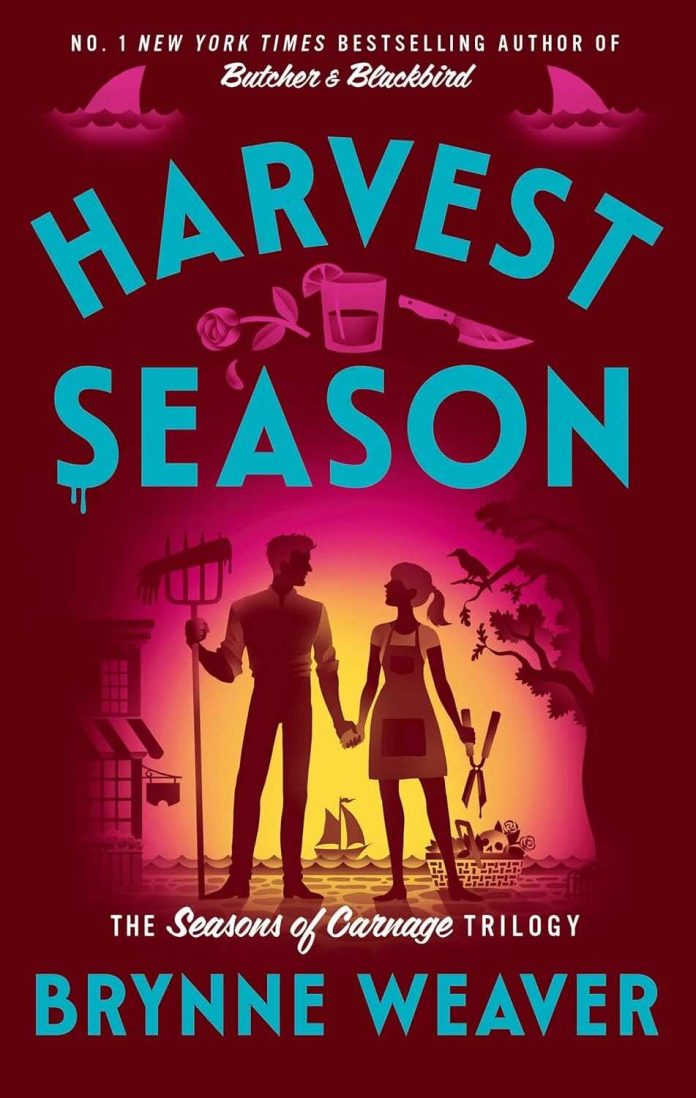
Cape Carnage is a town with deep roots, and those roots are tangled around bones. Brynne Weaver returns with the second installment of her Seasons of Carnage trilogy, Harvest Season, picking up the morally questionable threads she left dangling in Tourist Season and pulling them tighter until something has to snap. If you came for slow-burn menace, sweet-and-sour banter, and the question of how two killers might actually love each other without losing the plot, this is the book you have been waiting for. And if you are worried it might be a meandering middle act, that worry can be safely composted.
What’s Growing Behind the Lancaster Hedges
Harper Starling has spent four years burying her past beneath a name that isn’t hers, tending Arthur Lancaster’s gardens by day and helping the old man dispose of his “little mistakes” by night. Then Nolan Rhodes, a Search and Rescue specialist with a hobby of his own, finally figures out who she really is. Harvest Season by Brynne Weaver opens precisely where Tourist Season closed, with the mask peeled back and Nolan staring at the woman his memory could never quite reach.
What follows is less a romance setup and more a careful unearthing. True crime “Sleuthseekers” descend on the town hunting answers Nolan and Harper cannot afford anyone to find. Sheriff Yates keeps appearing in places he probably shouldn’t be. Arthur’s worsening Alzheimer’s makes him a brilliant, dangerous wild card. And every secret Nolan tries to bury sprouts another one in its place. The gardening motif runs through everything: cultivar, blight, bolting, ergot. Each chapter title is the name of a step in tending or destroying a crop, and the structure works because Weaver actually delivers on the metaphor instead of just decorating with it.
A Cast Whose Sharp Edges Earn Their Keep
The strongest thread in Harvest Season by Brynne Weaver is what happens when characters who have always weaponized their armor begin lowering it. A few observations on what works:
- Harper stops being just the snarky brat with an ax. We get the deep wound beneath the punchlines, particularly in a confession scene around a kitchen table that genuinely hurts to read. Her grief over Adam, her terror of trusting Nolan, her devotion to Arthur, all of it lands with weight.
- Nolan is no longer the hunter circling his prey. He is a man trying to protect someone whose past he was, until recently, planning to end. His POV chapters give the author room for tenderness she could not access in book one.
- Arthur Lancaster is the quiet triumph here. His Alzheimer’s is rendered with care that never tips into sentimentality. Weaver has acknowledged drawing from her own grandparents, and it shows in the frustrations, the fleeting lucidity, the dread of forgetting and being forgotten.
- Morpheus the raven keeps stealing scenes by saying “murder” at the worst possible moments. Yes, he is a gimmick. He is also the best gimmick.
- Sheriff Yates quietly becomes the most interesting antagonist in the series so far, and his interludes contain some of the most unsettling material Weaver has written.
How the Author Writes a Knife Fight Between Banter and Heartbreak
Weaver has always written like she is daring you to laugh at a funeral, and the prose in Harvest Season by Brynne Weaver leans further into that contradiction than her previous work. The dialogue cracks with sarcasm; the internal monologue often whiplashes from a sex joke to existential dread inside a single paragraph. It shouldn’t work as often as it does. The first-person, present-tense alternating POVs keep the pace tight, and the inclusion of a third voice late in the book (a deliberate choice that pays off in chilling fashion) gives the story a quiet horror that the previous installment did not have.
The spice is plentiful and inventive, the violence is creative without being gratuitous, and the small-town texture (Maya at the gardening store, Lukas being adorably oblivious, the Three Bobs, the ridiculous Sarah Winkle feud) makes Cape Carnage feel lived-in rather than staged.
Where the Soil Gets a Bit Thin
This is the part where balance matters. The book sits comfortably around four stars for most readers, and the reasons are worth naming honestly.
- The middle stretch overplants. Between the exhumations, the search operation, the Sleuthseekers, Arthur’s caregiving arc, the Lukas and Max slow-burn subplot, and Yates circling, a few stretches feel like they exist to keep the timeline moving rather than because they earned their page count.
- The tonal whiplash will not work for everyone. Weaver fans love this trademark. New readers may find a comedic raven punchline immediately following a serious Alzheimer’s scene to be jarring rather than charming.
- It is unmistakably a middle book. Payoffs are gathered, withheld, and parceled out, and the ending lands with a cliffhanger so steep that some readers will love it and others will throw the book at the wall. Both reactions feel earned.
- Repeated lampshading of Nolan and Harper’s intensity occasionally pads scenes that would land harder with restraint. A little less “I am obsessed with her” inner monologue and a little more silent action would have sharpened the romance.
None of these are dealbreakers. They are the honest reasons this is a strong book rather than a flawless one.
Where This Fits in Brynne Weaver’s Bookshelf
Weaver built her devoted readership with the Ruinous Love trilogy (Butcher & Blackbird, Leather & Lark, Scythe & Sparrow), three interconnected dark romances about siblings, serial killers, and chosen family. The Seasons of Carnage trilogy began with Tourist Season as a deliberate evolution: bigger mystery, less ensemble warmth, more atmospheric horror. Harvest Season by Brynne Weaver is the bridge between the two flavors. The found-family heart of Ruinous Love peeks through here, especially in Harper’s bond with Arthur, while the gothic noir of Cape Carnage tightens its grip.
Who Should Plant Themselves in Cape Carnage
This book is for readers who like their love stories with a body count, their dark humor with actual stakes, and their gothic small towns full of people who would absolutely help you hide a corpse. Mind the content warnings at the front of the book, which are extensive and sincere. If Alzheimer’s caregiving is a difficult subject for you personally, know that it is depicted with respect but it is present throughout.
Similar Reads to Sow on Your Shelf
- Butcher & Blackbird by Brynne Weaver, for the closest tonal cousin and the natural entry point into her catalog
- Haunting Adeline by H.D. Carlton, for stalker-romance darkness with a similar appetite for shock and dread
- The Wives by Tarryn Fisher, for unreliable women and small-town secrets stacked on top of each other
- Born of Sin by Nikita Sloane, for two morally bankrupt leads finding each other in the wreckage
- Salt Kiss by Sierra Simone, for lush, gothic, dangerous romance with literary ambition
- King of Pride by Ana Huang (the darker entries of the series), for the brat-tamer energy and obsessive intensity
The Last Word
After the last page, Harvest Season by Brynne Weaver leaves behind something quieter than its body count or cliffhanger ending. It is the ache of watching characters who have spent years pretending not to feel realize, too late, how much they actually do. The garden metaphor is on the nose, sure, but the book earns it. Sometimes love is harvested. Sometimes it’s just buried. And in Cape Carnage, the difference is harder to tell than you’d think.







