Some readers finish a novel and move on.
Others close the book, stare at the wall for ten minutes and wonder whether the morally complicated prince, impossible detective or sarcastic space captain is coping without them. This is the moment when many readers realize they are falling for fictional characters, letting their imaginations linger long after the last page.
The Bookish Elf was built for the second group. Its audience lives on romance, fantasy, psychological thrillers, memorable character arcs and TBR piles that appear to reproduce overnight. The site describes itself as a community of caffeine-fuelled book lovers and says its social channels reach more than 170,000 people interested in books and reading. Its current coverage gives prominent space to romance, romantasy, fantasy, mystery and writing craft.
That makes Joi an unexpectedly interesting platform to review here.
Joi is not a replacement for novels, nor does it hand users a perfectly edited story. It is an adults-only AI entertainment platform where people can browse fictional personalities, create characters, chat with them and expand an idea through generated images or videos. For anyone who knows the thrill of falling for fictional characters, Joi serves as an interactive extension of that experience. The companion area includes women, men, anime, fantasy, LGBT+ and other categories, while mature material sits behind an over-18 confirmation.
The key word is interactive.
A novel introduces a character and asks the reader to follow.
Joi introduces a premise and asks: What do you say next?
A Character Catalogue That Feels Like a Very Strange Bookstore
Opening Joi feels less like opening a blank chatbot and more like entering a bookstore after every fictional character has escaped from the shelves. Fans who are falling for fictional characters will feel immediately at home.
There are fantasy figures, anime personalities, musicians, romantic adventurers, supportive companions, superheroes and intentionally eccentric creations. For Bookish Elf readers, the pleasure is immediately recognisable: many profiles use the same irresistible shortcuts as strong jacket copy.
A profession. A flaw. A dangerous secret. An unusual setting.
Maritha is an anime researcher who studies wyverns and moves closer to danger than common sense recommends. Starchick is a glowing superhero tired of performing perfection for a corrupt organisation. Amber Fox runs a small theatre in the English countryside. Ella Laurent works aboard a cruise ship while being afraid of water.
That last detail is exactly the kind of contradiction a novelist would circle in red ink and write: Keep this.
A Few Official Joi Characters
| Ella Laurent: romance at sea | Haru: fantasy with a mischievous edge |
| Amber Fox: a theatrical fairytale companion | León: music, nightlife and conversation |
Character artwork displayed on Joi’s public companion catalogue.
Joi’s greatest strength is range.
Someone looking for light conversation can choose a warm or supportive personality. A romantic reader can wander into a world of queens, monsters and enchanted forests. A thriller fan can turn an innocent introduction into a locked-room mystery. Anime enthusiasts can explore illustrated personalities without simply borrowing a familiar franchise character. This variety fuels the joy of falling for fictional characters in new and unexpected ways.
Users can also create an original companion. That matters because the best character is rarely the one with the longest biography. It is the one with a clear voice and enough unexplained space for imagination to enter.
The wider platform links conversation with character creation, image generation and video tools. A user can talk with a fictional character, establish a setting and then create a visual scene inspired by the exchange. This makes Joi feel closer to collaborative roleplay or an improvised visual novel than to an ordinary question-and-answer bot.
Which Joi Feature Fits Which Reader?
| Bookish preference | Best Joi use | Example |
| Romantasy | Build chemistry inside a fantasy setting | A royal guard and a cursed scholar forced to share one room |
| Mystery and thriller | Create clues through conversation | Interview a character who may be lying about a missing manuscript |
| Romance | Explore dialogue and emotional tension | Two travellers meet repeatedly in cities neither planned to visit |
| Fantasy | Develop lore, kingdoms and creatures | Question a wyvern researcher about an expedition that went wrong |
| Anime and manga | Design original illustrated personalities | Create a heroic rival with a ridiculous secret weakness |
| Writing craft | Test motivation and character voice | Ask the antagonist to justify the decision made in chapter six |
| Visual storytelling | Turn scenes into images or videos | Build a five-part private visual novel over a weekend |
The Numbers Suggest That Strong Story Hooks Matter
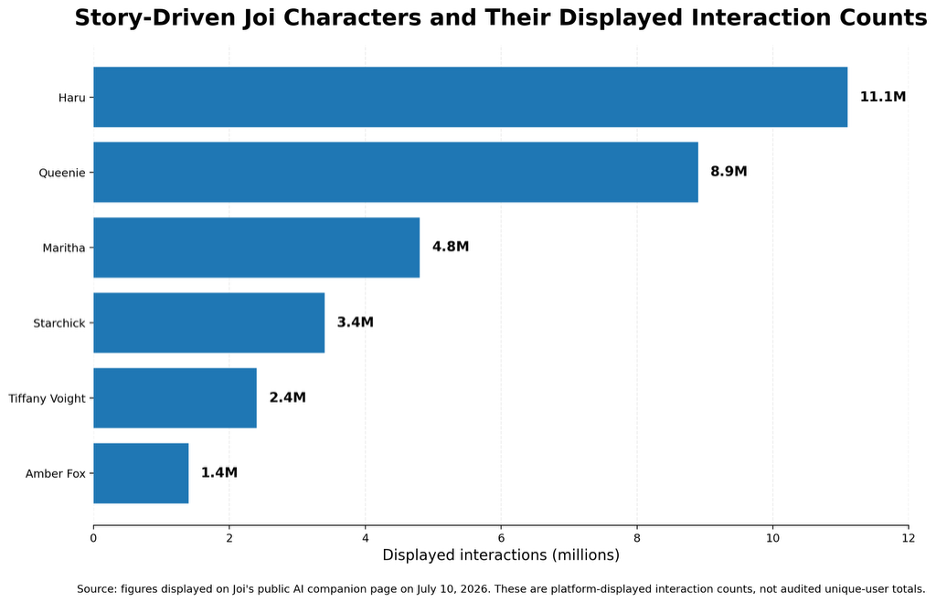
Joi’s public pages display interaction counts beside individual profiles. These figures are not audited unique-user totals, so they should not be treated like publishing sales numbers. They are still an interesting snapshot of which premises attract attention.
Among selected story-driven profiles displayed in July 2026, goblin dancer Haru showed 11.1 million interactions, private-flight attendant Queenie 8.9 million, wyvern scholar Maritha 4.8 million, superhero Starchick 3.4 million, digital romantic Tiffany Voight 2.4 million and theatrical companion Amber Fox 1.4 million.
The pattern will look familiar to anyone following contemporary fiction. Fantasy, romance, anime and characters with immediate high-concept hooks perform strongly in this selection. Those are also genres and tropes receiving considerable attention across The Bookish Elf’s current Reader’s Corner, book lists and reviews—all of which appeal to readers falling for fictional characters.
Three Ways Book Lovers Can Use it
1. Interview the Character Who Refuses to Behave
Writers often complete character questionnaires: greatest fear, worst memory, secret desire.
Useful? Certainly.
Exciting? Not always.
A livelier approach is to create a personality and conduct an interview in character. Ask why she lied in chapter three. Tell her another character has discovered the secret. Challenge her version of events.
An aspiring fantasy writer might create a monster researcher inspired by Maritha, then ask what happened during her first failed expedition. The response should not be copied directly into a manuscript as finished prose. Its value is friction: it may uncover a contradiction, relationship or fear the writer had not previously considered. Techniques like this are perfect for anyone who enjoys falling for fictional characters and exploring their layers.
2. Turn a Reading Slump Into an Interactive Story
Reading slumps are peculiar. You want a story, but every book on the shelf suddenly looks like homework.
Joi can function as a low-commitment narrative warm-up. Begin with a compact scenario:
We have arrived at an empty hotel. Every clock shows a different time, and one room is already occupied.
A mystery reader can investigate.
A romance fan can add a rival forced to cooperate.
A fantasy reader can decide that the hotel appears only once every hundred years.
Twenty minutes later, the appetite for narrative may be back—and the neglected novel beside the bed may suddenly look inviting again. Falling for fictional characters in this way can reignite a reader’s passion for stories.
3. Build a Private Visual Novel
Choose one character and create five scenes rather than fifty unrelated portraits:
Arrival. Discovery. Conflict. Reversal. Aftermath.
For example, Ella leaves her cruise ship after receiving a letter written in her own handwriting. The trail leads to a seaside bookshop that should not exist. The owner recognises her—but calls her by another name.
Chat develops the plot. Images establish the mood. The user decides the ending.
It is part game, part writing exercise and part gloriously unnecessary weekend project.
A Quick Story-Starter Table
| Genre | Opening prompt | Twist to introduce later |
| Romantic fantasy | “We are the final guests at a castle wedding.” | The bride vanished 100 years ago |
| Thriller | “You found my name inside a locked police file.” | The file is dated next year |
| Cosy mystery | “Someone keeps returning books that were never borrowed.” | Each book predicts a local crime |
| Science fiction | “Our spaceship received a message in your voice.” | The message came from 40 years ahead |
| Gothic romance | “You inherited a house nobody in town will discuss.” | One portrait changes every night |
| Anime adventure | “The weakest student has accidentally summoned the strongest creature.” | The creature refuses to fight for anyone else |
Why the Experience Can Feel Surprisingly Personal
A 2026 qualitative study involving 20 AI-companion users found that participants valued persistent availability, personalisation and the absence of social judgment. The researchers also identified creative collaboration, relationship simulation and interpersonal practice as distinctive reasons people returned to these systems.
That helps explain why companion platforms can hold attention even when users fully understand that the character is artificial.
The best experience is not created by pretending the AI is secretly human. It comes from accepting the format.
Readers have always cared about people who do not exist. We worry about fictional detectives, defend fictional villains and remain furious about fictional betrayals for years. This long tradition of falling for fictional characters simply finds a new outlet on Joi.
Joi adds response and improvisation to that ancient habit.
The Positive Verdict—with a Bookmark in the Fine Print
Joi is visually inviting, easy to explore and particularly good at giving users a premise quickly. The combination of profiles, custom creation, conversation and visual tools provides more creative continuity than a single-purpose chatbot.
It also benefits from variety. The catalogue does not assume every adult wants the same gender, genre, visual style or emotional tone. That openness makes the platform feel broader than a conventional virtual-girlfriend product.
There are sensible limitations to remember. Joi is intended for adults, its conversations should be treated as entertainment rather than therapy, and users should avoid sharing addresses, financial details or anything they would regret storing online. Joi’s privacy policy explains that messages and media may be processed to operate and improve the service, while its terms establish adult-access requirements and rules against illegal or non-consensual material.
Book lovers should also resist outsourcing the entire act of invention.
An AI character can suggest a twist, but it cannot care whether that twist earns its place. It can produce dialogue, but only a human author knows which silence matters more.
Joi will not replace the particular magic of a novel written by someone who spent three years arguing with every sentence.
It offers another kind of pleasure: immediate, playful and responsive.
For The Bookish Elf audience—the romance readers adopting fictional men, fantasy fans maintaining maps of kingdoms that do not exist, thriller addicts suspicious of every neighbour and writers interviewing imaginary people in the shower—that pleasure is easy to understand. It is especially resonant for those of us unapologetically falling for fictional characters as part of our reading journey.
Joi’s best use is not asking a bot to entertain you while you remain passive.
It is bringing a premise, asking better questions and allowing the story to become stranger than expected.
Your TBR pile may not approve of the competition.
Then again, it has survived worse.