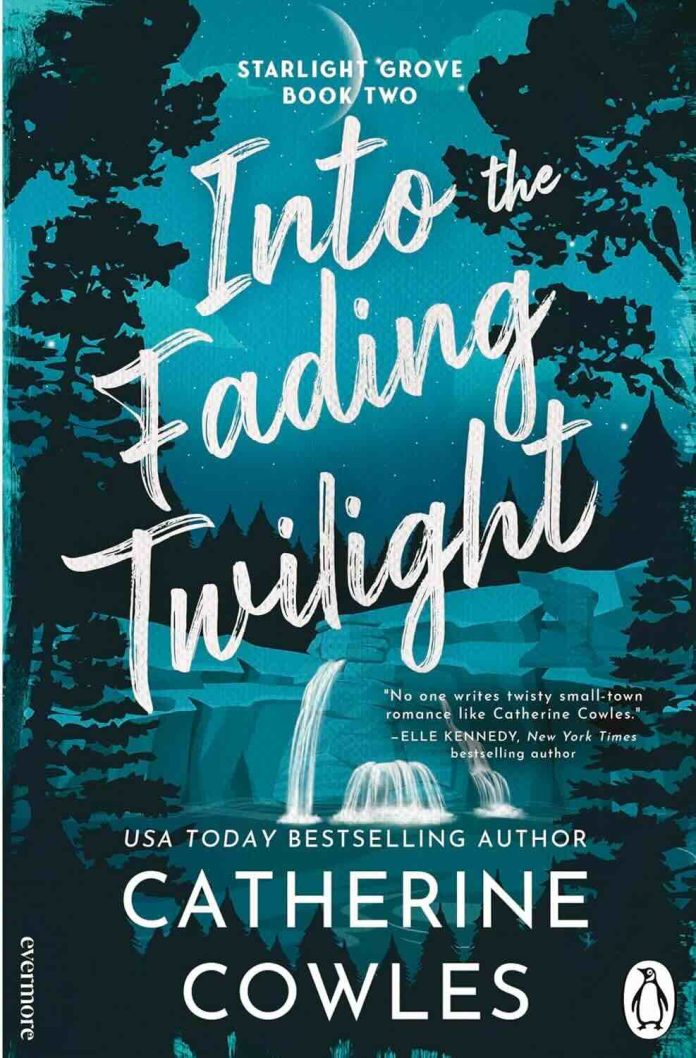
The prologue is a woman chained to a tree in what she thinks is snowfall, counting the days that were stolen from her and losing the count somewhere past three hundred. It is a rough place to open a romance. It also sets a bar the rest of the book has to clear, and for the most part it does, because what follows is not a story about a damaged woman being repaired by a good man. And “Into the Fading Twilight” is a story about a woman who has already decided to live, out loud and at speed, and a man who slowly works out that his job is to hand her the tools rather than the leash.
That distinction is the entire novel.
The Premise, Kept Clean
Nova Monroe returns to Starlight Grove after more than a year in captivity to find that the world kept spinning without her. Her best friend Brae has built a life, a fiancé, and a home. Her nephew-in-all-but-blood has grown up a full year. Nova is the one who does not fit anymore, including inside her own body, which has been starved, scarred, and stripped of its light tolerance. Nobody touches her. Everyone watches her. So she throws herself off cliffs into freezing lake water because the cold slap of it is the only thing loud enough to drown out the memories she cannot verify.
Kol Archer, the Forest Service investigator who found her when everyone else had written her off, has his own reasons for not sleeping. When Nova needs somewhere to breathe, he offers the apartment above his garage. The setup is roommates-to-lovers on paper. In practice it is a story about proximity as a form of care, and about a man learning the difference between protecting someone and containing them.
What This Book Gets Genuinely Right
Nova is the freshest survivor heroine in the subgenre right now
Most trauma-recovery romances give you a heroine who flinches. Cowles gives you one who jumps. Nova is mouthy, funny, and reckless in ways that read as a coping mechanism rather than quirk. She smart-mouths a handsy patron out of a tip. She spikes an Archer brother’s burger with Carolina Reaper sauce as payback. And she also has panic attacks she hides so well that an eight-year-old is the first person to name them. The gap between her armor and her interior is where the book does its best work, and it is why Into the Fading Twilight by Catherine Cowles lands harder than the average small-town suspense.
Touch is the actual love language
The central romantic beat of “Into the Fading Twilight” is a hug. Not a kiss, not a bedroom scene, a hug, and Cowles builds it for eighteen chapters and then absolutely earns it. Nova cannot ask for physical contact because she once screamed until she was sedated when someone tried, and now everyone in her life gives her a careful six-inch berth that feels like exile. The moment she manages the words is one of the more affecting things I have read in contemporary romance this year.
Kol builds instead of hovers
The hero’s love is expressed in carpentry and equipment. A skylight, because she was kept in the dark. Bookshelves, because he noticed hers. A welcome-home bag containing pepper spray, a taser, a whistle, and a small brutally cute self-defense keyring, with a note reading to help you make yourself safe. That framing, safe by her own hand rather than by his, is the thematic spine of the book, and Cowles returns to it in the bedroom too. The intimacy scenes are structured around explicit verbal consent and, in one striking sequence, a full reversal of physical control that the hero clearly finds costly. It is the boldest choice in the novel and the best executed.
The Archer family is a genuine ecosystem
Waylon, the Bigfoot-obsessed great-uncle raising alpacas and building animal-print clocks. Skylar, eight, dressed in a tiara, tactical goggles, and combat boots. Orion, who has not spoken since he was fifteen and communicates in ASL, cupcakes, and hand-drawn maps. These people are not set dressing, and Skylar in particular is a small masterpiece. Her line about her absent mother leaving “room” for Nova is the kind of thing that earns a book its keep.
Where It Loses Altitude
This is a four-star book and not a five-star one, and the reasons are structural rather than emotional.
- The suspense architecture is the weak beam. The cast of suspects is small enough that a genre-literate reader will have a shortlist by the halfway mark, and the loudest red herring is drawn so broadly that it announces itself as a decoy on arrival.
- The workplace antagonist is a cardboard obstacle. Kol’s assigned partner exists only to be obnoxious, generate friction, and then be dispatched in a throwaway line. He never functions as a real threat.
- The conflict-of-interest bomb never detonates. The book repeatedly warns us that an investigator sleeping with the survivor of his active case could end his career. Then it defuses the whole thing with a joke. It is a real dramatic engine, and choosing comfort over consequence is a missed opportunity.
- Sequel scaffolding intrudes. Threads for the next three books, most obviously an enemies-with-history pair and a silent brother’s abandoned first love, occupy chapters that the central romance could have used.
- The mantras wear thin. “You’re alive. You’re breathing” is a beautiful anchor. By the fiftieth appearance it has lost some voltage, as has the recurring wave of dizziness that signals every escalation.
The Prose Itself
Cowles writes in dual first person, present-tense urgency in past-tense clothing, in short chapters that almost always end on a hook. The sentences are lean. Fragments do a lot of the emotional lifting. Nature imagery is used with real precision rather than as wallpaper, and the twilight motif that gives the book its title genuinely pays off in the final chapters. Her dialogue is her strongest technical asset. The Archer brothers’ group chat is funny in a way that feels observed rather than constructed, and the banter never sands the edges off the darker material.
The heat level is high, and unusually, the sex scenes are the ones doing the most character work.
Where It Sits in the Series
Starlight Grove, in order
- Across the Vanishing Sky
- Into the Fading Twilight
- Beneath a Midnight Moon
- Through the Gathering Storm
- Within the Starry Silence
Book one, Brae and Dex’s story, supplies the villain and the trauma that this novel is cleaning up after. Cowles markets Into the Fading Twilight by Catherine Cowles as a standalone, and it technically is, but you will get significantly more out of it having read book one first. Readers coming from her Sparrow Falls series (Fragile Sanctuary, Delicate Escape, Broken Harbor, Beautiful Exile, Chasing Shelter, Secret Haven) will recognize the formula, executed here with more emotional discipline.
Read This If You Also Loved
- The Obsession by Nora Roberts, for a survivor rebuilding in a small town under a serial killer’s long shadow
- Archer’s Voice by Mia Sheridan, for touch-starved healing and a hero who communicates in everything but speech
- Reckless by Elsie Silver, for grumpy protector energy and small-town found family
- The Coppersmith Farmhouse by Devney Perry, for single-dad romance with a suspense undertow
- Things We Never Got Over by Lucy Score, for the community texture, at a lighter register
- Chasing Shelter by Catherine Cowles, if you want more of this exact voice
- Say You’re Sorry by Karen Rose, if you want the suspense dialed considerably darker
The Verdict
Read Into the Fading Twilight by Catherine Cowles for Nova, for Skylar, for the hug in chapter nineteen, and for a romance that treats consent as an act of love rather than a legal formality. Do not read it for the mystery. The thriller plot is competent scaffolding around a genuinely moving character study, and if you go in wanting the former you will feel the seams. If you go in wanting the latter, this is one of the better trauma-recovery romances on the shelf, and it is generous enough to leave you with a phrase you will probably repeat to yourself at some point.
You’re alive. You’re breathing. That turns out to be a whole book’s worth of argument.







