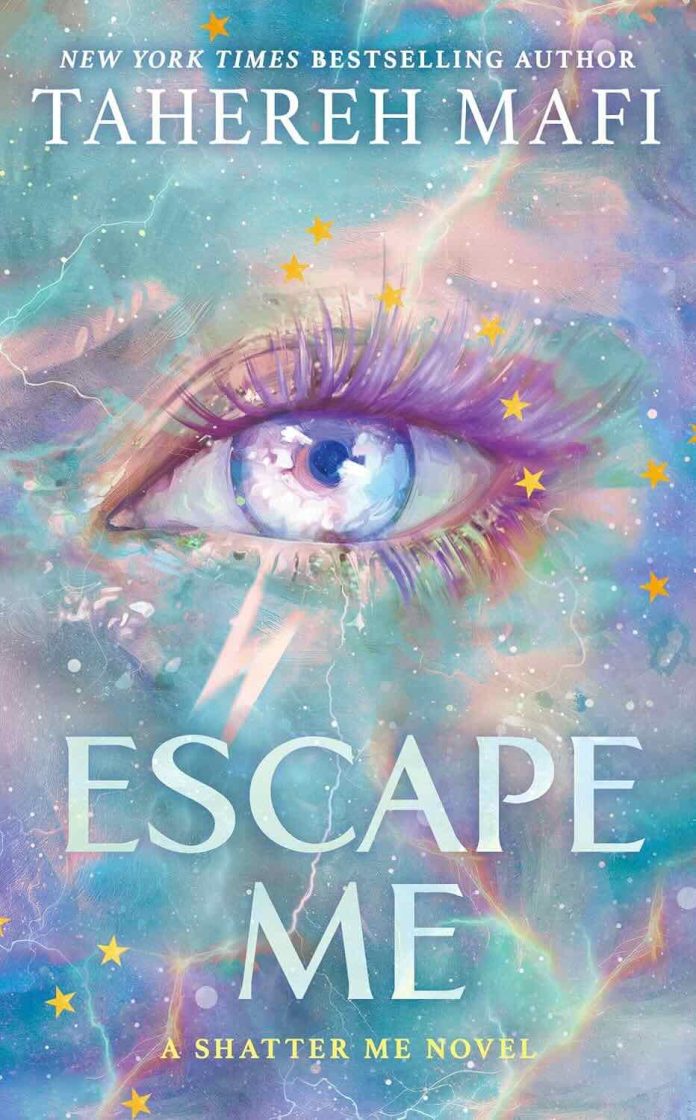
Here is the structural fact that organises Escape Me by Tahereh Mafi. The book has thirty-nine chapters and three narrators. James gets twenty. Rosabelle gets eleven. Warner gets eight. And the narrator with by far the most chapters is the one who has been told, by legal instruction, that he is not permitted to know anything at all.
Three Voices, Unequal Information
The arithmetic is deliberate and it is uncomfortable to sit inside. James spends twenty chapters feeling: fury, humiliation, the specific helplessness of being the only person who thinks something is badly wrong. Rosabelle’s eleven chapters contain the plot of Escape Me by Tahereh Mafi. Every fact the reader needs, from what the synthetic mind on the island actually is to how much time is left, arrives in her sections, and she is the one person forbidden from speaking to him.
Warner gets the fewest chapters and the clearest head. After six books as the most frightening person in the series he is now the adult in it: the one who apologises, who reads a novel his wife asked for, who notices that his driver’s granddaughter has a birthday. His chapters are the reader’s relief valve, and the book would be unmanageable without them.
What Escape Me by Tahereh Mafi Lets Rosabelle Know
The plot that has been built here is genuinely good, and it is the most frightening thing Mafi has written for this world. The regime’s endgame is not invasion. It is a series of staggered, undetectable explosions designed to erase the genetic mutations in about two percent of the population, after which the affected submit to an edit that prepares the mind to receive an external intelligence. Six months, and a continent decides to stop resisting, in its own voice, as its own free thought.
Her view is that this has already happened and everything else is theatre. Her counter-plan is to be escorted onto the island as a bride, on the arm of the supreme commander’s son, and to use the wedding as the distraction that lets her reach the machine. She also has a sister there she cannot confirm is alive.
What makes the strategy land is the cost. She goes to her betrothed unarmed, sits in a chair she asked to have placed against the far wall, tells him a true thing about the surveillance in the room, then waits for him to hit her, because nothing in fifteen years has made him gentler with her than fresh damage. She calculated that it would buy his trust. Her only regret, stated flatly, is the closed fist rather than an open hand, because a closed fist takes longer to heal.
Why the Boy With Twenty Chapters Has the Least to Do
James has been benched: not discharged, not punished exactly, just demoted into standby and handed work beneath his training. His chapters are the record of what that does to a twenty-one-year-old who was right, and Escape Me by Tahereh Mafi is honest that he was right, which matters, because the running joke of this series has been that nobody takes him seriously.
Alongside that, the best contemporary idea here: his encrypted line is breached, and the messages come in three registers at once. Graphic propositions from strangers. Sincere notes from people who grew up on his story. Anonymous threats using his full name. He scrolls all three interleaved, looking for a work message, and the passage is unusually exact about being desired, admired and hunted at once by people who have never met you.
Escape Me by Tahereh Mafi Is Also Very Funny
This is easy to underrate. The novel opens on five exhausted people too depleted to hand Winston his glasses, which are wedged under somebody’s back. It contains a five-year-old conducting a hostage negotiation over those glasses. It contains James, armed and in a leather bomber, buying underwear in an entirely pink boutique from three employees having a collective breakdown, then walking home through a crowd carrying the bags. And it contains Nazeera’s house, which holds two liquefying bananas, a single spoon in the freezer, a roll of lavatory paper in a kitchen cabinet and ammunition in the fridge, and no plates.
It also contains Warner buying a historical romance from a bookshop his wife built, because she left a note in his coat pocket specifying happy endings only, and then having to fight Castle for it. That scene is the funniest thing in six books and the most tender.
Where Escape Me by Tahereh Mafi Runs in Place
- It is an interstitial. Thirty-six hours, one campus, and the plot ends roughly where it began: she still intends to marry him, he is still in a cell, the machine is still unreached. What advances is feeling, plus the last page.
- James’s interiority loops. The mental basement, the boxes of bad feelings, the fight to compartmentalise, the conviction that something is wrong. By the fifteenth pass these have stopped registering as insight.
- Kenji and Nazeera resolve offstage. The confrontation is superb; the repair happens during a car journey we never see and is reported back by a woman the book writes as comically stupid for a chapter and a half.
- The harassment thread is dropped. It is raised brilliantly and then abandoned the moment a rumour plot takes over.
- The possessive register will split the readership. The declarations of ownership read either as protection from a lifetime of nobody intervening, or as one teenager telling another what she may do with her own body.
- The corpse comedy runs long. Five pages of friends refusing to accept that she is breathing is about two pages of joke.
Content Notes
Escape Me by Tahereh Mafi is considerably harder than the early Shatter Me books. Intimate-partner violence on the page: a fiancé breaks the narrator’s jaw with a closed fist, twice, and she has engineered it. Roughly three hundred identical bruises described as evidence of systematic torture. A childhood memory in which a boy mutilates an animal and presents the remains as a gift. A week spent standing upright in lightless isolation without food. A chronically ill child left lying in her own blood and vomit, and a sibling’s rations withdrawn as punishment. Torture, a fall from a height and a long coma recounted. An explosion at a school that killed over a hundred children, referenced. Suicidal despair. A windowpane through the throat, and a character presumed dead. Anonymous sexual messages and anonymous death threats sent to a named young man. One extended and fairly explicit sex scene, including oral sex, in which one party has been unintentionally sedated by the other’s healing, a problem the novel names and does not settle.
Read These Next
- The Toll by Neal Shusterman. The nearest match for a benevolent synthetic intelligence that has taken over the thinking.
- Conform by Ariel Sullivan. For readers who came for the surveillance apparatus rather than the romance.
- Iron Embers by Helen Scheuerer. Another trained killer who cannot work out what to do with being cared for.
- Immortal Rose by Alexandra Bracken. For the high-intensity YA romance register at a similar pitch.
- The Best Dystopian Fiction Books. Useful for placing this against the tradition it argues with.
The Verdict
The series runs Watch Me, then Release Me, then this, and the epigraphs tell you the split before the first chapter: Mary Shelley’s creature on love and rage is James, and Kafka on staying silent to avoid screaming is Rosabelle. The whole book is those two positions failing to reach each other.
Then the last page happens. I will say only that the reveal takes about forty words, that it relocates the threat from an island thousands of miles away to somewhere considerably closer, and that it retroactively reframes a twenty-four-hour fever everybody assumed was grief and blood loss. It is superb timing and an enormous gamble, because a book that has spent three hundred pages standing still now ends by making its heroine’s plan obsolete.
Which leaves Escape Me by Tahereh Mafi hard to score honestly. As a novel it loops, it withholds, and it asks for a great deal of patience in the middle third. As an instalment it is the best-constructed thing in this second series: the architecture means something, the villain’s plan is properly terrifying rather than merely large, and a girl who spent ten years teaching herself to die inwardly discovers here, to her horror, that she can feel a bruise. What it earns is not admiration. It is dread.







