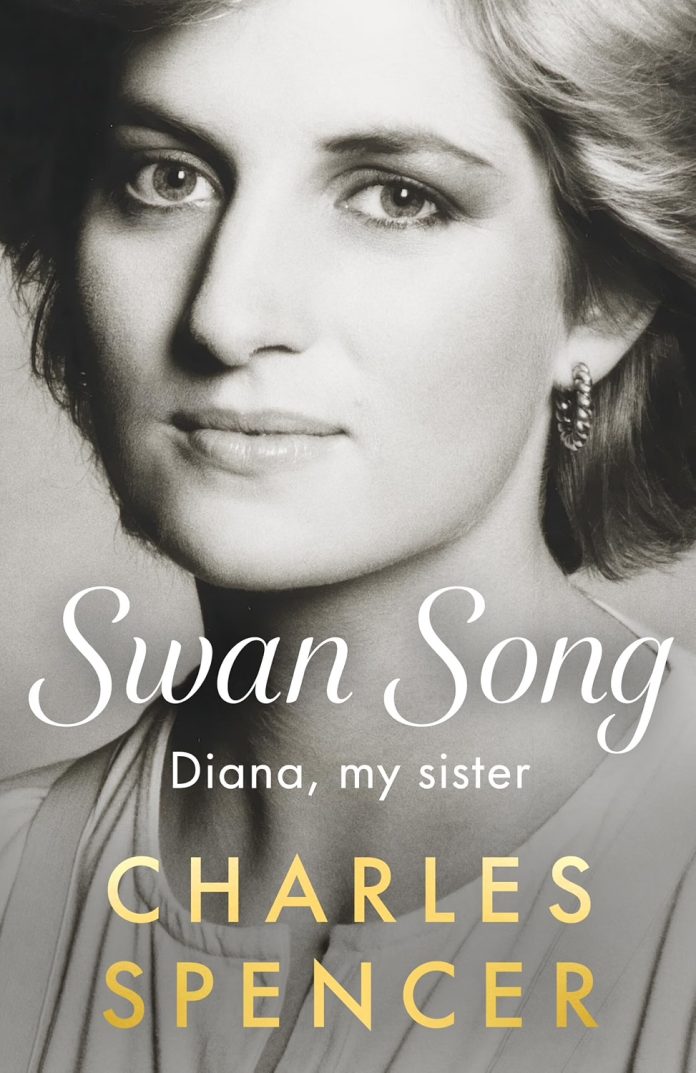
At 7.12 on the morning of 3 September 1997, having no printer at home, Charles Spencer faxed four handwritten pages to himself. They had taken about ninety minutes to write. Three days later he read them aloud in Westminster Abbey, to his sister’s former in-laws and an audience since estimated at 2.5 billion. Swan Song – Diana, My Sister by Charles Spencer is the book he has built around those pages, and its organising decision deserves stating plainly: thirty chapters, each titled with a phrase from that speech, and then the speech itself as chapter thirty-one.
Thirty Chapters Named After a Single Morning’s Work
Three strands alternate. One runs the week between the death and the funeral almost hour by hour: the phone ringing in Cape Town, the consecration of an island grave, a pontoon bridge thrown across a lake by army engineers. One runs his sister’s life chronologically. The third tracks the drafting, from a crowded half-page of headings to the deletions he now regrets.
The payoff is real. By the time you reach the full text you have been shown the manufacture of nearly every clause, which converts a speech remembered as a howl of grief into a drafted document with intentions, written by a man who had spent a decade writing scripts for NBC News and knew how long a sentence can run before an unforgiving acoustic eats it.
What Swan Song – Diana, My Sister by Charles Spencer Argues About a Schoolgirl
The strongest thesis here is not about palaces. Spencer has read every one of his sister’s school reports, kindergarten to final term, and lays them out in sequence: short concentration, restlessness, a mind repeatedly called flighty, and not one instance across a decade of anybody offering practical help. She sat her O-levels and passed none. He describes her opening the envelope at their mother’s house in Scotland, and the sound she made.
His argument is that this, not a divorce or a marriage, set the floor of her self-worth, and that she built a life of charitable work on top of the hole it left. He goes further and proposes a diagnosis nobody could have offered in 1972: undiagnosed ADHD, and the rejection sensitivity that often travels with it. He notes that he is neurodivergent himself and knows the condition from inside, which is both the claim’s best support and the reason to read it as a brother’s interpretation rather than a finding.
The Reporter Who Came to the Library
The reporting on Martin Bashir is the best sustained passage in Swan Song – Diana, My Sister by Charles Spencer, and genuinely new in places, because Spencer kept everything. Approached in 1995 by a Panorama journalist who said explicitly that he did not want an interview, he was shown forged bank statements implicating his own former head of security and then two of his sister’s senior staff. He checked the man with Panorama’s executive producer, who said he was one of their finest. He then took him to meet his sister in a borrowed flat, and sat taking longhand notes in an NBC notebook while the claims got wilder.
Spencer worked out inside an hour that the man was lying and warned his sister as soon as he had gone. The account of what followed is unsparing about his own failure as well as the BBC’s, and the documents in his safe at Althorp mattered to a judge-led inquiry twenty-five years later. He also traces a chain of consequence from that deception to a Paris underpass; the chain has a weak link or two, but it is argued rather than asserted.
Swan Song – Diana, My Sister by Charles Spencer and the Question of a Single Witness
The passages that will generate headlines concern the present King, and a reader needs to be clear about their status. Spencer reports a phone call on the morning of the death in which he found the tone jarringly buoyant; a remark after their father’s funeral in 1992 about the luck of inheriting young, delivered with a stamped foot; and a furious call about the boys walking behind their mother’s coffin, ending in a line about how quickly she would be forgotten.
None of this is corroborated, and none of it can be. It is one man’s memory of private conversations with someone who cannot answer in the same register. That matters here because Spencer is otherwise scrupulous with paper: faxes, memos, school reports, a secretary’s typed note, his own handwritten proviso about the boys not being dragooned. The honest response is neither to swallow the anecdotes nor to dismiss them, but to notice that the evidentiary standard drops exactly where the temperature rises.
Where Swan Song – Diana, My Sister by Charles Spencer Loses Its Footing
- The chapter titles govern the chronology, and the chronology suffers. Because each heading is a phrase from the speech, the life strand lurches across decades. Several transitions are handbrake turns.
- The drafting material outstays its welcome. Fascinating for twenty pages, then a concordance, with passages logging a deleted adverb.
- Chapter thirty-one is redundant by design. Having walked you through almost every line, printing the speech entire adds ceremony, not information.
- The case against the tabloids is made, then made again. It is the right case, argued with real evidence, and it recurs well past the point of persuasion.
- The royal-anecdote layer sits oddly. A corgi’s ear, a bottle of raffle sherry, an exiled great-uncle in spats. Entertaining, tonally strange in a book about a violent death.
Content Notes
Swan Song – Diana, My Sister by Charles Spencer is heavier than its jacket suggests. A sibling’s death in a car crash, narrated from inside the family. Suicidal ideation stated plainly by the author about himself and about his sister, in both cases with what stopped them. Eating disorders throughout, with weights given. The death of a newborn with severe malformations, and a mother prevented from holding him. Physical abuse of two small children by paid carers. A sexual assault on his sister, recounted to him by her. A stroke and long convalescence. Heavy drinking. Sustained press harassment, including of a bereaved family and a dying woman, and photographers at a fatal crash scene. A false public allegation of spousal abuse against the author’s late father, rebutted at length. Divorce and custody proceedings.
Read These Next
- From Here to the Great Unknown by Lisa Marie Presley and Riley Keough. The closest cousin: blood family taking custody of a famous life.
- Redwood by Ben Macintyre. For the documentary method Spencer uses well and then abandons where it would matter most.
- Memorial Days by Geraldine Brooks. Sudden death and its administration, by someone equally good on the paperwork of grief.
- Sonny Boy by Al Pacino. A famous life in its own voice, with the same problem of proportion.
- Must Read Biography Books and Memoirs. Useful for placing this in the form it belongs to.
The Verdict
The title of Swan Song – Diana, My Sister by Charles Spencer comes from an epigraph about the swan’s last and sweetest song, and from his observation that his sister died too suddenly to utter one of her own. He wrote hers. He is in his sixties now, neither parent reached seventy, and he says openly that this is a swan song of his own, and the only one of his ten books that matters to him.
What survives is smaller and better than the controversy. A nine-year-old leaving her classroom to check that her little brother has settled on his first day, then reporting that he is doing fine. A girl of five or six closing every curtain in a large house at dusk, which her brother reads as a child taking over a departed mother’s job. Four black swans arriving at a lake as a stranger’s gift, the morning after he had privately decided to find some. A man in a pulpit pretending to have mislaid his speech because he has just realised it is about to be vetted, reading a page of the prayer book instead.
Swan Song – Diana, My Sister by Charles Spencer is partisan and says so on its first page. It is too clever structurally for its own chronology, and its hardest accusations rest on a single memory apiece. But it is the only account of that week by someone inside the family, the negotiations and the pulpit, and on what he can document, which is most of the book, he is precise, self-critical and frequently devastating. The shape is the argument, and the shape mostly holds.







