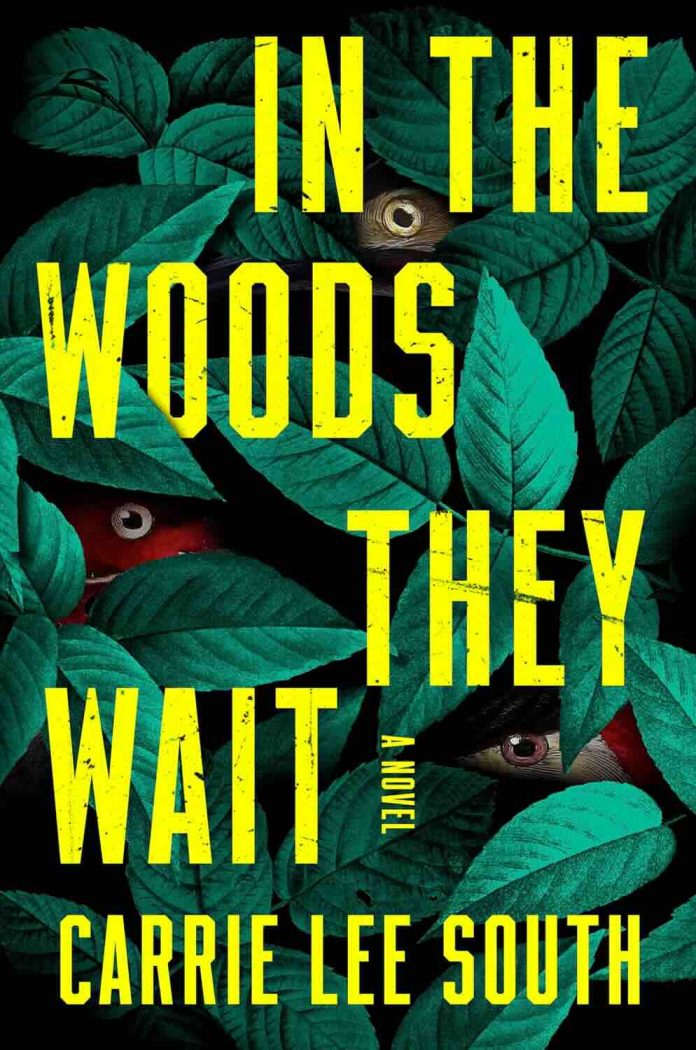
Early in In the Woods They Wait by Carrie Lee South, a sixteen-year-old hears her little brother call two words from somewhere deeper in the trees. She has just spent twenty minutes terrifying him, and watched him wander off looking for her. She runs toward the voice, the wrong way, and never finds him. Fifteen years later she hears those same two words again, in the same husky pre-adolescent pitch, played back at her like a tape that has been left in a hot car. That is the whole novel: not a mystery about where a boy went, but a slow demonstration that something out there has been keeping his voice.
In the Woods They Wait by Carrie Lee South Keeps a Stolen Voice
South builds the book out of things that get dismissed. A grandmother who hangs flowers over her doorframes because she and her husband used to hear crying from the tree line, and whose horses refused to cross it. A boy who woke in his tree house to something scratching at every surface at once. A girl who swore she heard her own scream come back out of a hole in the ground. A woman who wakes at three in the morning to a lost child sobbing for her mother, and realises the sob is identical each time.
Each is explained away by somebody sensible, usually with fond exasperation. Foxes sound like women. Sound bounces strangely off sandstone. You were exhausted and you had not eaten. The novel collects those explanations, one per chapter, then turns them over. Its real subject is not a monster. It is what happens to people who report one.
Two Clocks, One of Which You Already Know
The chapters carry no numbers. They carry a year, and under it a running count: three days, seven days, three weeks, three months, one year. The 2019 strand gets its own counter, hours at first, then days, as a six-year-old goes missing from a trail in the same park. Two tallies climbing in parallel, and the reader knows from the first page which of them never stops.
It is the best decision in the book, doing the emotional arithmetic without a word of commentary. The older number is up in the thousands by the time the newer one reaches fourteen, and every time In the Woods They Wait by Carrie Lee South cuts back to 2004 the gap between them widens. Fifteen years, six days, the narrator notes at one point, a figure she has never needed to write down.
The Ranger Who Told the Truth and Was Hospitalised for It
The park superintendent is the most interesting adult here, and the most compromised. He ran the search for the brother in 2004 and runs the search for the girl in 2019, and in between he taught the narrator everything she knows: contour lines, fire, and how to make sure you can always find the way back to where you started.
He is also the man who saw something happen to a colleague in 1989, reported it in full, was treated for shock-induced psychosis, and was banned from his friend’s funeral. What he did with that is the moral engine of In the Woods They Wait by Carrie Lee South. He stopped talking. He barred the caves and gave a conservation reason for it that was not the real one. And he set traps that are illegal and filed no paperwork. And he let a thirteen-year-old’s search run for months without ever naming the possibility he privately believed. The novel gives him a superb confession scene and then, to its credit, does not let him off.
In the Woods They Wait by Carrie Lee South Knows How Searching Actually Works
The procedural layer is the reason the horror lands. South went and asked people. Probability of area. Sector searches drawn like spokes. Trail blazes that must each be within sight of the last. Desire paths that have to be kicked over with scree before hikers follow them off the map. Why a cadaver dog fails in a drought. The seventeen hours it takes to winch one woman out of a squeeze she slid into by accident.
Two sequences inside narrow cave passages are as unpleasant as anything I have read this year, and they work because they are written from inside the ribcage of the woman in them: exhale to make yourself small enough to move, breathe in and the rock is already there. Nothing supernatural is required. The ground is doing it.
Where In the Woods They Wait by Carrie Lee South Gives Itself Away
- The plot needs its heroine to break her own rules. She enters unsecured caves without gear, twice, and sets off into the backcountry without telling anyone where she is going, days after lecturing a trainee about precisely that. The book says so out loud, which flags the contrivance rather than fixing it.
- The 2005 and 2006 chapters drift. The grandmother material and one brutal hospital sequence earn their place. A prom subplot and a satirical funeral director do not.
- The entomologist exists to deliver a lecture and a locked door. One scene of information, one grudge, then a reappearance in the closing pages as an author of the paper.
- The rescued child is a device more than a person. She is given four or five eerie lines while sedated and then goes home offstage, and the novel wants more feeling from her survival than it has built.
- The last act explains itself in press clippings. A news story, a closure notice, a public alert, a science feature. Efficient, and it lets the air out of the most frightening thing in the book by giving it a taxonomy.
Content Notes
Unusually heavy, and one item is a structural spoiler that arachnophobic readers need anyway: In the Woods They Wait by Carrie Lee South becomes a spider novel, sustained and specific, and no version of it will be survivable for that phobia. Also: a teenager frightens and abandons a younger child, narrated from her side. Two named adults are killed by predation on the page, at length, and a third death is recounted in the same detail. A horse is killed. A small farm’s chickens are killed. Animal remains, a human jawbone and a dead child’s shoe are found in a nest. A six-year-old is kept alive as bait. Parental abandonment, including the legal surrender of a child. Compulsive hoarding and squalor, described closely. A parent’s alcoholism, cleaned up by her teenage daughter. Withdrawal of life support. A bear-trap injury released by hand. Sustained survivor guilt, and one passage of suicidal resignation. Severe claustrophobia. Snakebite.
Read These Next
- When the Bones Sing by Ginny Myers Sain. The closest comparison: the same Ozarks, the same bones in the same hills.
- Something in the Walls by Daisy Pearce. For the folk-horror half, and for a community that has decided what it will not discuss.
- The Children by Melissa Albert. Another woods, another vanished child, a very different answer.
- Solace House by Will Maclean. If the dread rather than the creature is what kept you reading.
- Bone-Chilling Classic Horror Books to Keep You Up at Night. Useful for placing South in a much older tradition.
The Last Word
The family is in Arkansas in the first place because of a bird. In 2004 a kayaker reported an ivory-billed woodpecker in a Cache River swamp, a species thought gone since the 1940s, and birders came from everywhere to look for a ghost. South opens on that and never labours it, but it sits under all five hundred pages: an entire search built on the possibility that something is still out there, sustained by people who cannot afford to be told otherwise.
What makes In the Woods They Wait by Carrie Lee South better than its premise is that it takes the guilt seriously without letting it become the answer. The narrator did a genuinely cruel thing. She has spent fifteen years certain it was the cause, and the book will not confirm that or clear her, which is harder and truer than either. The best line anyone offers her is arithmetical: think how many teenagers have made exactly that choice, and how few of them lost a brother to it. She declines the comfort. So does the novel. There is a dedication at the front to the author’s own brother, and once you have finished, it is difficult to read this as anything other than a book written to give a real absence a shape.







