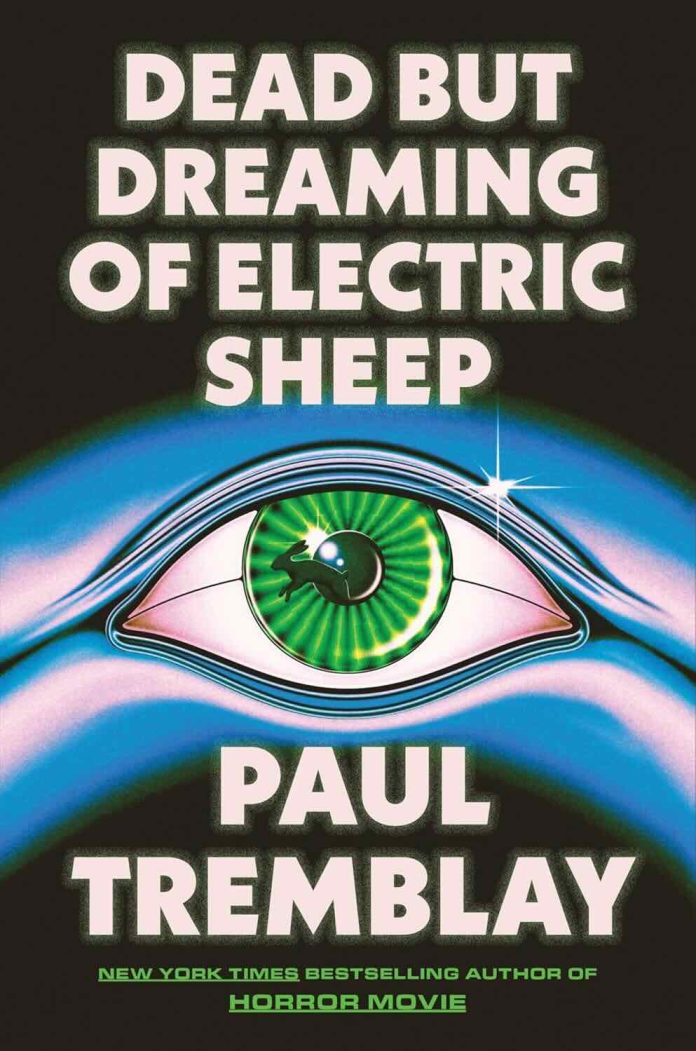
Some novels hand you a seat and a map. This one straps you to a couch that rearranges its own furniture every time you blink. Dead But Dreaming of Electric Sheep by Paul Tremblay opens inside a living room that refuses to hold still, told by a “you” who cannot recall his own name, and it never quite lets go of that off-balance, seasick feeling. Which, for a horror-tinted science fiction story about a man being remote-piloted across America like a rental car, turns out to be the point.
The Setup: One Dead Guy, Two Coasts, No Refunds
Julia Flang is broke, sardonic, and stuck. A former semi-professional gamer in her twenties, she works two jobs she hates and lives with her retired uncle in Glendale. Then her estranged mother, the CFO of a bloated tech giant called Decillion, offers her a temp gig with a payday she can’t sanely refuse: chaperone a comatose man with proprietary AI stitched into his skull from California to the East Coast. Julia sizes it up in a single, perfect line. She’s being asked to remote-control a dead dude across the country.
He isn’t dead dead, as the book keeps needling us. She christens the stranger “Bernie” and steers his body with a phone modeled after a video game controller. Meanwhile, in the chapters simply titled “You,” Bernie wakes inside a warping nightmare, hunting for a person he can’t name, branded with a rabbit tattoo he doesn’t remember getting.
Two Voices, One Failing Nervous System
The book runs on alternating current. Julia’s chapters are third person, present tense, wry, and grounded in airport terminals, rideshares, and the small humiliations of gig work. Bernie’s “You” chapters are second person and pure liquid dread, a place where a man in a red tracksuit interrogates him and furniture oozes when he isn’t looking. Between them sit a couple of snarky metafictional interludes where the narrator turns and stares straight at you, the reader, daring you to ask who has been telling this story all along.
That structure is the engine of Dead But Dreaming of Electric Sheep by Paul Tremblay, and it does something clever. Julia’s thread gives you traction and jokes. Bernie’s thread pulls the floor out. You keep reading partly to escape one for the other, which is exactly the trap the book wants you in.
Where Tremblay’s Prose Earns Its Keep
Tremblay has spent years proving he can make dread feel domestic, and here his sentences do a lot of quiet work. The “You” sections are genuinely unsettling in the way a fever is unsettling, all shifting geometry and wrong colors, yet they stay legible enough to follow a thread of grief and searching underneath the strangeness. The horror isn’t gore. It’s the slow terror of a mind trying to inventory itself and coming up short.
Julia carries the human warmth. She’s a fully realized narrator with a gamer’s problem-solving reflexes and a working person’s chip on her shoulder, and her voice crackles. Uncle Fun, a retired pilot who develops one disposable camera a week and quotes noir films, is the kind of side character who could anchor his own book. The near-future satire lands too, skewering monopoly tech culture, nepotism gigs, and the way a company can dress exploitation up as opportunity without ever raising its voice.
A few things the book does especially well:
- A killer premise executed with restraint. The remote-control-a-body hook could have been a gimmick. It becomes a genuine ethical vise.
- Comedy and horror in the same breath. The Coen Brothers comparison in the marketing is earned, not borrowed.
- A protagonist worth the trip. Julia is funny, flawed, and easy to root for even when she’s making a mess.
- Big ideas worn lightly. Questions about consciousness, memory, and what a self even is thread through the action instead of stalling it.
The Cracks in the Windshield
For all its ambition, this is a four-star book rather than a flawless one, and it’s worth being honest about why.
The “You” chapters, so effective early, start to strain. Their whole design is repetition and mutation, and past the midpoint that surreal churn can feel like tapping a nail that’s already flush. Readers who want forward motion may find themselves skimming the dream logic to get back to Julia’s clearer, faster lane. The novel is aware of this tension, and even jokes about your “dopamine-addled” attention span in an interlude, but self-awareness isn’t the same as a fix.
Those interludes will also divide people. When they work, they’re bracing and funny. When they don’t, they read as the author elbowing you in the ribs to make sure you noticed how smart the structure is. The book’s anti-AI convictions run hot in these passages, and while that argument is sincere and timely, a few beats tip from theme into sermon.
The plot itself is thin by design. This is a mood-and-idea machine more than a twist-delivery machine, so anyone arriving for a tightly plotted thriller should recalibrate. And the ending, without spoiling a thing, leans into ambiguity and interpretation. Some readers will find it haunting. Others will close the book wanting one more solid handhold on the way out.
A quick tally of the trade-offs:
- Dazzling voice, occasionally at the expense of momentum.
- Bold structure that asks patience some readers won’t want to give.
- A sharp message that sometimes forgets to whisper.
Context Worth Knowing
Tremblay isn’t a newcomer swinging at big themes. He’s the Bram Stoker Award winner behind A Head Full of Ghosts, The Cabin at the End of the World (adapted into the film Knock at the Cabin), Survivor Song, and 2024’s Horror Movie. He also holds a master’s in mathematics and was among the authors who sued a major AI company in 2023, which makes a novel this preoccupied with computation, consciousness, and human-made art feel less like a trend chase and more like a personal reckoning. That lineage shows. The craft here is deliberate, and the anger under it is real.
Who Should Take This Trip
Reach for Dead But Dreaming of Electric Sheep by Paul Tremblay if you like speculative fiction that prioritizes atmosphere and ideas over tidy resolution, if you enjoy horror that itches rather than screams, and if a story willing to argue with you sounds like a feature instead of a bug. Approach with caution if you need a linear plot, dislike experimental structure, or want your science fiction served with clear answers.
If You Liked This, Try These
- Do Androids Dream of Electric Sheep? by Philip K. Dick, the obvious ancestor and namesake.
- Annihilation by Jeff VanderMeer, for reality that keeps mutating around its characters.
- Klara and the Sun by Kazuo Ishiguro, a gentler meditation on machine consciousness.
- Recursion by Blake Crouch, for near-future tech dread with a faster pulse.
- The Last House on Needless Street by Catriona Ward, for structure that reshapes what you thought you were reading.
- A Head Full of Ghosts by Paul Tremblay, if this is your first Tremblay and you want more.
The Verdict
Dead But Dreaming of Electric Sheep by Paul Tremblay is a strange, funny, and quietly furious book that trusts you to sit with discomfort. It doesn’t hit every note it reaches for, and its middle sags where the dream logic loops. But as a genre-blurring howl about what we lose when we let machines do our dreaming, Dead But Dreaming of Electric Sheep by Paul Tremblay stays with you like a half-remembered nightmare you’re not sure you want explained.







