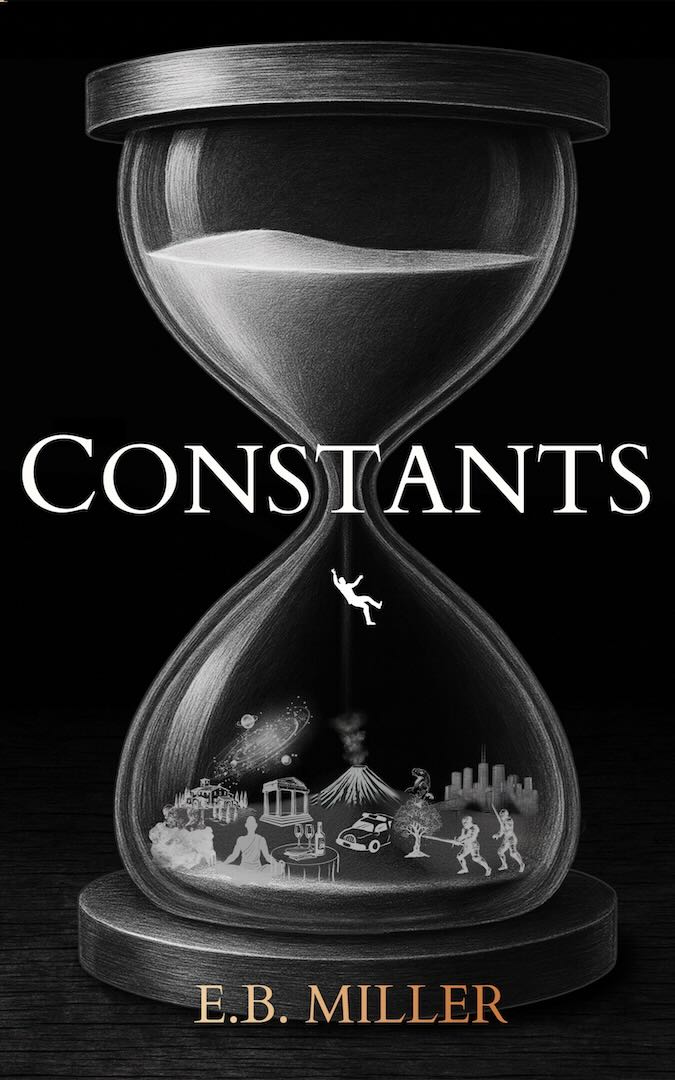
Imagine knowing the exact length of your life. Not roughly, not statistically, but down to the second. Now imagine that when the clock runs out and death arrives, as it always does, you simply open your eyes somewhere new. A crowded street market in colonial India. A candlelit restaurant where your wife is waiting. A cartoon kitchen surrounded by pigs in police uniforms. And the countdown begins again.
That is the engine at the heart of Constants by E B Miller, a debut novel that takes one of speculative fiction’s oldest fascinations, the resetting life, and rebuilds it into something stranger, sadder, and far funnier than readers will expect. Mark Robson, an archaeologist with a pregnant wife and a past he would rather not examine, is trapped in what he calls flux. Every 18 minutes and 32 seconds, he dies. Every death drops him into a new reality. His only hope of getting home lies in the handful of things that refuse to change across worlds: a number, a recurring disaster, a stranger chasing the same clues, and the woman he loves, who never remembers him the way he remembers her.
The Premise: A Multiverse Told in Real Time
What separates this novel from the crowded shelf of multiverse fiction is its clock. The story unfolds in real time, with nearly every chapter spanning one full existence, which means the reader lives inside Mark’s countdown with him. The effect is remarkable. Even in quiet scenes, a therapy session, a conversation with a professor about the digits of pi, a dinner over red wine, there is a second hand ticking underneath the prose. Tension is not manufactured through cliffhangers. It is structural. It is always there.
Miller wastes none of that pressure. Each world is sketched quickly and vividly, then mined for meaning before it collapses. Some existences are historical, some are contemporary, some are gleefully impossible. The variety could have felt like a gimmick, but the novel treats every reality as another interrogation room where Mark is forced to confront the same questions: What is real? What persists? And why does his wife Lya keep appearing when nothing else does?
A few of the recurring anchors that give the story its shape:
- The number 1832, which surfaces in addresses, timers, room numbers, and stranger places, always refusing explanation.
- Earthquakes, which arrive too often to be coincidence and give Mark a grim relationship with the ground beneath his feet.
- Lya, his wife, present in nearly every world yet never carrying their shared history with her.
- The Psychiatrist, a figure who begins as a skeptic and becomes something closer to a co-investigator, mapping Mark’s constants across sessions that should be impossible.
These anchors turn a potentially chaotic structure into a genuine mystery. The reader starts keeping a mental bulletin board of clues right alongside the characters, and the novel rewards that attention without ever explaining itself too early or too neatly.
The Voice: Gallows Humor with a Broken Heart
The prose in Constants by E B Miller is kinetic, profane, and frequently hilarious in the way that only truly desperate narrators can be. Mark’s interior voice swings between philosophy and sarcasm within a single paragraph. He lectures himself about Buddhist cosmology in one breath and complains about rave music in the next. He calls himself the greatest expert on death who has ever lived, then admits he knows nothing about it at all.
This voice is the book’s secret weapon. A premise this heavy, endless dying, a lost home, a wife who thinks her husband is delusional, could easily have collapsed into misery. Instead, Miller writes panic the way it actually feels: racing, absurd, self-mocking, and shot through with sudden moments of unbearable tenderness. When Mark closes his eyes and returns to the memory of Lya reading beneath a cherry tree, the novel goes quiet, and those pauses land harder because of all the noise around them.
There is also real craft in how the humor works. The comic worlds, and yes, there is an extended sequence involving cartoon police pigs that should not work and absolutely does, are never throwaway jokes. Even the silliest existence carries information, and some of the novel’s most unsettling ideas arrive wearing bright colors and balloon lettering.
The Themes: Grief, Addiction, and the Search for Something That Lasts
Beneath the reality-hopping, this is a novel about a man learning to look at his own life. Mark’s backstory unspools gradually: a mother lost in childhood, a father who left, a twin sister named Alex who vanished into addiction and street life years before the story begins. His marriage, his drinking, his ambivalence about fatherhood, all of it surfaces across worlds like sediment shaken loose by each new earthquake.
The epigraphs signal the book’s ambitions early. Iris Murdoch on the task of finding reality. Nietzsche on hope. And then, unforgettably, a third quote attributed to the Universe itself: “Hold my beer.” That tonal range, philosophy pressed right up against a bar joke, is the whole novel in miniature.
Readers who enjoy fiction that asks large questions will find plenty to chew on:
- Whether identity survives when everything around it changes
- What love means when only one person remembers the relationship
- How belief systems, from Shaivism to modern psychiatry, try to explain the unexplainable
- Whether meaning is discovered or built, and who exactly is doing the building
Crucially, Miller keeps a second reading alive the entire time. Is Mark genuinely crossing realities, or is flux the architecture of a mind in crisis? The novel takes both possibilities seriously, and its refusal to cheapen either one is among its most impressive qualities. The final act resolves the mystery in a way that is both surprising and emotionally earned, which is a rare combination, and this review will not spoil a moment of it.
About the Author
Constants is E B Miller’s debut novel, published by Evil Eye Publishing in 2026, and the author has said he began working on the story at seventeen. That long gestation shows in the best way. The book has the density of something lived with for years: recurring images planted early and paid off late, a countdown structure sustained across hundreds of pages, and a mystery whose answer was clearly known from the first chapter. For a first novel, the control on display is striking, and it marks Miller as a writer worth watching.
Books to Read If You Loved Constants by E B Miller
Readers looking for similar journeys through fractured realities and haunted minds should consider:
- Dark Matter by Blake Crouch for a propulsive multiverse thriller anchored in marriage and identity
- The Midnight Library by Matt Haig for parallel lives weighed against regret and depression
- Slaughterhouse-Five by Kurt Vonnegut for a man unstuck in time, told with dark wit
- The First Fifteen Lives of Harry August by Claire North for death as a repeating doorway
- Recursion by Blake Crouch for memory, loss, and reality bending under pressure
- Piranesi by Susanna Clarke for a stranded narrator mapping an impossible world
Our review of Real Life Is Elsewhere by Mark Stewart-Jones covers another literary fiction in the same vein.
Final Verdict: Who Should Read This Book
Constants by E B Miller is speculative fiction with its heart wide open. It offers the puzzle-box pleasures of a multiverse mystery, the momentum of a thriller with a literal ticking clock, and the emotional weight of literary fiction about grief, addiction, and the stubborn hope of getting home. It is inventive without being cold, philosophical without being dry, and funny in places you will feel slightly guilty laughing at.
If you like your science fiction conceptually daring and emotionally honest, put Constants by E B Miller at the top of your reading list. Few debuts arrive this confident, and fewer still make eighteen and a half minutes feel like an entire lifetime.