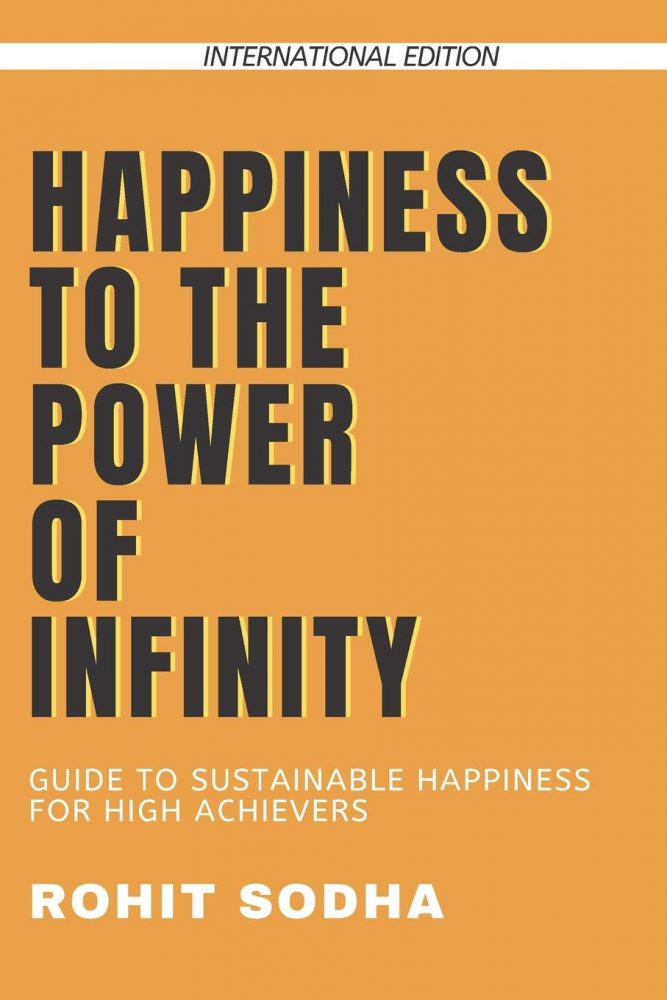
Book Summary: Happiness to the Power of Infinity
Everything we do is with the inherent intention of making us happy – largely without us even being aware about it. Despite happiness being so central to our lives there is little that we actively do about it. We cant and don’t really measure it, we don’t clearly know what triggers happiness and what does not, and we don’t actively work to improve it.
Compare this with physical fitness – a multibillion dollar industry exists around it; guiding us on how to become and stay healthy. We know our starting point: body weight, BMI, muscle percentage, current eating habits etc and we set a target – particular weight with a particular BMI and a muscle percentage.
There is a stringent path to the target state – involving highly regimented exercise schedule and dietary choices to be made over weeks if not months. How to get from initial to final stage is shared with us through all kinds of media – books, apps, internet videos, DVDs, gyms, personal trainers, nutritionists, chefs and all the rigmarole that you can imagine.
This is not a book – this is a self-help guide which you should work with to make yourself happier and stay that way throughout life.
Book Review: Happiness to the Power of Infinity
Happiness to the Power of Infinity by Rohit Sodha was much more interesting and much more challenging (at least, to me) than most other self-help books I’ve read. I actually found parts of this book quite confronting.
Happiness is a skill you can develop. What’s great about this book is that it doesn’t make the assumption that something is inherently wrong with the reader, rather it gives readers practical advice on small things they can do to get their brains more tuned in to being happy. It’s a state of mind—one that does come more naturally to some than others—but it’s also a muscle that can be exercised.
It’s just doing small things that make you happy, no matter how small. Doing this can help rewire your brain to see more possibilities, more insights, and help you see and seize upon opportunity when it arises.
“Happiness is to life what fizz is to soda” – Rohit Sodha
While most people assume that success will bring them happiness, this book allows the reader to take a step back and evaluate why this may not be the case. Instead, by being more positive or happy, we can live life in the moment and stop striving for some elusive “success” that is somewhere in the horizon and always out of reach. While this may seem obvious, Author Rohit Sodha is able to illustrate why most people are not so good at finding a happiness equilibrium. In a world where more and more people suffer from depression, it may not be the worst idea to re-evaluate how to make not only ourselves but also other people around us happier.
To attain this happiness, author developed a patented 3 step system called HappSys, a system to live a happy life and stay happy:
1. LifeJourney 2. HappFrame and 3. HappIndex.
Author Rohit Sodha does an amazing job of distilling the research and findings of positive psychology through HappySys that predict happiness and success.
The title, Happiness to the Power of Infinity, succeeds to convey the breadth and depth of Author Rohit Sodha’s search, which touches on philosophy, psychology, economics, evolution, and cognitive science, and skips effortlessly across the centuries.
Happiness to the Power of Infinity is brilliant book with concrete techniques to change ones habits, founded in extensive research. Much of what is presented, is common sense I think, but the difference is, that it is articulated in ways I can not, and is tested in research studies. I like the link the book makes between happiness and productivity. I recommend this book to everyone who strives to get closer to their full potential.
About the author: more on Rohit Sodha.







