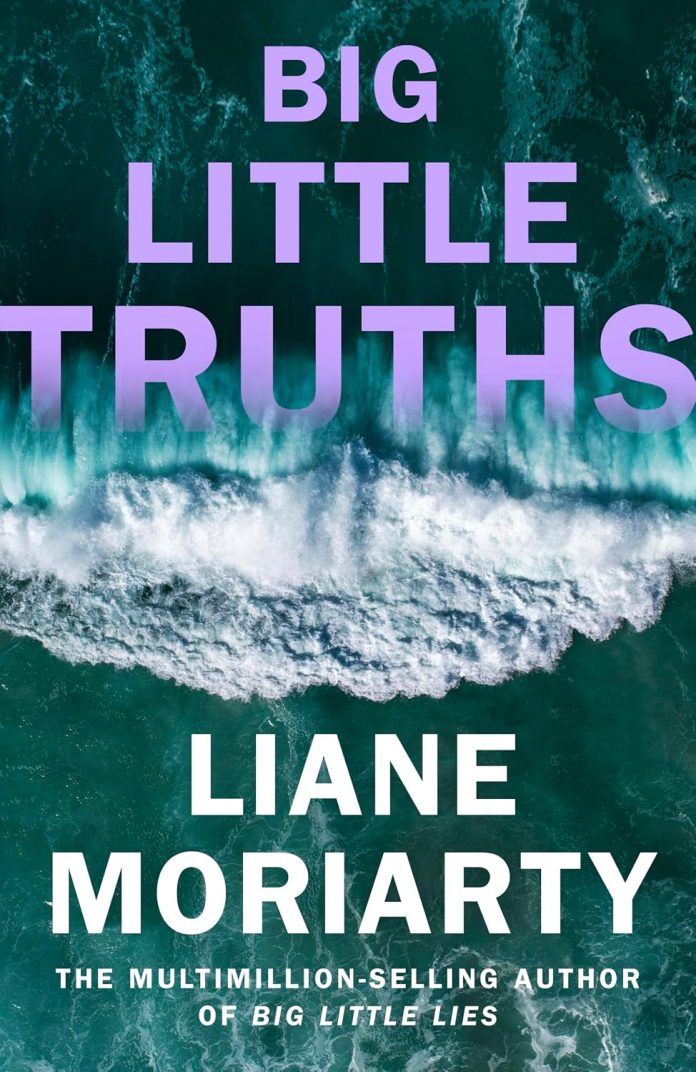
Ten years on from the trivia night, the Pirriwee mothers have swapped one school WhatsApp group for another, and the children who were five are fifteen now and half a head taller than their parents. That is the setup of Big Little Truths by Liane Moriarty, and it is cannier than it sounds. The first novel was about what women hide from each other. This one is about what everybody, in every direction, has stopped bothering to look at.
It opens with a severed human finger arriving at the high school by post, addressed to the principal, a teacher’s name on a label inside the box. A ludicrous object. Moriarty knows exactly how ludicrous, and then spends four hundred pages earning it.
Where Big Little Truths Sits
This is the direct sequel to Big Little Lies, and an author’s note at the front is unusually firm about which version it continues. The book, not the television series. Pirriwee rather than Monterey, the Australian vowels intact, Madeline’s eldest son Fred restored to a family the screen quietly wrote him out of. Moriarty is warm about the adaptation and honest that two performances earned their characters more room here than the novels had given them, which is why Renata and Mary-Louise both get considerably more to do.
Reading order is short: Big Little Lies first, then Big Little Truths by Liane Moriarty. Nothing else in her catalogue connects. Her last two, Here One Moment and Apples Never Fall, are the nearest relatives in method rather than plot.
What Big Little Truths Adds
Structure, mostly, and it is the best decision in the book. Madeline, Celeste and Jane still take turns in close third person. Braided through them are four other registers: a detective’s chapters ticking toward a date the characters have named D-Day, the principal’s magnificently pompous all-parent emails, the Year 10 group chat, and one mandated hour of student counselling in which six teenagers narrate the whole affair to a woman called Brenda.
That transcript is the engine of Big Little Truths by Liane Moriarty. Chloe, Skye, Amabella, Ziggy and the twins interrupt each other, correct each other’s idioms, take credit, assign blame, and reveal the plot roughly forty pages before their parents get there. It also lets Moriarty withhold. One of the six says almost nothing for most of the book, and the silence is doing work.
The thematic spine is a woman called Melody Montclair, a new history teacher who arrives and makes herself indispensable to every household on the peninsula. She fast-tracks a biopsy. She talks a school-refusing boy back through the gate. And she takes a lonely woman dancing. Only Renata, who trusts nobody, keeps asking what she wants. The novel’s real subject, which it approaches slowly and then states without flinching, is the sexual exploitation of teenage girls by an adult everyone has decided to love, and the machinery of charm that makes it possible for years at a time.
What Works
- The reader gets groomed too. For most of its length the book supplies genuine evidence that this woman is wonderful, then makes you sit with having believed it. That is a harder trick than a twist.
- Consent is argued across three generations without a lecture. A fifteen-year-old insisting she said yes, a mother who cannot say the thing that happened in her delivery room, a car park full of parents announcing that teenagers know exactly what they are doing.
- Two medical plots rhyme. A cancer drug manufactures a monster out of a kind man; an antihistamine manufactures dementia out of a sharp woman. Both are read as character before anyone checks the packet.
- The comic apparatus is precision-cut. A reply-all catastrophe from the principal’s office, and a group chat that responds to the possibility of a criminal investigation with four deleted messages and a question about band practice.
- Mary-Louise. The small domestic antagonist of book one is handed interiority, grief and the final chapter of Big Little Truths by Liane Moriarty, and the novel declines to tell you what to think about her.
Where Big Little Truths Gives Ground
- The villain stays a mechanism. No point of view, no interior life, one gestured-at fragment of backstory. Defensible, since she works as a hole the other characters pour themselves into, but everything around her is better drawn than she is.
- The coincidence engine runs hot. The one man in Australia investigating her happens to start dating one of the four friends. The book notices, and hangs a lampshade on it, which is not quite the same as fixing it.
- The last act hands down a verdict that the courtroom the book has spent its final pages promising was better placed to deliver.
- It is overstuffed. A motorbike, an engagement, a broken hip, a phone scam, a vape business and a local gangster. Enjoyable, largely decorative, and worth perhaps a hundred of the pages Big Little Truths by Liane Moriarty spends on them.
- It cannot be a first Moriarty. Nearly every relationship here is drawing on ten years of credit the reader has to have banked.
Content Notes
Organised grooming and the sexual abuse of minors, described at length by adult survivors; coercion using photographs; a teenager’s account of her own abuse; cancer diagnosis and chemotherapy; involuntary psychiatric detention and forced sedation; alcoholism and alcohol poisoning; retrospective domestic violence; a mutilated corpse; a serious road accident; a reference to abortion.
Do You Need the Earlier Books?
Yes. Not as homework, but genuinely. The friendships here carry a decade of accumulated debt, and the reason Bonnie standing in a fountain at midnight is unbearable rather than merely odd is that you were on the balcony at the trivia night. Read Big Little Lies first. It is short, and Big Little Truths by Liane Moriarty is better for it.
Read These Next
- Big Little Lies by Liane Moriarty, the necessary first half, and still the tighter of the two.
- Here One Moment by Liane Moriarty, for the same interest in what a community does with information it cannot verify.
- Apples Never Fall by Liane Moriarty, if the adult children and the unreliable family record are what you came for.
- Darling Girls by Sally Hepworth, Australian domestic suspense with a similar refusal to let a charming carer off the hook.
- It Should Have Been You by Andrea Mara, for school-gate paranoia that turns out to have been justified.
The Last Word
The showcase at the centre of the book asks the students to argue whether a historical figure was a villain or a hero, and the teacher who set the assignment opens the evening dressed as Marie Antoinette, explaining that the queen never said the line everyone quotes at her. History is interpretation, she tells them. Truth is a matter of perspective. It is a lovely lesson, and the children have been paying closer attention than she realised.
That is what Big Little Truths by Liane Moriarty is finally about: who is allowed to write the account, and what happens when the people with the fewest legal rights in the room decide to write it themselves. The adults spend the novel being competent about the wrong things. The teenagers, who cannot drive and are not believed, build the only piece of evidence that matters. Big Little Truths by Liane Moriarty is messier than its predecessor and less disciplined, and it is angrier in a way that suits the subject.
It ends on a wet road at six in the morning, with a woman who has decided she is finished looking backward.