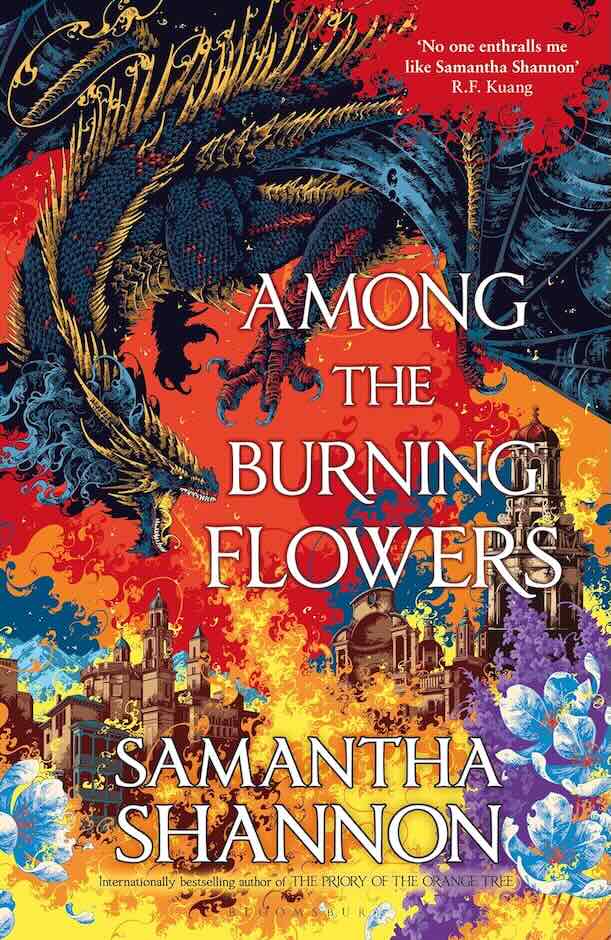
In the sun-drenched Kingdom of Yscalin, where lavender fields stretch toward mountain peaks and copper mines echo with ancient curses, Samantha Shannon has crafted a devastating prequel that serves as both standalone masterpiece and essential bridge to The Priory of the Orange Tree. Among the Burning Flowers doesn’t merely fill gaps in the chronology—it transforms our understanding of the world Shannon has built, revealing the tragic circumstances that paved the way for the events in her million-copy bestseller.
Set in the spring of CE 1003, this novella chronicles the fall of Yscalin through three interconnected perspectives, each carrying the weight of impending doom with Shannon’s characteristic blend of political intrigue, mythological grandeur, and deeply human emotion. The result is a work that stands proudly alongside The Priory of the Orange Tree (2019) and A Day of Fallen Night (2023), proving that Shannon’s mastery of epic fantasy continues to evolve and deepen.
Characters Caught Between Love and Destruction
Marosa Vetalda: A Princess in Chains
Shannon’s portrayal of Marosa Vetalda represents some of her finest character work to date. The Donmata of Yscalin emerges as a figure of tragic nobility, her golden Vetalda eyes reflecting both the divine forge of legend and the burning desperation of a woman trapped by circumstances beyond her control. Confined within the Palace of Salvation by her increasingly tyrannical father, King Sigoso III, Marosa becomes a study in constrained agency—every gesture monitored, every hope systematically crushed.
The relationship between Marosa and her betrothed, Aubrecht Lievelyn, provides the novella’s emotional heart. Shannon captures the delicate flowering of their courtship with exquisite tenderness, making their separation all the more devastating when political realities intervene. Their correspondence reveals two young rulers trying to navigate duty and desire, each bearing the weight of kingdoms that may not survive their reign.
Aubrecht Lievelyn: The Burden of Crown and Heart
Perhaps no character in Shannon’s expanded universe carries emotional complexity quite like Aubrecht. The Red Prince of Mentendon grapples with responsibilities thrust upon him by tragedy—the deaths of his parents, the devastating sweating sickness that claimed so many of his relatives, and now the impossible choice between personal happiness and political survival. Shannon’s exploration of his anxiety and trauma feels remarkably contemporary, grounding the fantasy elements in recognizable human psychology.
His internal monologues reveal a ruler haunted by loss, desperately trying to protect those he loves while accepting that protection may require heartbreaking sacrifice. The scene where he receives Marosa’s final letter—her acceptance of their doomed situation and her blessing for him to find happiness elsewhere—ranks among Shannon’s most emotionally devastating writing.
Estina Melaugo: Survival in the Shadows
The third perspective belongs to Estina Melaugo, a dragon hunter whose gritty determination provides contrast to the courtly concerns of Marosa and Aubrecht. Shannon excels at depicting characters from different social strata, and Melaugo’s sections crackle with the desperate energy of someone who has learned to survive through wit, violence, and uncompromising pragmatism.
Melaugo’s journey from outlaw to culler of Draconic sleepers illuminates the dangerous profession of those who hunt the dormant monsters scattered across the world. Her relationship with Liyat adds emotional depth to what could have been merely an action-oriented subplot, while her ultimate encounter with the wyverns in Ortégardes provides some of the novella’s most visceral and terrifying moments.
The Architecture of Apocalypse
Political Intrigue and Family Betrayal
Shannon weaves political complexity with the skill of a master craftsman. The revelation of King Sigoso’s past crimes—his role in Queen Rosarian’s death, his systematic abuse of his own daughter, and his eventual capitulation to the ancient wyrm Fýredel—unfolds with the inexorable logic of Greek tragedy. The discovery of the poisoned gown, the mysterious Cupbearer’s correspondence, and the web of manipulation spanning decades creates a conspiracy that feels both intimately personal and globally significant.
The author’s exploration of how religious faith can be twisted to justify atrocity adds layers of contemporary relevance. Sigoso’s conviction that he serves a greater good while committing increasingly heinous acts speaks to timeless questions about the corruption of power and the dangerous certainty of zealots.
The Awakening Terror
When Fýredel finally emerges from his centuries-long slumber within Mount Fruma, Shannon’s descriptive powers reach their apex. The scene of wyverns erupting from the cave system, spreading across the Great Yscali Plain like some terrible murmuration of starlings, combines mythological grandeur with visceral horror. The image of red fires blooming across the lavender fields—corruption spreading through beauty—captures the essence of what makes Shannon’s fantasy so compelling.
The tactical brilliance of Fýredel’s assault, using King Sigoso to sabotage Yscalin’s defenses from within, demonstrates Shannon’s understanding that the most effective horror often comes from betrayal rather than brute force. The citizens of Yscalin find themselves not just facing external monsters, but discovering that their own king has orchestrated their doom.
Literary Craftsmanship and World-Building
Prose That Sings and Burns
Shannon’s prose in Among the Burning Flowers demonstrates remarkable maturity and control. Her descriptions shimmer with sensory detail—the sulfurous heat of Cárscaro’s volcanic foundations, the sweet fragrance of lavender fields doomed to burn, the metallic taste of fear in Melaugo’s mouth as she stalks through cave systems. The writing manages to be both lush and economical, never allowing beauty to overwhelm narrative momentum.
The author’s skill with dialogue particularly shines in the intimate moments between characters. Conversations between Marosa and Aubrecht crackle with unspoken longing and political awareness, while Melaugo’s interactions with fellow outcasts carry the hard-earned wisdom of survival. Shannon has an ear for how different social classes speak, making each character’s voice distinct and authentic.
Expanding the Mythological Tapestry
For readers familiar with The Priory of the Orange Tree, this prequel provides essential context for the world’s current state. The fall of Yscalin explains the political landscape, the distribution of Draconic creatures, and the complex relationships between Western kingdoms. Shannon’s ability to write both backward and forward in time—creating a prequel that enhances rather than diminishes the original work—demonstrates sophisticated narrative planning.
The incorporation of Eastern elements, particularly through the character of Chassar uq-Ispad and references to Seiikinese culture, reminds readers that Shannon’s world extends far beyond the Western kingdoms. These details create tantalizing connections to A Day of Fallen Night while maintaining the novella’s focus on its central tragedy.
Strengths That Illuminate and Inspire
1. Character Depth and Development
Shannon’s three protagonists feel fully realized despite the novella’s length constraints. Each character arc complements the others while maintaining distinct emotional trajectories.
2. Political Complexity
The web of international relationships, religious conflicts, and personal grievances creates a believable foundation for the larger fantasy elements.
3. Atmospheric World-Building
From the sweltering heat of Cárscaro to the cool forests where Melaugo hunts, Shannon creates environments that feel both magical and lived-in.
4. Emotional Resonance
The tragic love story between Marosa and Aubrecht provides genuine heartbreak without feeling manipulative or overwrought.
5. Series Integration
The novella enhances understanding of the larger series while standing alone as a complete narrative.
Areas for Consideration
Pacing and Structure Challenges
While Shannon handles multiple perspectives skillfully, the novella’s structure occasionally feels uneven. Melaugo’s sections, while individually compelling, sometimes feel disconnected from the main political narrative until the climactic convergence. A more tightly interwoven structure might have strengthened the overall impact.
The revelation of King Sigoso’s crimes, while dramatically effective, unfolds through exposition and flashback rather than direct action. This approach works for the novella’s intimate scale but occasionally makes crucial plot points feel distant from immediate experience.
Limited Scope and Consequence
As a prequel, Among the Burning Flowers faces the inherent challenge that readers know the ultimate outcome. Shannon mitigates this through character focus and emotional investment, but the sense of inevitable doom, while thematically appropriate, can limit dramatic tension.
The novella’s length, while allowing for focused storytelling, means some promising elements—particularly the relationship between Melaugo and Liyat, and the broader resistance movement in Yscalin—feel underdeveloped. Readers may find themselves wanting more exploration of these rich narrative threads.
Artistic Achievement and Visual Splendor
Shannon’s collaboration with illustrator Rovina Cai deserves special recognition. The artwork doesn’t merely decorate the text but extends its emotional impact, capturing both the beauty and horror of Yscalin’s fall. Emily Faccini’s maps and chapter headings create additional layers of immersion, making this a truly collaborative artistic achievement.
The physical production values reflect the care taken with the story itself. Special editions from various publishers indicate the level of anticipation and appreciation for Shannon’s work within the fantasy community.
Connection to the Larger Series
Among the Burning Flowers serves multiple functions within the Roots of Chaos series. For newcomers, it provides an accessible entry point that doesn’t require knowledge of the earlier books. For established fans, it deepens understanding of key characters and events, particularly the relationship between Marosa and Aubrecht that resonates through The Priory of the Orange Tree.
The novella also bridges thematic elements between the books, exploring how personal relationships survive (or fail to survive) large-scale political upheaval. The question of whether love can endure in the face of impossible circumstances connects directly to themes in both previous books while establishing its own distinct emotional territory.
Recommendations for Similar Reads
Readers who appreciate Shannon’s blend of political intrigue, mythological elements, and romantic tragedy in Among the Burning Flowers might explore these complementary works:
Fantasy Epics with Political Depth
- The Goblin Emperor by Katherine Addison – For court intrigue and sympathetic royal characters
- The Priory of the Orange Tree by Samantha Shannon – The direct sequel that follows these events
- A Day of Fallen Night by Samantha Shannon – The companion novel exploring Eastern perspectives
Character-Driven Fantasy Romance
- The Ten Thousand Doors of January by Alix E. Harrow – For lyrical prose and magical world-building
- The Bear and the Nightingale by Katherine Arden – For folklore elements and atmospheric setting
- The Song of Achilles by Madeline Miller – For tragic love stories in mythological settings
Dragon-Focused Fantasy
- The Dragon Republic by R.F. Kuang – For complex political fantasy with Eastern influences
- Temeraire series by Naomi Novik – For intelligent dragon characters and historical fantasy
- The Rage of Dragons by Evan Winter – For epic scope and military fantasy elements
Final Verdict: A Masterful Addition to a Growing Legacy
Among the Burning Flowers succeeds as both an emotionally satisfying standalone work and an essential piece of Shannon’s expanding fantasy universe. The novella’s focus on character relationships over action sequences may surprise readers expecting dragon-heavy adventure, but this emphasis on human connection in the face of impossible circumstances creates the story’s lasting impact.
Shannon demonstrates that epic fantasy can embrace intimacy without sacrificing scope, and that prequels can illuminate rather than diminish their source material. The fall of Yscalin becomes not just a historical event but a deeply personal tragedy for three individuals caught in forces beyond their control.
The book’s exploration of love, duty, political manipulation, and survival feels particularly relevant to contemporary readers, while its fantasy elements provide the distance necessary for objective consideration of these themes. Shannon has created a work that satisfies both emotional and intellectual engagement, delivering the rare fantasy novel that works equally well as entertainment and literature.
For fans of the series, Among the Burning Flowers represents Shannon at her most focused and emotionally direct. For newcomers, it offers an ideal introduction to a world that rewards both casual reading and deep analysis. In either case, it stands as evidence that Shannon’s reputation as one of fantasy’s most important voices continues to be well-deserved.
This prequel doesn’t just prepare readers for The Priory of the Orange Tree—it transforms how we understand the sacrifices that make heroism possible and the prices that must be paid for the greater good. In Shannon’s hands, the fall of kingdoms becomes a mirror for the rise and fall of individual hearts, and the result burns as brightly as the flowers of its title.







