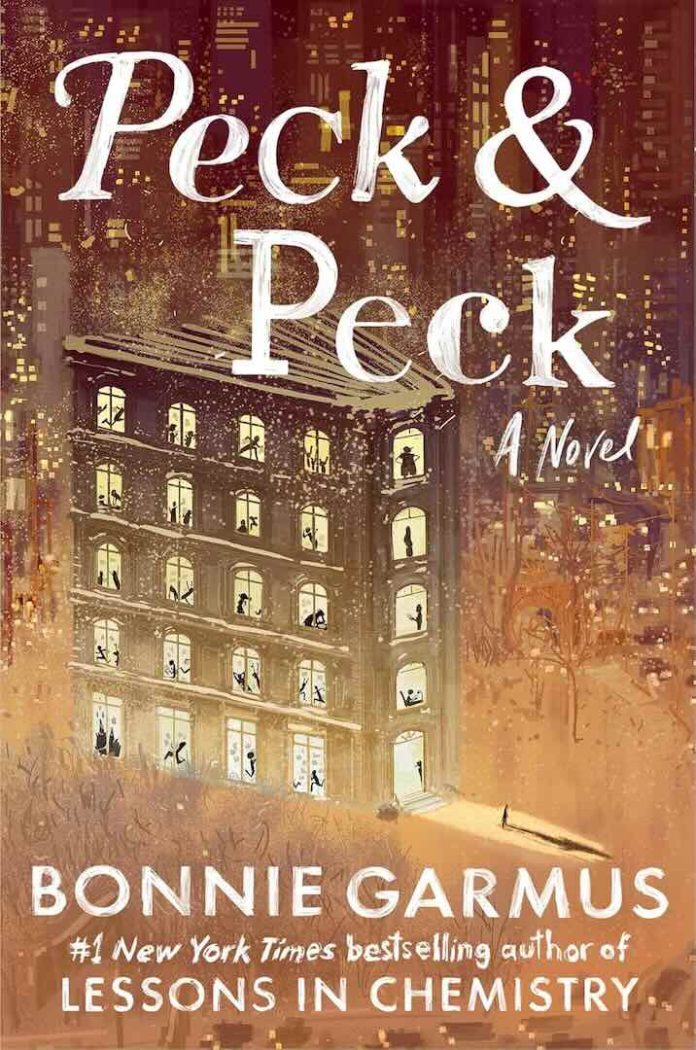
There is a particular kind of novel that wants to be read aloud, ideally at a kitchen table with strong coffee and someone willing to laugh in the right places. Peck & Peck by Bonnie Garmus is precisely that book. Four years after Lessons in Chemistry turned a chemist named Elizabeth Zott into a household saint, Garmus returns with a story about a young man who wants to spend his life on the least practical art form ever invented. She writes about poetry the way she once wrote about cooking: as a stand-in for everything that matters and almost nothing the modern world will pay for.
The Setup: A Boy, a Dog, and a Quarterly That Hates You
Batter Gray is a Yuba City kid raised by Rainey, a type designer who treats Helvetica as a moral statement, and John, a community college historian who carries every televised tragedy like a private bruise. Batter is an identical twin minus the twin. He is also named after a dog his mother insists was a heart-stopping hero. By his early twenties he has fled to New York, lied to his parents about a print shop job, and somehow talked his way into Peck & Peck, a famously secretive poetry quarterly run out of a triangle of Manhattan real estate that looks like a greenhouse and behaves like a cult.
What he actually does there, at first, is run three copiers in a converted bomb shelter. Above him, thirty-nine editors and one Editor in Chief argue about commas, eggs, and which young hopeful deserves a spot in the slim leather-bound quarterly that arrives, every issue, wrapped in the image of a single glowing quail egg.
Voice and Style: Garmus Doesn’t Sound Like Anyone Else
This is where the novel earns its keep. The voice in Peck & Peck by Bonnie Garmus is a first-person, slightly older Batter looking back on the year that changed everything, and the result reads less like a novel than a long, funny, anxious confession told over a bar. Garmus writes sentences that ricochet between joke and grief inside a single paragraph. A line about why parents never want a poet for a son sits beside a line about a stillborn brother, and somehow neither feels engineered.
Dialogue as Architecture
Her dialogue is the real flex. Conversations between Batter and his mother are running ten-rounders of digression. Rainey can begin with the failure of school punctuality, detour through Christopher Columbus, the etymology of “discover,” the ergonomics of Macy’s at Herald Square, and arrive at a chastisement about your posture without losing her thread. It is exhausting in the best way. Garmus has clearly grown more confident in the comic monologue since Lessons in Chemistry. She lets her characters talk longer and trusts the reader to keep up.
What Works Beautifully
Five things this novel does better than almost any literary comedy on the shelves right now:
- Rainey Gray is one of the year’s great mothers. She is opinionated, secretly wounded, frequently absurd, and never sentimentalized. Her relationship with grief, which the book unpacks slowly, is the emotional engine of the whole thing.
- The Peck & Peck offices themselves are practically a character. The Aviary, the marble staircase, the alphabetic topiaries, the pneumatic chute system that hurls cylinders past the basement at the speed of a small bull. Garmus has built a literary New York fever dream and then sketched it with such tactile detail you can almost smell the toner.
- The 1980s setting is handled with restraint. No nostalgia karaoke, no laundry list of references. Just the right amount of IBM Selectrics, payphone messages, and AZT-era worry to make the period feel lived in.
- The workplace satire is sharp without being mean. Salton Peck, the tyrannical Editor in Chief, is funny in a way that does not let him off the hook morally.
- There is a love story that genuinely earns its swoons, and you will not see its full shape until late in the book.
Where the Novel Hits a Few Speed Bumps
In the interest of honesty, Peck & Peck by Bonnie Garmus is not flawless, and pretending otherwise would do Garmus a disservice. The book occasionally suffers from the same condition as its protagonist: it has trouble committing to one thing at a time. Several issues stand out for a reader who already loves Garmus and wants this to be even better than it is.
- The middle section sags. Once Batter is settled into the copy room and the office politics get rolling, the plot enters a long holding pattern in which similar comic beats repeat. A leaner edit by perhaps fifty pages would have sharpened the ending.
- Some of the side editors blur together. Peck & Peck employs forty editors by design, but in narrative practice that is too many. A few feel sketched rather than fully drawn.
- Rainey’s monologues, much as I loved them, occasionally tip from charming digression into authorial soapbox. Garmus has things to say about typography, history, women’s medicine, and American hypocrisy, and Rainey is the willing megaphone.
- The mystery elements teased in the opening lines, including the question of why Batter ends up Prisoner 83A0956, are dangled early and resolved very late. The payoff is strong, but the wait stretches a beat too long.
None of this sinks the book. It just keeps it from the genuine knockout that Lessons in Chemistry turned out to be.
The Beating Heart: Identity, Duality, and Earning a Name
What lifts Peck & Peck by Bonnie Garmus above its workplace comedy bones is the quiet conviction that names matter, that they are a kind of inheritance you either live up to or unlive your way out of. Batter spends the book trying to understand what his name actually means. The truth he uncovers, when it lands, reframes everything we have read. It is a novel about a young man searching for permission to take poetry seriously, but underneath that it is a novel about the parents who shape us through omission as much as instruction, and about the strange comfort of being one half of a pair that history erased before you arrived.
A Study in Doubles
The motif of doubles runs through every layer of the novel. Twin protagonists. Twin Peck brothers. And Twin desks pushed back to back. Twin lions outside the New York Public Library. Right versus wrong. Truth versus lie. Garmus uses the architecture of duality without ever calling attention to it, and that restraint is its own quiet triumph.
Who Should Read This Book
This one will land especially hard for readers who:
- Loved Lessons in Chemistry but want something slightly stranger and more melancholy.
- Have ever worked at a place that took itself far too seriously.
- Care about poetry, typography, or the dignity of small, unprofitable obsessions.
- Believe a well-written mother can carry an entire novel.
If You Loved Peck & Peck by Bonnie Garmus, Try These Next
- Lessons in Chemistry by Bonnie Garmus. The natural starting point and a useful reference for what Garmus does best.
- Less by Andrew Sean Greer. For similarly literate comedy with a tender backbone and a wandering protagonist.
- A Confederacy of Dunces by John Kennedy Toole. For sprawling office absurdity in a fully realized city.
- Mrs. Bridge by Evan S. Connell. For an interior portrait of a mother who carries her own private weather.
- The Pursuit of Love by Nancy Mitford. For sharp social comedy with grief humming underneath.
- Trust Exercise by Susan Choi. For another novel that quietly rearranges itself in the back half.
Final Thoughts
Garmus has written a second novel that does not chase the success of her first. It is smaller in plot, looser in shape, and richer in voice. There are moments in Peck & Peck by Bonnie Garmus where the prose is so loose and so happy with itself you can almost hear the author laughing in the next room, and there are other moments, especially anywhere Rainey opens her mouth or anywhere a quail egg is mentioned, where the book quietly breaks your heart. It does not entirely cohere. It does not have to. Like the quarterly at its center, this novel is interested in originality, beauty, and substance, and it lands two of those three without breaking a sweat.







