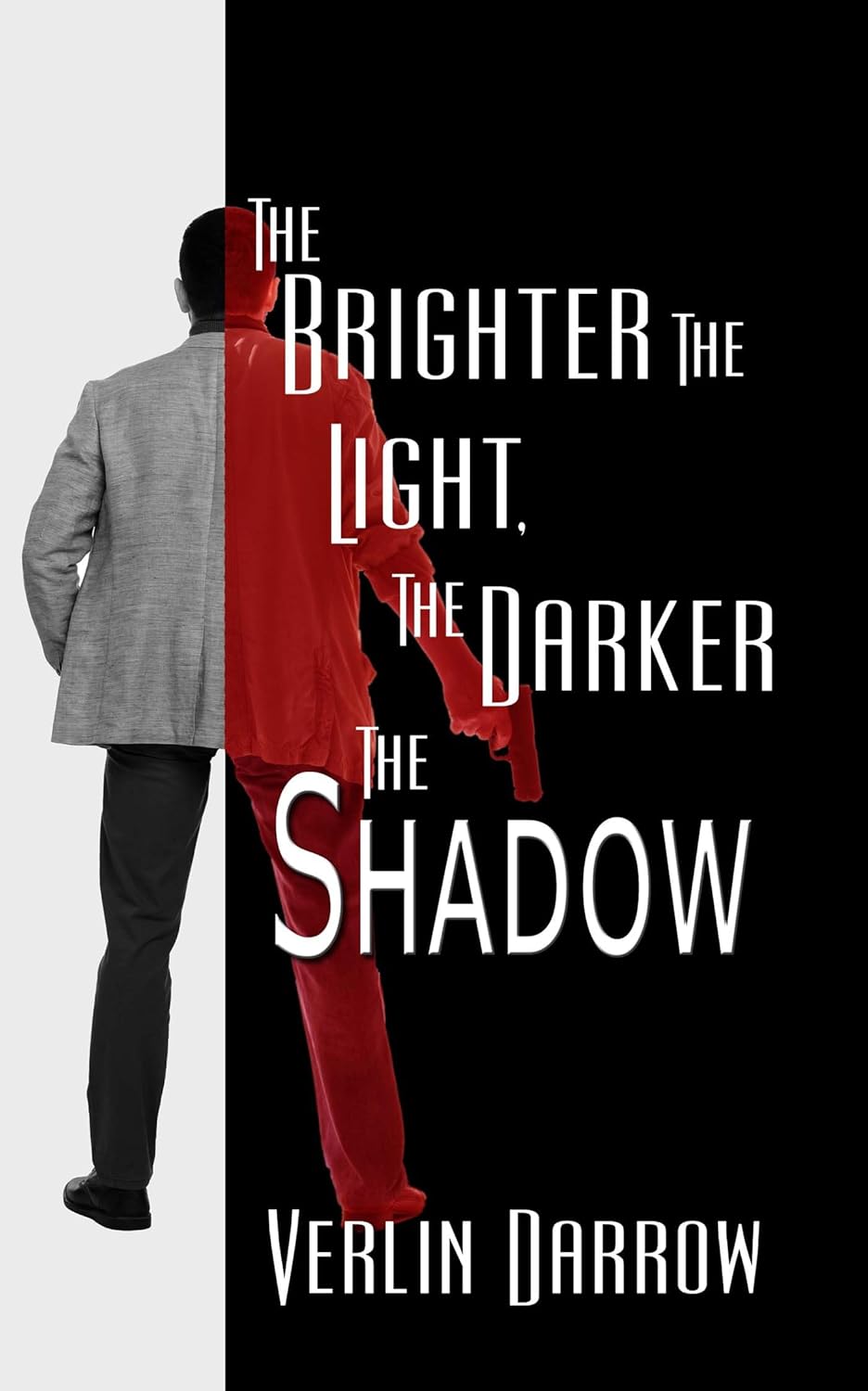
There is something quietly subversive about a murder mystery that begins with its narrator asking whether he can fully experience a horrific moment without losing his center. Most thrillers open with adrenaline. The Brighter the Light, The Darker the Shadow by Verlin Darrow opens with mindfulness — a yurt at dawn, a dewy Santa Cruz meadow, a Newfoundland-malamute mix named Zeus, and a corpse the protagonist would rather not look at. Within a page, you know you are not reading a standard whodunit. You are reading a procedural conducted by a man whose first instinct is to meditate on his own flinching.
Verlin Darrow, a working psychotherapist with a former life as a spiritual teacher, has spent decades observing how people behave under pressure, and that watchful, slightly amused gaze suffuses every chapter. The result is a courtroom-tinged thriller that earns its suspense by refusing to chase it.
The Premise, Without Giving the Game Away
Kade Tobin leads a rural spiritual community called the Brethren of Congruence, tucked into the redwood mountains north of Watsonville. When a young woman’s body turns up in his meadow, he is invited to assist a sheriff’s detective with interviews — a courtesy that curdles into suspicion within days. As bodies and questions accumulate, the man whose vocation is guiding others toward their truer selves becomes the chief suspect in a multi-victim case, dragged from his sandalwood-scented yurt to a county jail cell, then to a podium across from twelve strangers tasked with deciding his future.
That is all the plot you need. The Brighter the Light, The Darker the Shadow by Verlin Darrow is the kind of novel where each small revelation earns its place, and to summarize further would steal real pleasures from any reader.
A Voice Built from Hard-Won Stillness
The most striking craft decision here is point of view. Kade narrates in a register that is at once disarmingly modest and quietly authoritative. He pauses to notice the wear pattern on a detective’s shoes, the listing of a follower’s blondish bangs, the way an aging judge’s neck pokes turtle-like out of his robe. Then, in the very next paragraph, he is mapping the architecture of his own anxiety or admitting that “arguing is a subtle form of violence.” Darrow has the rare confidence to let a character think out loud about karma without bleeding the tension out of an investigation.
It helps that the sentences carry a dry, sometimes stand-up rhythm. A witness “looked like a stork.” A jail cafeteria “resembled an expanded version of my high school cafeteria — if the school staff had bricked up the windows.” Zeus settles at the foot of his master’s futon, “farting furiously.” Within the same scene, that humor will pivot to philosophical weight. This tonal range is the engine of the novel.
A Cast That Earns Its Page Time
The supporting players are sharply drawn and rarely interchangeable. Bill Cullen, the senior detective, is methodical and unexpectedly literate about police procedurals. His partner brings an abrasive energy and a backstory the plot uses with care. The DA, Marion Burke, prosecutes with theatrical flair while juggling complications that hit closer to her own household than the courtroom realizes. Phil Karanos, the pro bono defense attorney pulled from inside the community itself, becomes one of the book’s quiet revelations.
Then there is the community: hysterics, gentle giants, a Basque dreamer with a knack for premonitions, an OCD neighbor down the road, a fugitive hidden in plain sight. A few highlights worth flagging without spoiling anything:
- Zeus the dog is not a prop. He functions as comic relief, emotional anchor, and occasionally a wordless commentator on his owner’s worst choices.
- The jailhouse stretch introduces a parade of inmates — Lucas the trustee, Billy the stork-like fixer, a tattooed crew called the Terrores Del Lado Este — and Kade’s reflex to every one of them is to ask how he might be of service.
- The courtroom scenes are written with insider precision and outsider wonder. A judge who calls one attorney by her first name and the other by his last. A tactical decision to push a witness until the jury physically stops nodding. It all feels lived-in rather than televised.
A Mystery That Trusts Its Reader
What makes The Brighter the Light, The Darker the Shadow by Verlin Darrow feel fresh in a crowded genre is its restraint. There is no exposition dump, no convenient flashback, no villain monologue at the end. Clues are seeded patiently — a watch on a victim’s wrist, a stranger’s slip about a Pennsylvania museum, a borrowed car with built-in GPS, a paperback wedged inexplicably between two airport thrillers in a jail library — and the reader is trusted to keep their own ledger.
The pacing accelerates as the second half tilts into trial territory. Cross-examinations land like body blows. Opening statements double as character studies. The narrative lets you feel the grind of incarceration without dragging the prose through it.
Themes Worth Underlining
A handful of ideas earn their italics by the final page.
- Identity is a layered thing. Names, pasts, vocations, and reputations are all garments; pulling on a new one does not always change the body underneath.
- Kindness under pressure is a discipline. Kade’s vow to remain kind to bullies, prosecutors, and the press is tested on nearly every page, and the book takes that test seriously.
- The justice system and justice are not synonyms. Darrow lets characters say this aloud, then dramatizes it with patience.
- Surrender is not the same as giving up. The closing pages reframe the title in a way that lingers.
Who Should Pick This Up
Readers who enjoy a thinking person’s mystery — one where the inner life of the suspect carries as much weight as the forensic evidence — will find The Brighter the Light, The Darker the Shadow by Verlin Darrow an unhurried pleasure. It is equally suited to lovers of contemplative fiction who can stomach a body or two, and to mystery readers willing to slow down for a paragraph about levels of consciousness before the next courtroom volley.
More from Verlin Darrow’s Shelf
If this is your first encounter with the author, his earlier titles make a generous on-ramp:
- Blood and Wisdom — a psycho-spiritual mystery set at a retreat center.
- Murder for Liar — a psychotherapist pulled into impossible events.
- Coattail Karma — a wild, no-holds-barred fantasy thriller.
- Prodigy Quest — a wisdom-seeking adventure with a ten-year-old genius at its centre.
- Kinney’s Quarry and The Not Quite Enlightened Sleuth — rounding out his run of unconventional, philosophically charged thrillers.
Read-Alikes If You Need a Next Book
A few hand-picked companions for readers ready to keep the mood going:
- Father Brown stories by G.K. Chesterton — for clergymen and crime.
- The Brother Cadfael Chronicles by Ellis Peters — for monastic detectives with patience.
- The Lincoln Lawyer by Michael Connelly — for tactical, charismatic defense work.
- Defending Jacob by William Landay — for the slow burn of a courtroom turning on a single life.
- Mr. Penumbra’s 24-Hour Bookstore by Robin Sloan — for the wonder-tinged side of an investigation.
Final Word
The Brighter the Light, The Darker the Shadow by Verlin Darrow is that uncommon thing — a mystery written by someone who has spent a working life listening carefully to other people, and who trusts language enough to let his protagonist think on the page. Atmospheric, wry, generous with its supporting cast, and quietly daring in its philosophical scope, it is the rare thriller that leaves you slower, not faster, when you set it down. By the time the last juror’s verdict registers, you may find yourself less interested in who did it than in who Kade Tobin has become — which is, perhaps, exactly the trick The Brighter the Light, The Darker the Shadow by Verlin Darrow has been playing on you all along.