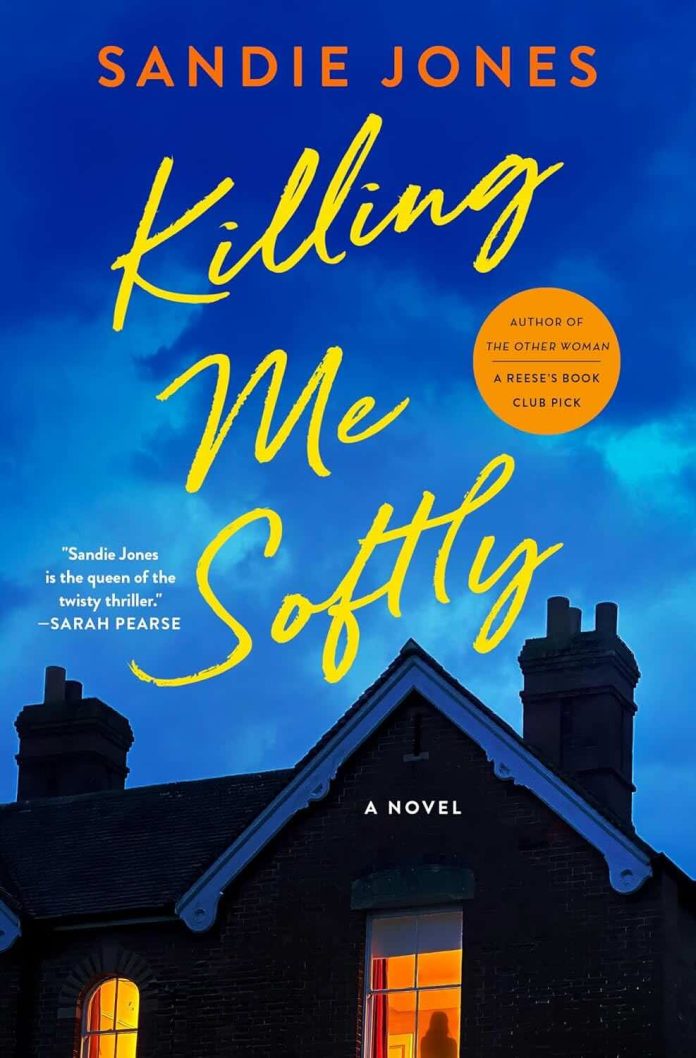
There is a particular kind of dread that domestic thrillers do best — the slow, creeping realization that the person sharing your bed may not be who you thought they were. Killing Me Softly by Sandie Jones weaponizes that dread with remarkable precision, wrapping a hit-and-run, a cover-up, and a collapsing marriage inside the deceptive prettiness of the English Cotswolds. If you thought you knew how a love story turns dark, Jones is here to remind you that the most lethal poison is often the kind that is administered with a smile.
The Author Behind the Suspense
Sandie Jones is no stranger to the art of the slow reveal. The New York Times bestselling author built her reputation on The Other Woman — a Reese’s Book Club Pick that earned its place as a compulsive read — before following it with The Guilt Trip and The Trade Off, each one tightening her grip on the domestic thriller form. Her novels share a particular DNA: a heroine navigating the treacherous terrain of a relationship she thought she understood, and a plot that keeps pulling the rug from beneath reader expectations. Killing Me Softly by Sandie Jones continues in that tradition, though with a darker edge and a more cynical eye than her earlier work.
The World Jones Has Built — and How Carefully It Shatters
The novel opens in London, where Freya and Charlie Adams are the couple everyone envies: her ambitious and sharp, him the celebrated chef on the cusp of taking a stake in one of the city’s most sought-after restaurants. Jones drops readers into a dinner party at Regent’s Park — all Calacatta Gold marble and Hockney originals — with an eye for class performance that is both satirically precise and socially astute. A single evening, fueled by expensive wine and barely contained jealousy, sets off a chain of events that sends them fleeing to the Cotswolds carrying a secret that could destroy them both.
What makes the setup so effective is Jones’s refusal to let the idyllic relocation feel like redemption. The farmhouse kitchen, the rolling meadows, the birdsong — it all reads as a trap dressed up in pastoral clothing. The Cotswolds here are not cozy. They are the walls of a cage.
Freya and Charlie: Two Unreliable Narrators in a War of Omissions
The novel alternates between Freya’s and Charlie’s perspectives, and this is where Killing Me Softly by Sandie Jones earns its psychological credibility. Neither narrator is fully trustworthy — not because Jones cheats the reader, but because both characters are cheating themselves. Freya’s self-awareness is painfully acute; she sees her own insecurities with forensic clarity, yet keeps walking toward the fire anyway. Charlie, on the other hand, operates with a terrifying capacity for compartmentalization, his affection for Freya never quite separating from his impulse to control her.
Jones gives both characters enough internal logic to make you root for them in spite of everything, which is a harder trick than it sounds. Freya’s hidden vodka bottle, her visit to the hospital bedside of the man they wronged, her desperate friendship with Tess — all of it layers into a portrait of a woman under siege, not just from external threat but from her own conscience. Charlie’s dogged determination to keep their house of cards standing, his covert tracking of Freya’s car, his relationship with Tess — it all reflects back something more disturbing than villainy. It reflects love curdled by guilt and fear.
Where the Novel Gets It Right
Killing Me Softly by Sandie Jones delivers on several fronts that readers of the genre will recognize and relish:
- The dual-perspective cat-and-mouse dynamic is executed with real confidence. Neither character has the full picture, which means neither does the reader — and Jones manages the information flow with surgical control.
- The social observation is razor-sharp. From the passive aggression of Coco’s dinner-party barbs to the quietly devastating transactional nature of wealth, Jones understands that cruelty operates in registers as refined as it is brutal.
- The pacing in the opening third is close to flawless. The dinner party sequence — building from pleasantry to accusation to catastrophe — is among the tautest writing Jones has produced, each beat landing with the conviction of a thriller writer at the top of her craft.
- The theme of addiction is handled with more nuance than the genre usually permits. Rather than using alcoholism as shorthand for dysfunction, Jones lets it operate as a lens: revealing how dependency distorts memory, compromises loyalty, and makes complicity feel almost inevitable.
- Freya’s mother Anita is a quietly extraordinary supporting character — all narcissism and sharp instincts, never fully wrong and never fully right, and entirely capable of pulling a thread until the whole sweater unravels.
Where It Doesn’t Quite Land
For all its strengths, Killing Me Softly by Sandie Jones carries a few of the genre’s familiar limitations. Coco, for all the menace she represents, tips occasionally into caricature — too decorated in leopard print and fake lips to feel fully threatening. The novel’s most commercially satisfying impulses sometimes override its more interesting ones; there are moments when the plot reaches for a clean twist where ambiguity might have done more work. And while the middle third earns its tension, it does occasionally stall in its own circling, with both narrators retreading their anxieties in ways that stop just short of claustrophobic in the productive sense. Readers looking for a jaw-drop final act may find the resolution somewhat tidier than the chaos that precedes it — though Jones executes it with enough earned emotional weight to make it stick.
If You Enjoyed This, Try These
- I Would Die For You — Sandie Jones
- The Girl on the Train — Paula Hawkins
- Behind Closed Doors — B.A. Paris
- Big Little Lies — Liane Moriarty
- The Silent Patient — Alex Michaelides
- The Perfect Marriage — Jeneva Rose
The Verdict
Killing Me Softly by Sandie Jones is the novel that asks, with genuine moral interest, how well any two people can ever really know each other — and what happens when the answer turns out to be: not well enough. It is not always a comfortable read. It is not meant to be. But it is an accomplished one, from a writer who understands that the most dangerous relationship is often the one where love is real, the harm is real, and both people are telling themselves they had no other choice. Pick it up in the daylight. You will finish it when you should be sleeping.