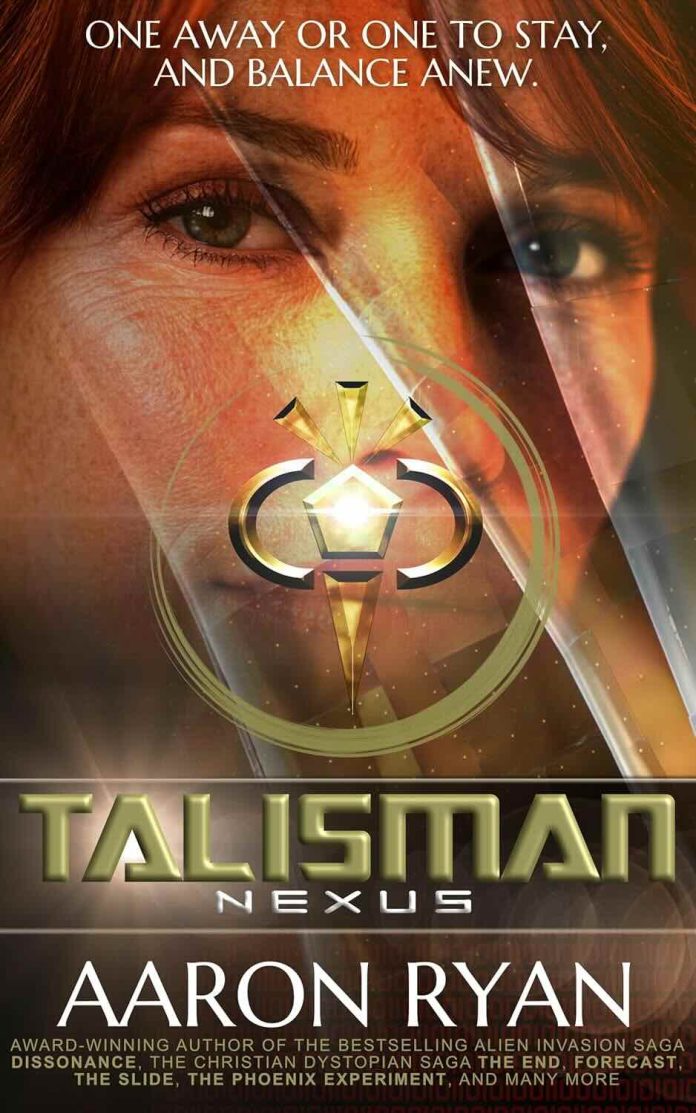
There are stories that entertain, and then there are stories that reach through your ribcage and squeeze. Talisman: Nexus by Aaron Ryan belongs firmly in the latter category. The second installment in the Talisman trilogy picks up the narrative threads left dangling at the precipice of its predecessor, Subterfuge, and weaves them into something far more ambitious, far more emotionally devastating, and far more cosmically expansive than the first book dared to attempt. This is not simply a sequel — it is an escalation of everything that made the original work, dialed up to a frequency that vibrates between intimate heartbreak and interstellar reckoning.
Set primarily in the bleak, frozen isolation of Svalbard in 2062, the novel plunges readers into the claustrophobic tension of The Refuge — a clandestine underground bunker where Liam “Foxy” Mayfield’s fractured inner circle waits, argues, and simmers in a pressure cooker of blame, fear, and fragile hope. Ryan wastes no time. From the opening chapter, narrated with biting wit and emotional sincerity through the eyes of journalist Onyx Sleater, the stakes are made brutally clear: Liam’s sons have been taken, and the man who took them wants nothing less than total annihilation.
The Architecture of Anguish
What distinguishes Talisman: Nexus by Aaron Ryan from conventional science fiction sequels is its structural courage. The novel is divided into three parts — Heartbreak, Family, and Truths — and each section functions almost as its own emotional movement, building upon the last like orchestral crescendos in a symphony of grief.
Ryan employs a rotating perspective technique that shifts between Liam, Onyx, and The Zorander, and each voice carries its own distinct cadence:
- Liam’s chapters are raw and guttural, saturated with the weight of a father’s desperation. His internal monologue swings between controlled military precision and unraveling vulnerability, and those transitions happen within single paragraphs — sometimes within single sentences.
- Onyx Sleater’s voice is sharp, sardonic, and deeply human. Her chapters inject levity into an otherwise heavy narrative, her reporter’s instinct serving as both comic relief and narrative engine. She glares at former presidents with practiced contempt, trades barbs with Wayne Trudeau, and yet beneath that bristling exterior lies a woman quietly falling apart with concern for a man she cannot quite reach.
- The Zorander’s sections are written in a deliberately alien register — grandiose, theatrical, ancient. Ryan gives his antagonist a voice that feels genuinely otherworldly, laced with a strange beauty that makes his eventual transformation all the more compelling.
Character as Crucible
The emotional core of this novel is not its cosmic mythology or its superpowered confrontations — though both are executed with flair. The core is family, and the ways in which love survives the unsurvivable.
Liam’s reunion with his sons, Joseph and Carson, forms the beating heart of the book’s midsection. Ryan handles this with remarkable restraint. There is no saccharine reconciliation. Joseph, the eldest, is angry — righteously, stubbornly, quietly angry — and Ryan lets that anger breathe without rushing toward resolution. Carson, the younger, reaches out with a maturity that exceeds his fifteen years, and the dynamic between the three Mayfields is drawn with the kind of specificity that suggests lived experience rather than invented drama.
One of the novel’s most affecting passages involves nothing more than a father and his younger son sitting together, catching up on five lost years. There are no explosions, no glowing glyphs, no teleportation — just two people tentatively rebuilding a bridge across grief. Talisman: Nexus by Aaron Ryan understands that these quiet moments carry more dramatic weight than any cosmic battle, and it trusts its readers to feel that weight.
The Pivot That Redefines Everything
Without revealing the specifics of how the narrative arrives at its central revelation, it is fair to say that the book’s third act fundamentally recontextualizes everything that came before — not just in Nexus, but in Subterfuge as well. The relationship between The Iskander, The Zorander, and the mysterious Aeterium Axis undergoes a seismic shift, and Onyx Sleater’s role evolves from observer and love interest into something far more mythologically significant.
Ryan earns this transformation. It does not feel contrived or rushed because the emotional groundwork has been meticulously laid across hundreds of pages of internal reckoning. When the truth finally crystallizes, it arrives with the force of inevitability rather than surprise — which is precisely the kind of revelation that stays with a reader long after the final page.
The title itself, Nexus, proves to be far more than a marketing decision. It is the thematic spine of the entire novel: the point where disparate threads of loss, love, vengeance, and cosmic manipulation converge into a single, irreversible truth.
Writing Style and Craft
Aaron Ryan writes with a visceral intensity that borders on the cinematic. His prose is muscular and emotionally unguarded, often reading like a war correspondent embedded in the chaos of the human soul. There is a biblical cadence to certain passages — particularly those involving The Zorander — that elevates the text beyond genre convention into something approaching mythic storytelling.
The pacing of Talisman: Nexus by Aaron Ryan deserves particular praise. The novel oscillates between white-knuckle action sequences and deeply contemplative character studies, and neither pace feels subordinate to the other. The confrontation in Svalbard is pulse-pounding and visually vivid, but it is immediately followed by scenes of quiet devastation that hit harder precisely because the adrenaline has just receded.
The Broader Canvas
For readers unfamiliar with Aaron Ryan’s body of work, Talisman: Nexus by Aaron Ryan exists within a larger fictional universe established in his bestselling six-book Dissonance alien invasion saga, which chronicles humanity’s near-extinction at the hands of telepathic extraterrestrials called gorgons. The Talisman trilogy functions as both a sequel and a standalone narrative, though familiarity with Dissonance deepens the resonance of certain character histories — particularly those of Liam, Cameron “Jet” Shipley, and Vance Cardona.
Ryan is also the author of THE END Christian dystopian trilogy, the sci-fi thrillers Forecast, The Slide, and The Phoenix Experiment, along with numerous other works spanning fiction, nonfiction, and children’s literature.
Who Should Read This Book
This novel will resonate with readers who appreciate science fiction that refuses to sacrifice emotional depth for spectacle. If you have enjoyed the following, Talisman: Nexus by Aaron Ryan belongs on your reading list:
- The Expanse series by James S.A. Corey — for its blend of interpersonal drama and cosmic-scale stakes
- Recursion by Blake Crouch — for its exploration of memory, loss, and the cruel machinery of hope
- Old Man’s War by John Scalzi — for its military science fiction with genuine heart
- The Power of the Dog by Don Winslow — for its relentless pacing and morally complex characters
- Children of Time by Adrian Tchaikovsky — for its willingness to examine alien perspectives with empathy
Final Thoughts
What Aaron Ryan has accomplished with this second installment is no small feat. He has taken a premise that could have easily devolved into formulaic superhero fiction and instead crafted a meditation on what happens when the things we cling to most desperately — hope, trust, the promise of restoration — are revealed as instruments of manipulation. The result is a novel that is simultaneously a cosmic thriller and a deeply personal story about a broken father learning that the path forward may not lead where he always believed it would.
Nexus bridges the personal and the universal with uncommon grace, setting the stage for what promises to be a cataclysmic conclusion in Halcyon. The shift from personal quest to universal battle has begun, and there is no turning back.







