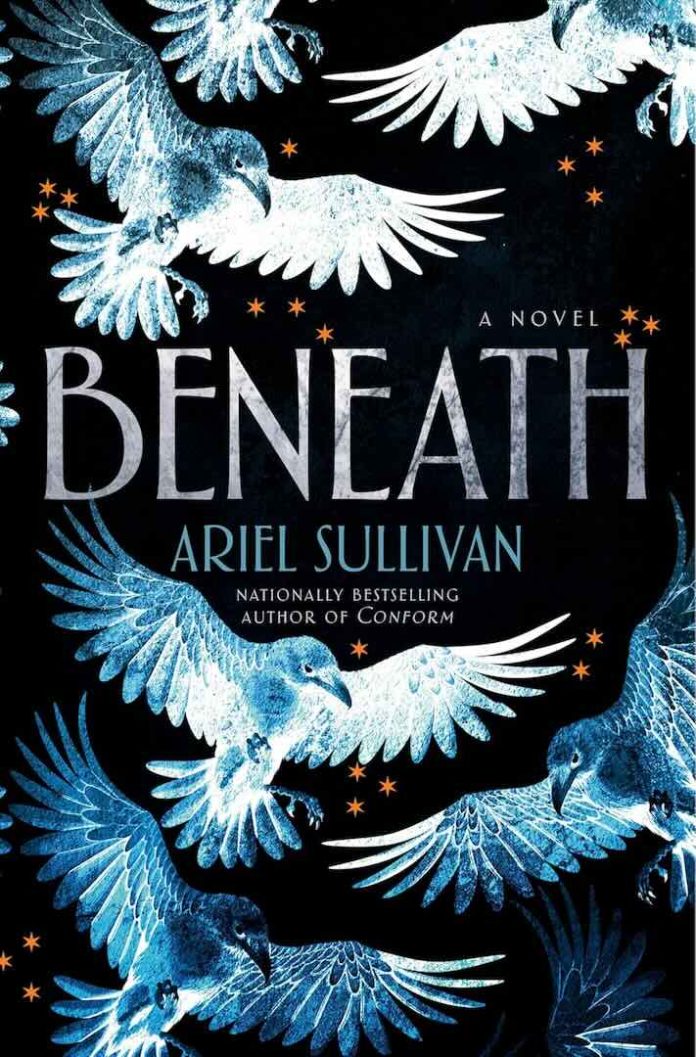
Prequels carry a particular burden. They must illuminate without spoiling, deepen without over-explaining, and stand fully on their own while gesturing at something larger. Beneath by Ariel Sullivan does all of that — and then some. Set hundreds of years before the dystopian world of the Conform series, this Book 0 drops readers into the raw, suffocating aftermath of nuclear war, where what remains of humanity has retreated underground and is slowly, quietly running out of time.
This is not a gentle entry into a fictional universe. It is something more difficult and more rewarding: a portrait of a woman so thoroughly broken by loss that her survival feels less like a gift and more like a punishment she didn’t ask for.
The World Beneath Our Feet
Sullivan constructs Haven with remarkable economy. An underground city divided into five sectors — the Force, the Kitchens, the Hospital Ward, Sanitation, and Expansion — Haven operates on a kind of enforced rationing of both resources and hope. Color-coded identification bands mark every citizen by their function. The tunnels are alternately suffocating and oddly familiar, and Sullivan leans into that claustrophobia intentionally. The world above has been rendered a gray, poisoned wasteland; the world below is just barely holding together.
What makes this world-building work is that it never exists merely as backdrop. Every tunnel wall, every rationed meal, every siren and sector designation reinforces the central tension: humanity built something to survive in, not to live in. There is a palpable, creeping dread to Haven that Sullivan sustains throughout the book.
Sasha Cadell: Not Your Typical Heroine
A Wound That Walks
The emotional engine of Beneath by Ariel Sullivan is Sasha Cadell, and she is one of the more genuinely complex protagonists to emerge from the dystopian romance genre in some time. At twenty-three, Sasha has already outlived everyone she loved — her parents, her younger brother Eli, and her sister Lara, whose dying wish becomes a weight Sasha carries on every page. She is not a reluctant hero awaiting her awakening. She is a woman who has actively chosen numbness, trading her skills as a trauma medic for a pickaxe in the Expansion Sector because the routine of digging is easier than the routine of watching people die.
Sullivan writes grief the way it actually behaves — not as a single dramatic event, but as something that distorts everything. Sasha’s internal voice is raw, self-lacerting, and often viciously funny in a way that feels true. The “beast” she references — that dark thing in her chest that has been slowly devouring her — is one of the novel’s most effective recurring images, and Sullivan handles it without melodrama.
What the character arc asks of the reader is patience. Sasha’s walls don’t crumble easily or conveniently. Her growth is hard-won and, at times, almost uncomfortable to witness.
Tristian Hayes and the Art of the Slow Burn
A Commander Who Listens More Than He Commands
Tristian Hayes is the kind of male lead who earns the reader’s investment not through grand declarations but through consistent, quiet attention. As commander of Unit Seven — the elite exploratory team tasked with finding resources that could extend Haven’s survival — he is methodical, principled, and carrying his own considerable weight of betrayal and loss. What Sullivan does particularly well is show Tristian’s intelligence as leadership, not just charisma.
The romance in Beneath by Ariel Sullivan is, at its core, a slow burn built on mutual recognition. These are two people who see each other clearly in a world where most people are too frightened or too broken to look. Their dynamic is pushed forward not by contrived misunderstandings but by Sasha’s genuine terror of caring for anyone she might lose. The heat between them is real, and their most emotionally charged scenes carry weight precisely because Sullivan makes the reader wait for them.
One of the novel’s genuine pleasures is the ensemble. Unit Seven — Levi, Rumi, Patrick, Isla, Ingrid, and Damien — collectively functions as a kind of ragged, chosen family, each member bringing a distinct voice and history. Sullivan resists the temptation to flatten any of them into supporting roles. Levi, in particular, is a standout: perceptive, loyal, and quietly hilarious in a way that cuts the tension at exactly the right moments. Damien’s warmth is a counterpoint to the novel’s bleakness, and his backstory, delivered in a single, deceptively simple scene, lingers long after the pages turn.
This found-family dynamic, earned gradually through shared danger and grief, becomes the emotional spine of the second half of the novel.
What Works — and What Asks More of the Reader
Beneath by Ariel Sullivan is a deeply accomplished book, but it earns its four-star consensus rather than exceeding it in a few specific areas. Some key strengths:
- Prose: Sullivan’s style is spare and precise, written in close first-person present tense that places the reader inside Sasha’s body and mind with uncomfortable intimacy. The rhythm of her sentences shifts with Sasha’s emotional state — clipped and breathless in moments of crisis, slower and more searching in grief.
- Thematic depth: Questions about whether humanity deserves saving, whether survival without purpose is worth the cost, and what it means to care for others after catastrophic loss are woven throughout without ever becoming heavy-handed.
- The surface missions: When the unit finally emerges above ground, the writing sharpens dramatically. The barren world above Haven is rendered with a desolate vividness, and the physical and emotional danger of the missions generates genuine tension.
Where the novel asks more patience of its reader:
- Pacing in the early sections: The opening act, while necessary for establishing Sasha’s world and emotional state, moves slowly enough that some readers may find the momentum uneven before the mission kicks into gear.
- Ingrid’s arc: One of the unit’s more antagonistic members, Ingrid is a compelling presence whose transformation feels slightly rushed given the depth afforded to other characters.
- The prequel’s inherent limitation: For readers new to the Conform series, some of the conspiratorial threads — involving Force Commander Burdon, Kaleo, and the broader political maneuvering within Haven — require a degree of patience, as their full significance promises to pay off in the subsequent books.
Sullivan’s Voice in the Larger Series
Readers familiar with Conform (Book 1) will find Beneath by Ariel Sullivan an essential and illuminating companion — a bridge that explains not just events but the emotional DNA of the world to come. For those arriving to the series here, this is a fully functional entry point, though the ending will send them directly to the next book. The seeds of what becomes the Illum’s iron grip are visible in Haven’s cracks, and Sullivan plants them with care.
If You Loved This, Read These Next
- Red Rising by Pierce Brown — For readers drawn to the underground society, class systems, and a protagonist forged by grief who must choose between survival and revolution
- The Hunger Games by Suzanne Collins — The godmother of this subgenre; Sasha’s relationship with survival and self-sacrifice echoes Katniss’s in all the most interesting ways
- Daughter of No Worlds by Carissa Broadbent — A similarly slow-burn romance between emotionally guarded characters set against a world on the brink of collapse
- The Atlas Six by Olivie Blake — For readers who love ensemble casts where every member has their own agenda and history
- Dark Matter by Blake Crouch — For readers drawn to the existential dread beneath the genre’s surface; a different genre but a similar emotional register
- Caraval by Stephanie Garber — If the romantic tension and layered secrets appealed, Garber delivers that same building pressure
The Verdict
Beneath by Ariel Sullivan is the kind of prequel that justifies its own existence. It does not coast on the promise of the series around it. It earns its story through Sasha — a protagonist built from loss, stubbornness, and the fragile, terrifying possibility of being known by someone else. Sullivan’s prose is controlled and confident, her world-building purposeful, and her emotional instincts sharp. The book is not without its slower stretches, but when it lands — and it does land — it lands hard. For fans of dystopian fiction with genuine emotional depth and a romance that refuses to be rushed, this one is worth the descent.







