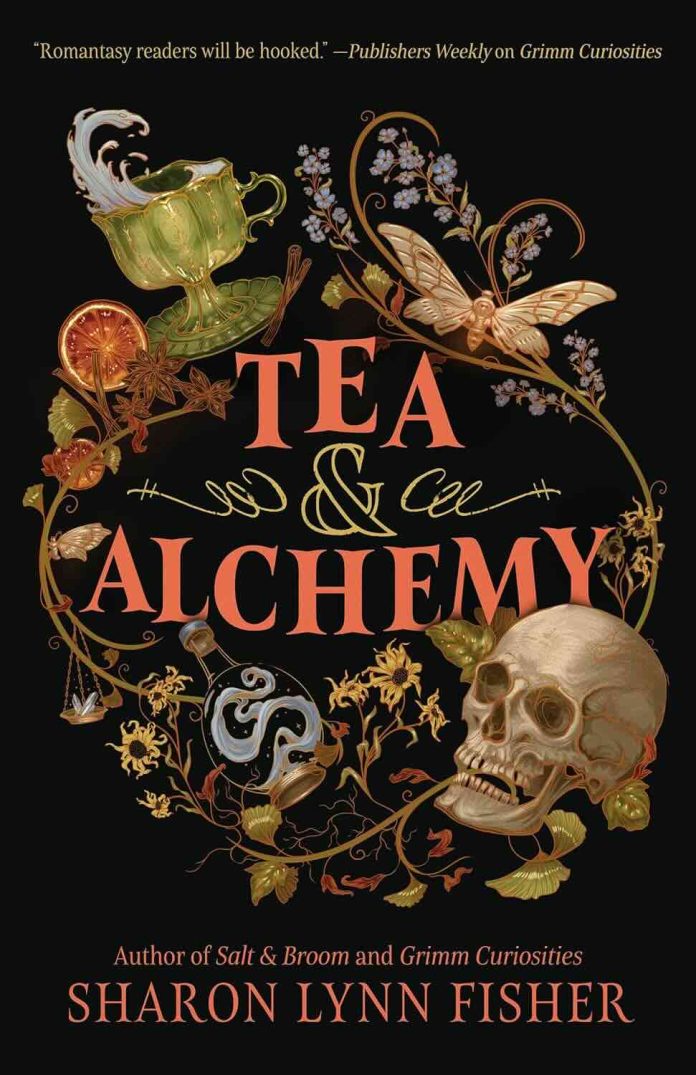
Sharon Lynn Fisher has carved out a distinctive niche in historical fantasy romance, and with Tea & Alchemy, she delivers perhaps her most atmospheric work yet. Set against the brooding moorlands of 1854 Cornwall, this novel weaves together murder mystery, supernatural intrigue, and achingly tender romance in a narrative that feels both freshly imaginative and steeped in gothic tradition.
A Heroine Who Sees Beyond the Veil
Mina Penrose serves as our window into this fog-draped world, and Fisher has crafted a protagonist who defies the passive maiden archetype so common in Victorian-set romances. Working at The Magpie tearoom in the village of Roche, Mina has recently discovered she’s inherited her late mother’s gift for tasseography—reading tea leaves. What begins as curious shapes in spent tea quickly becomes omens she cannot ignore, especially after a murdered solicitor is found on the heath.
Fisher develops Mina’s character with remarkable nuance. She’s neither helplessly naive nor unrealistically bold; instead, she exhibits a practical courage born from genuine loss and hardship. Her relationship with her troubled twin brother Jack adds emotional depth, grounding the fantastical elements in authentic family dynamics. When Mina sees wolves in the tea leaves and then encounters danger on the moor, her determination to uncover the truth stems not from recklessness but from a fierce protective instinct for those she loves.
The author’s portrayal of Mina’s evolving abilities feels organic rather than convenient. As Mina studies In the Leaves: A Primer on Tasseography by Mrs. Jane Rochester (a delightful callback to Fisher’s previous novel Salt & Broom), we witness her growth from uncertain beginner to confident interpreter of symbols. This progression mirrors her emotional journey from isolated grief to renewed hope.
The Alchemist in the Tower
Harker Tregarrick emerges as one of the more compelling vampire characters in recent romantasy fiction. Fisher’s decision to give him chapters told in first person creates an intimate portrait of centuries-old suffering. Unlike brooding immortals who revel in their darkness, Harker is a scientist desperately seeking a cure for his condition through alchemical experimentation. His laboratory, perched in the ruins of a medieval chapel atop Roche Rock, becomes both sanctuary and prison.
The author excels in depicting Harker’s internal struggle between his intellectual pursuits and his monstrous nature. His creation of a “vital essence” to suppress his bloodlust speaks to themes of self-control and the lengths one will go to maintain humanity. When he ventures into the village for the first time in decades, drawn by both necessity and a pull he cannot name, Fisher captures his vulnerability with poignant precision. His observations of the modern world through centuries-old eyes provide moments of both humor and melancholy.
What sets Harker apart from typical vampire love interests is his genuine moral wrestling. He doesn’t view his condition as making him special or powerful; he sees it as a curse that has cost him everything—family, freedom, and the simple pleasures of human connection. This perspective makes his attraction to Mina all the more dangerous and heartrending.
Cornwall as Character
Fisher’s rendering of mid-Victorian Cornwall deserves particular praise. The landscape becomes a character unto itself, from the haunting beauty of Goss Moor to the imposing white conical hills of quartz waste from the china clay operations. The author has clearly done her research, weaving historical details seamlessly into the narrative. References to the mining industry, parish churches, and rural life never feel like heavy-handed exposition but emerge naturally through Mina’s observations and experiences.
The real Roche Rock, which Fisher visited and felt compelled to immortalize in fiction, provides an evocative setting that grounds the supernatural elements. The black granite tower jutting from the moorland, wreathed in mist and mystery, becomes a perfect metaphor for Harker himself—ancient, imposing, yet somehow vulnerable. Fisher’s use of fog and atmospheric conditions to heighten tension shows sophisticated understanding of gothic conventions.
Where Magic Meets Science
One of the novel’s most intriguing aspects is Fisher’s treatment of the supernatural through multiple lenses. Mina’s tea leaf reading represents intuitive, feminine mysticism passed down through generations. Harker’s alchemy embodies rational, masculine pursuit of knowledge through experimentation. The revelation of an older, more primal magic woven through the landscape adds another layer entirely. Fisher doesn’t position these systems in opposition but shows how they can complement and illuminate one another.
The murder mystery that propels the plot forward is well-constructed, with genuine tension and misdirection. As bodies appear on the heath and suspicion falls on Harker, Fisher explores themes of prejudice, fear of the other, and how easily communities turn against outsiders. The constable’s investigation provides a grounding procedural element that balances the fantastical aspects.
Romance That Earns Its Intensity
The slow-burn romance between Mina and Harker crackles with both danger and tenderness. Fisher understands that true chemistry stems from more than physical attraction; it requires intellectual connection and mutual respect. Their conversations over cups of smoky Lapsang Souchong tea become intimate exchanges where two lonely souls recognize kindred spirits.
The obstacles to their union feel genuinely insurmountable rather than artificially imposed. How can Mina love a creature who craves her blood? How can Harker allow himself to care for someone so fragile and mortal? Fisher doesn’t rush past these questions but explores them with emotional honesty. The moments when Harker’s control wavers are terrifying precisely because we’ve come to care for both characters.
When they finally come together, the scenes pulse with hard-won passion. Fisher writes intimacy with a deft hand—sensual without being gratuitous, conveying both the physical and emotional dimensions of their connection.
Critical Considerations
While Tea & Alchemy excels in many areas, it’s not without minor stumbles. Some readers may find the pacing uneven, particularly in the middle section where investigation and revelation slow the momentum. A few plot points rely on convenient timing, and the resolution of certain threads feels slightly rushed given the careful buildup.
The dual perspective, while generally effective, occasionally creates jarring tonal shifts. Harker’s formal, introspective voice contrasts sharply with Mina’s more immediate, earthy narration. This stylistic choice serves the characters well but may challenge readers who prefer more consistency.
Additionally, while Fisher’s research into tea reading and alchemy enriches the narrative, there are moments when the exposition becomes slightly heavy-handed. Readers already immersed in the story might wish for less explanation and more action during these passages.
Verdict: A Gothic Romance with Substance
Tea & Alchemy succeeds in doing what the best historical fantasy romance should: it transports readers to a fully realized world while exploring timeless questions about love, identity, and redemption. Fisher has created a vampire novel that feels fresh despite working within well-established conventions, primarily because she focuses on character and atmosphere over shock value or melodrama.
Tea & Alchemy works beautifully as a standalone while rewarding those familiar with Fisher’s previous Cornwall-set romance, Salt & Broom. Her ability to blend historical detail, supernatural elements, and emotional depth marks her as a distinctive voice in the romantasy genre.
This is a book for readers who savor atmospheric world-building, complex characters wrestling with moral questions, and romance that feels earned rather than inevitable. It’s perfect for autumn nights with a cup of tea at hand, ready to lose yourself in the mists of Cornwall and the mysteries of the human heart.
For Readers Who Enjoyed
- Salt & Broom by Sharon Lynn Fisher – Fisher’s previous Victorian Cornwall novel featuring Jane Rochester
- The Kingdoms by Natasha Pulley – For atmospheric historical fantasy with romance
- Apprentice to the Villain by Hannah Nicole Maehrer – For cozy fantasy romance with darker elements
- A Dowry of Blood by S.T. Gibson – For reimagined vampire dynamics and gothic atmosphere
- The Invisible Library series by Genevieve Cogman – For Victorian-era settings with supernatural mysteries
- Sorcery of Thorns by Margaret Rogerson – For historical fantasy with slow-burn romance
- Emily Wilde’s Encyclopaedia of Faeries by Heather Fawcett – For scholarly protagonists and atmospheric folklore