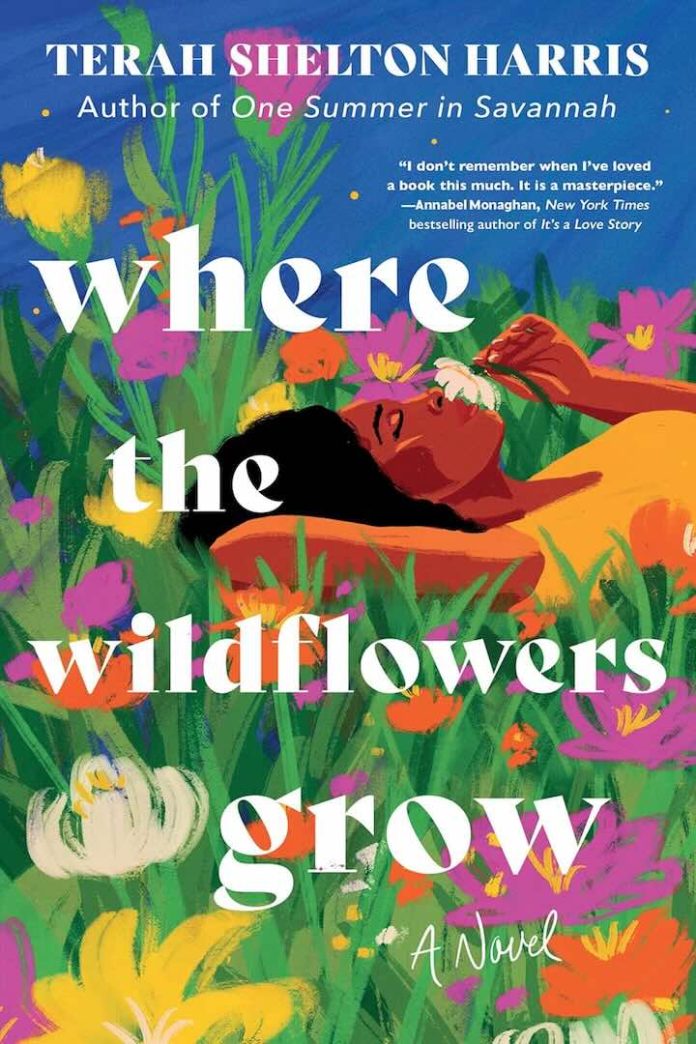
Terah Shelton Harris returns with her third novel, proving once again why she’s become one of contemporary fiction’s most compelling voices exploring the intersections of trauma, redemption, and the resilience of the human spirit. Where the Wildflowers Grow by Terah Shelton Harris opens with a premise that immediately captures attention: Leigh Wilde, the sole survivor of yet another catastrophe, stumbles upon a flower farm in rural Alabama while fleeing from her past. What follows is an intimate exploration of what it truly means to transition from merely surviving to genuinely living.
The novel’s strength lies in Harris’s unflinching examination of survivor’s guilt and complex grief. Leigh isn’t just running from the law; she’s running from the weight of being the last Wilde standing, haunted by family members whose deaths she witnessed and whose absences shape every breath she takes. Harris approaches this heavy material with remarkable sensitivity, never exploiting trauma for shock value but instead treating it with the care it deserves. The author’s note explicitly acknowledges the difficult content—childhood abuse, loss, and sexual trauma—signaling Harris’s commitment to honoring real experiences while crafting compelling fiction.
Cultivating Character in Unlikely Soil
Leigh emerges as a protagonist whose very existence feels like an act of defiance. Harris has created a character study in contradictions: someone desperate to disappear yet unable to stop blooming wherever she’s planted. The narrative voice is raw and contemplative, with Leigh’s first-person perspective allowing readers intimate access to her internal landscape. Her observations about flowers, nature, and the rhythms of farm life become metaphors for her own gradual unfurling.
Jackson Shepherd, the farm’s owner, serves as both love interest and catalyst for Leigh’s transformation. His character represents patience personified—a man who understands that growth can’t be rushed, whether you’re cultivating dahlias or coaxing someone back to life. The romance develops with deliberate slowness, mirroring the agricultural cycles that structure the novel. Their relationship unfolds across seasons, each bringing its own challenges and revelations.
The supporting cast enriches the narrative considerably:
- Luke, the young farmhand with dreams bigger than the fields he tends, brings youthful optimism to balance Leigh’s wariness
- Tibb, whose presence provides grounding and wisdom without becoming a stereotype
- The landowners and community members who form the backdrop of Jackson’s ambitious vision for revitalizing Wilcox County
These characters create the found family that becomes central to Leigh’s healing, demonstrating Harris’s skill in crafting ensemble dynamics that feel authentic rather than convenient.
The Architecture of Redemption
Where the Wildflowers Grow by Terah Shelton Harris employs a seasonal structure—Fall, Winter, Spring—that functions as more than mere organization. This framework mirrors both agricultural cycles and the stages of grief, creating natural progression without forcing artificial plot beats. The pacing occasionally suffers from this approach, particularly in the middle section where the repetitive nature of farm work translates to repetitive narrative rhythm. Readers seeking constant forward momentum may find themselves restless during passages focused on daily routines of cutting, clearing, and planting.
However, this deliberate pacing also allows Harris to explore the uncomfortable truth that healing isn’t linear or dramatic. It happens in small moments: Leigh learning to accept kindness, her gradual willingness to let others see her vulnerability, the way she begins to notice beauty without immediately searching for its expiration date. These quiet transformations prove more moving than any dramatic confrontation could achieve.
Language Blooming on the Page
Harris’s prose style deserves particular attention. She employs lyrical language without tipping into purple prose, creating sentences that feel both carefully crafted and naturally flowing. Nature imagery permeates every chapter, but rather than feeling overwrought, these descriptions ground the story in sensory reality:
“The afternoon sun shone on endless fields that burst forth in a variety of colors, ranging from the palest pastels to the deepest jewel tones. Each row was meticulously arranged, each flower standing tall and proud, each petal catching the light.”
This attention to visual detail creates vivid mental imagery that makes the Gee’s Bend setting feel tangible. Harris clearly conducted thorough research, and it shows in how authentically she captures both the beauty and challenges of this real Alabama community.
Where the Thorns Show
Despite its considerable strengths, Where the Wildflowers Grow by Terah Shelton Harris doesn’t entirely avoid certain narrative pitfalls. The central tension—Leigh’s inevitable discovery and the consequences she must face—hangs over the story in ways that occasionally feel manufactured. While readers understand consequences must come, the timing and nature of the revelation feels somewhat convenient rather than organic.
Additionally, some secondary plot threads, particularly concerning the townspeople’s resistance to Jackson’s cooperative plans, receive insufficient development. These community conflicts promise social commentary about rural economics, generational trauma, and land rights, but Harris doesn’t always fully explore these themes. They exist more as backdrop than fully integrated plot elements, leaving readers wanting deeper engagement with these important issues.
The romance, while tenderly rendered, may strike some readers as happening too quickly given Leigh’s profound psychological wounds. Her opening to Jackson feels both believable and slightly rushed, as if the novel’s structure demands their connection deepen faster than psychological realism might allow. That said, Harris handles their physical and emotional intimacy with care, never using romance as a magical cure for trauma.
The Harvest of Hope
What elevates this novel beyond a simple redemption narrative is Harris’s refusal to offer easy answers. Leigh’s journey doesn’t culminate in perfect healing or consequence-free happiness. Instead, Where the Wildflowers Grow by Terah Shelton Harris acknowledges that some scars remain, some debts must be paid, and some losses can’t be recovered. This bittersweet realism—Harris’s signature—prevents the story from feeling like a fairy tale while still offering genuine hope.
The epilogue provides satisfying closure for readers invested in these characters’ futures, though some may wish for more definitive answers about certain relationships. Harris trusts her readers to imagine possibilities rather than spelling out every detail, a choice that feels appropriate for a story about accepting uncertainty.
For Readers Who Loved
If Where the Wildflowers Grow by Terah Shelton Harris resonates with you, consider these similar titles:
- One Summer in Savannah by Terah Shelton Harris – The author’s debut explores family secrets and second chances with similar emotional depth
- Long After We Are Gone by Terah Shelton Harris – Harris’s sophomore novel examines land, legacy, and sibling bonds in rural Alabama
- The Book of Lost Friends by Lisa Wingate – Historical fiction exploring resilience, found family, and healing in the American South
- Where the Crawdads Sing by Delia Owens – Though more mystery-focused, it shares themes of isolation, nature as sanctuary, and complex female protagonists
- The Vanishing Half by Brit Bennett – Explores identity, family trauma, and what we inherit from those who came before
- Migrations by Charlotte McConaghy – Features a protagonist running from her past while finding unexpected connection to place and people
Final Thoughts: Beauty from Broken Ground
Harris has crafted a novel that asks difficult questions about redemption, justice, and whether someone can ever truly escape their past. The answer she provides isn’t comfortable, but it’s honest. Where the Wildflowers Grow by Terah Shelton Harris succeeds as both a love story and a meditation on grief’s many forms, though it occasionally struggles under the weight of its own ambitions.
For readers willing to accept deliberate pacing and sit with uncomfortable emotions, this novel offers substantial rewards. Harris’s commitment to emotional authenticity, combined with her lyrical prose and well-researched setting, creates a reading experience that lingers long after the final page. Like the wildflowers of its title, this story insists on blooming even in the darkest places—and invites readers to believe that perhaps they can too.







