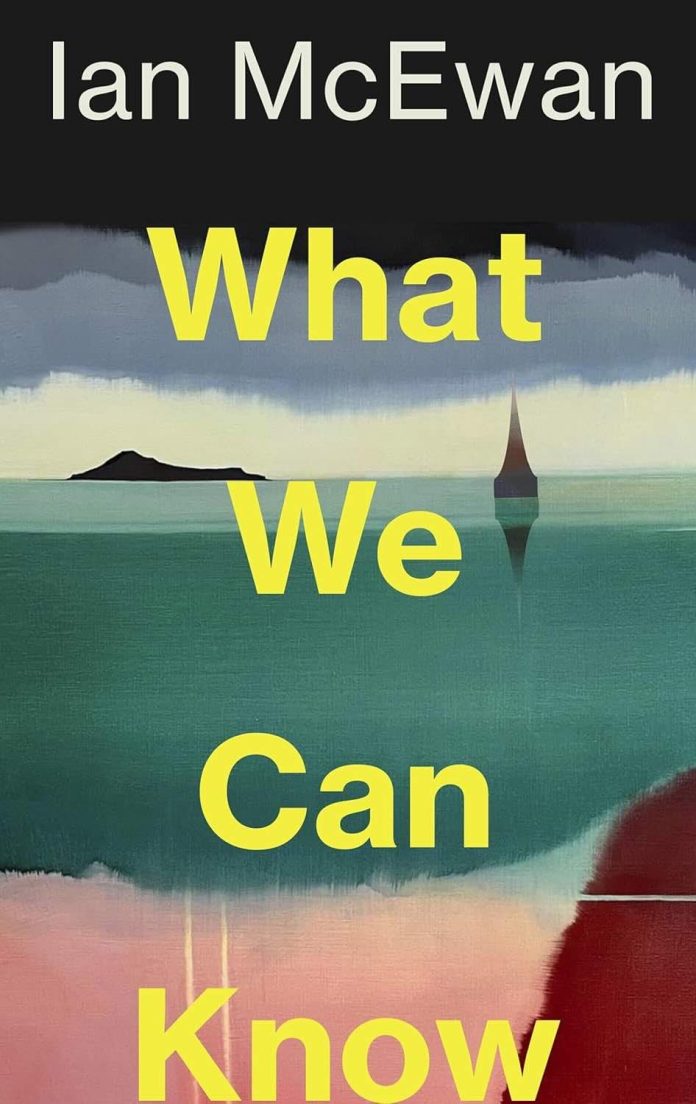
Ian McEwan’s latest novel arrives like a message in a bottle, washing up from a future we hope never to see. Set primarily in 2119, when rising seas have transformed Britain into a scattered archipelago, What We Can Know is both a profound meditation on literary obsession and a sobering vision of climate catastrophe. Yet this is no conventional dystopian tale—it’s something far more sophisticated: a meta-literary exploration of how we construct meaning from fragments, how we love what we cannot possess, and how the imagined can become more powerful than the real.
The novel centers on Tom Metcalfe, an academic at the University of the South Downs, one of Britain’s remaining island institutions. Tom has devoted his career to studying a lost poem called “A Corona for Vivien”—fifteen sonnets supposedly recited at a dinner party in 2014 but never written down. This obsession with the non-existent has consumed him, strained his relationship with his colleague and lover Rose Church, and led him on a quixotic quest that forms the heart of McEwan’s narrative.
The Architecture of Obsession
McEwan structures What We Can Know like Russian dolls, with stories nested within stories. We follow Tom’s contemporary search while simultaneously witnessing the 2014 dinner party where poet Francis Blundy first recited his corona to a small gathering including his lover Vivien. Through Tom’s research, we uncover the complex relationship between Francis and Vivien, the tragic decline of her husband Percy (a violin maker succumbing to dementia), and the various guests whose lives were touched by that singular evening.
The author demonstrates his characteristic precision in depicting academic life. Tom’s world feels authentically claustrophobic—the endless faculty meetings, the apathetic students, the petty rivalries dressed up as intellectual discourse. When Tom discovers a possible clue to the poem’s location buried on a submerged island, his determination transforms from scholarly interest to something approaching religious fervor.
McEwan’s prose captures the particular anguish of the researcher who knows too much and too little simultaneously. Tom becomes intimate with people he’s never met, constructing elaborate psychological profiles from email fragments and diary entries. The novel asks uncomfortable questions about the voyeuristic nature of biography and literary scholarship—are we honoring the dead or exploiting them?
Climate Fiction with Literary DNA
What elevates What We Can Know above standard climate fiction is McEwan’s refusal to sensationalize the environmental catastrophe. By 2119, the floods and wars are historical fact, processed through the academic lens of survivors trying to understand how their ancestors destroyed the world. The most affecting passages come not from descriptions of rising seas but from Tom’s melancholy cataloguing of what’s been lost: the fifty-seven species of butterflies reduced to eight, the vanished abundance of fish, the simple impossibility of a hundred thousand people gathering for a football match.
McEwan subtly weaves environmental themes throughout Francis and Vivien’s 2014 storyline. Vivien’s journals record unseasonably warm winters, polluted streams, and missing hedgehogs with the detached observation of someone witnessing change but not yet understanding its significance. Francis, meanwhile, emerges as a climate change denier, delivering a dinner party monologue about the benefits of global warming that reads as tragically prescient given the novel’s future setting.
The Corona as Literary MacGuffin
The lost poem functions brilliantly as what Hitchcock would call a MacGuffin—the object everyone wants but whose actual content matters less than its symbolic power. McEwan understands that the absent poem has achieved a kind of immortality precisely because it remains unknown. Like Plato’s forms, it represents the ideal of all poetry, unmarred by the disappointment of actual words on a page.
This creates fascinating tensions throughout the narrative. Tom’s obsession is simultaneously noble and absurd—he’s devoted his life to recovering a work of art while living in a world where most art has been lost forever. The irony isn’t lost on McEwan, who uses Tom’s quest to explore larger questions about what survives and what deserves to survive.
Character Studies in Grief and Yearning
Character Development and Emotional Resonance:
- Tom Metcalfe emerges as a compelling protagonist whose obsessions feel both pathetic and deeply human
- Rose Church provides necessary counterpoint, representing pragmatic acceptance versus romantic longing
- The historical characters (Francis, Vivien, Percy) achieve remarkable depth despite being filtered through Tom’s research
- Kevin Howard, the graduate student who briefly threatens Tom’s relationship with Rose, embodies the dangerous naivety of youth
McEwan excels at depicting the varieties of love and loss that bind his characters in What We Can Know. Tom’s love for the imaginary Vivien parallels Percy’s deteriorating relationship with the real one. Francis’s love for his own poem mirrors Tom’s obsession with finding it. The author traces how desire—whether for a person, a work of art, or a vanished world—can both sustain and destroy us.
The relationship between Tom and Rose provides the novel’s emotional anchor. Their academic partnership-turned-romance feels authentic in its mixture of intellectual respect and personal friction. When Rose’s brief affair with a graduate student threatens their bond, McEwan explores how even the most rational people can be driven to irrationality by jealousy and wounded pride.
Literary Craftsmanship and Style
McEwan’s prose maintains its characteristic elegance while adapting to serve the novel’s dual timeline structure. The 2119 sections adopt a slightly more formal, archival tone that suggests the distance of historical perspective, while the 2014 scenes pulse with immediate psychological insight. The author seamlessly moves between academic analysis and emotional intimacy, creating a hybrid form that feels both intellectually rigorous and deeply felt.
The novel’s treatment of poetry and literary criticism displays McEwan’s deep understanding of how literature functions in culture. His descriptions of Tom parsing email fragments and diary entries for psychological insights ring true to anyone who’s attempted biographical research. Similarly, his depiction of the academic world—with its combination of genuine intellectual passion and petty professional jealousies—feels authoritative without becoming satirical.
Strengths and Minor Reservations
What Works Magnificently:
- The ingenious conceit of the lost poem as organizing principle
- Rich character development achieved through fragmented historical evidence
- Seamless integration of climate themes without preaching
- Sophisticated exploration of how we construct meaning from incomplete information
- The haunting final revelation that recontextualizes everything we’ve read
Minor Concerns:
- The novel’s academic setting may limit its appeal to general readers
- Some readers might find the lack of traditional plot resolution frustrating
- The future world-building, while effective, occasionally feels underdeveloped compared to the historical sections
The pacing occasionally lags during Tom’s more intensive research sequences, though these serve the larger purpose of demonstrating the tedious obsessiveness required for such scholarly quests. McEwan trusts his readers to appreciate the intellectual pleasures of detection and analysis, even when they don’t advance the plot in conventional ways.
A Master’s Return to Form
What We Can Know represents McEwan at his most philosophically ambitious since Atonement. Like that earlier masterpiece, it’s fundamentally concerned with the relationship between reality and fiction, between what happened and what we choose to remember. The novel asks whether Tom’s years spent reconstructing the lives of people he’s never met constitute a form of love or a sophisticated form of stalking.
The book also serves as McEwan’s most direct engagement with environmental themes since Solar, though handled with far more gravity and sophistication. Rather than satirizing climate change denial, he lets the tragic consequences speak for themselves. The flooded world of 2119 serves as both setting and silent character, a constant reminder of what happens when we refuse to act on uncomfortable truths.
Similar Literary Companions
Readers who appreciate What We Can Know should seek out:
- The Sense of an Ending by Julian Barnes – for its exploration of unreliable memory and the stories we tell ourselves
- Possession by A.S. Byatt – for its parallel structure and academic detective work
- The Handmaid’s Tale by Margaret Atwood – for speculative fiction grounded in recognizable social and environmental concerns
- Saturday by McEwan himself – for similar psychological realism and moral complexity
- Station Eleven by Emily St. John Mandel – for post-apocalyptic fiction that emphasizes cultural continuity over disaster porn
Final Verdict
What We Can Know succeeds as both literary fiction and speculative warning. McEwan has crafted a novel that works on multiple levels—as a love story, an academic satire, a climate change parable, and a meditation on the nature of artistic immortality. The book’s greatest strength lies in its recognition that the stories we tell about the past inevitably reveal more about our present desires and fears than about historical truth.
In our current moment of environmental crisis and cultural polarization, McEwan offers no easy answers or false comfort. Instead, he provides something more valuable: a clear-eyed examination of how we construct meaning in the face of loss, and how the human capacity for love—whether for people, art, or the natural world—persists even when its objects have vanished beyond recovery.
What We Can Know is essential reading for anyone interested in how literature might help us navigate an uncertain future while honoring what we’ve already lost. McEwan has given us a masterpiece of literary speculation, one that haunts long after its final page.







