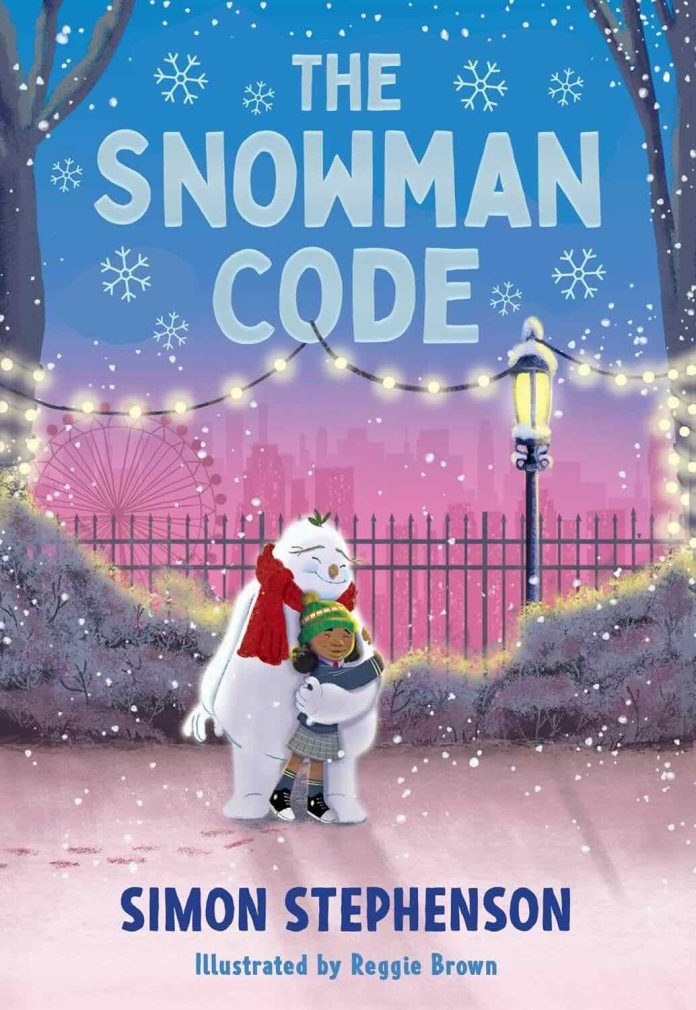
Snow falls, soft and slow, A girl speaks six times—he wakes, Friendship melts the cold.
There are stories that arrive precisely when you need them, like the first warm breeze after an endless winter. The Snowman Code by Simon Stephenson is such a story—one that understands the particular loneliness of being ten-and-a-half, the weight of worrying about a parent, and the miraculous possibility that magic might be hiding in plain sight, waiting for someone brave enough to speak to it six times.
A Tale of Frost and Friendship
Simon Stephenson, the acclaimed screenwriter behind Pixar’s Luca and Paddington 2, makes his children’s fiction debut with a novel that feels both wonderfully old-fashioned and startlingly fresh. Set in London during an impossibly long winter—the longest in three hundred years—the story introduces us to Blessing, a resourceful girl who has stopped attending school to avoid three particularly unpleasant bullies. Her mother Margaret suffers from seasonal depression so severe that Blessing fears being sent away again if she adds to her mother’s worries.
Everything changes when Blessing encounters Albert Framlington, a crooked, thoroughly unimpressive snowman with bottle-cap eyes, a small potato for a nose, and a personality that could only be described as magnificently wrong about nearly everything. Albert is six hundred and twenty-seven winters old, bound by something called the Snowman Code, and absolutely certain that Sherlock Holmes was a famous zookeeper.
The genius of The Snowman Code by Simon Stephenson lies in its ability to balance absurdist humor with genuine emotional depth. Albert’s confident incorrectness about basic facts—he believes Africa is famous for its snow, that encyclopedias are dictionaries about animals, and that being born in summer is a terrible insult among snowmen—provides endless comedy. Yet beneath his cheerful confusion beats a heart carrying six centuries of longing for a lost love named Clementine.
The Architecture of Wonder
What Makes This Story Shine
Stephenson constructs his narrative with the precision of a screenwriter who understands that every scene must earn its place. The story moves through distinct emotional registers:
- The opening chapters establish Blessing’s isolation with matter-of-fact clarity that makes her situation feel achingly real
- The middle sections build the friendship between girl and snowman through a series of misadventures that are genuinely funny
- The final act delivers emotional weight without descending into sentimentality
The world-building follows its own delightfully specific logic. Snowmen are nocturnal marsupials (they are not, but try telling Albert that). They gather at the Flower Market in the middle of the night because winter creatures rarely see blooms. They release steam from where their ears should be when thinking particularly hard. These details feel discovered rather than invented, as though Stephenson simply recorded what snowmen told him.
The Snowman Code Itself
The titular code provides both structure and philosophy. Its articles govern snowman behavior—they must ignore humans five times before responding on the sixth, they must help children in need, they cannot travel without disguises unless it is very late and very important. This framework gives Albert’s choices meaning and creates genuine stakes when he struggles between following rules and following his heart.
Characters Carved from Snow and Sunlight
Blessing emerges as a protagonist worth rooting for—clever without being precocious, brave without being foolhardy. She forges her mother’s handwriting to explain her Australian emigration to teachers. She reverses psychology on bullies. She refuses to burden her struggling mother with her own problems. Her voice feels authentically ten-and-a-half: old enough to understand complex emotions, young enough to believe a snowman might come alive if you ask the right questions.
Albert Framlington could easily have become tiresome—the bumbling magical creature is a familiar archetype. Instead, he feels like someone you might actually enjoy spending an endless winter with. His wrongness about facts never feels mean-spirited or stupid; it reads as the natural result of being ancient and only experiencing winter. His love for Clementine, stretching across six hundred winters and countless countries, provides the story’s emotional spine.
The supporting cast—Jeremiah with his fake pipe, the Three Boring Triplets who function as a single unit of menace, Margaret whose sadness feels specific rather than generic—populate the world without cluttering it.
Where the Snow Falls Short
Perfect things melt fast, Even stories carry flaws, Beauty needs its cracks.
The Snowman Code by Simon Stephenson occasionally stumbles in its pacing. The middle section, where Blessing and Albert search London’s parks and gardens for Clementine, stretches longer than necessary. We understand they are searching; we do not need quite so many days of fruitless exploration catalogued. The revelation that Albert knew Clementine’s location all along creates emotional impact, but the journey there could have been tightened.
Some readers may find Albert’s constant factual errors more exhausting than endearing after two hundred pages. The joke runs the same direction each time—Albert states something confidently wrong, Blessing corrects him, Albert insists he is right. While individual instances charm, the cumulative effect occasionally tips toward repetitive.
The story also assumes its readers will accept certain logical leaps without question. How exactly do snowmen travel between continents when they melt? The explanation—they simply wake up in new snowman bodies elsewhere—feels somewhat hand-wavy. For a story that otherwise builds its rules carefully, this central mechanism could have used more development.
Literary Lineage and Recommendations
The Snowman Code by Simon Stephenson positions itself alongside several beloved winter tales, and the comparison is earned. Readers who treasure these stories will find much to love:
- The Christmasaurus by Tom Fletcher—another tale of magical friendship during winter
- A Boy Called Christmas by Matt Haig—shares the blend of humor, heart, and seasonal magic
- The Snowman by Raymond Briggs—the silent classic that established snowman-child friendships in popular imagination
- Paddington by Michael Bond—Stephenson’s screenwriting background shows in similar fish-out-of-water comedy
- The Girl Who Saved Christmas by Matt Haig—matches the emotional stakes around believing in magic
Final Reflections
Pages turn to spring, What seemed solid becomes stream, Love outlasts the thaw.
This novel understands something essential: the best children’s stories do not protect young readers from sadness but rather provide them with tools for navigating it. Albert and Clementine’s fate—their willing embrace of what comes next—teaches something profound about love, loss, and the way water connects everything.
The Snowman Code by Simon Stephenson delivers a reading experience that families will want to return to on cold evenings when the wind howls and the radiator ticks and somewhere outside, perhaps, a snowman waits for someone to speak to him six times. It is not perfect—its middle sags, its jokes occasionally repeat, its mythology leaves questions unanswered. But perfection is perhaps beside the point. What matters is that it makes you feel something true about friendship and endings and the peculiar courage required to love anything that might melt.
A Note on This Review
In the spirit of the Snowman Code—which demands honesty, even when honesty is uncomfortable—I must share something. A publisher sent this book my way, asking only for truthful thoughts in exchange. No ice-promise required. No ceremonial meeting at the Flower Market at midnight. Just a reader, a story, and the understanding that some tales deserve to find their audience, flaws and magic alike.
If you find yourself in an endless winter of your own, this book might be exactly what the snow ordered.







