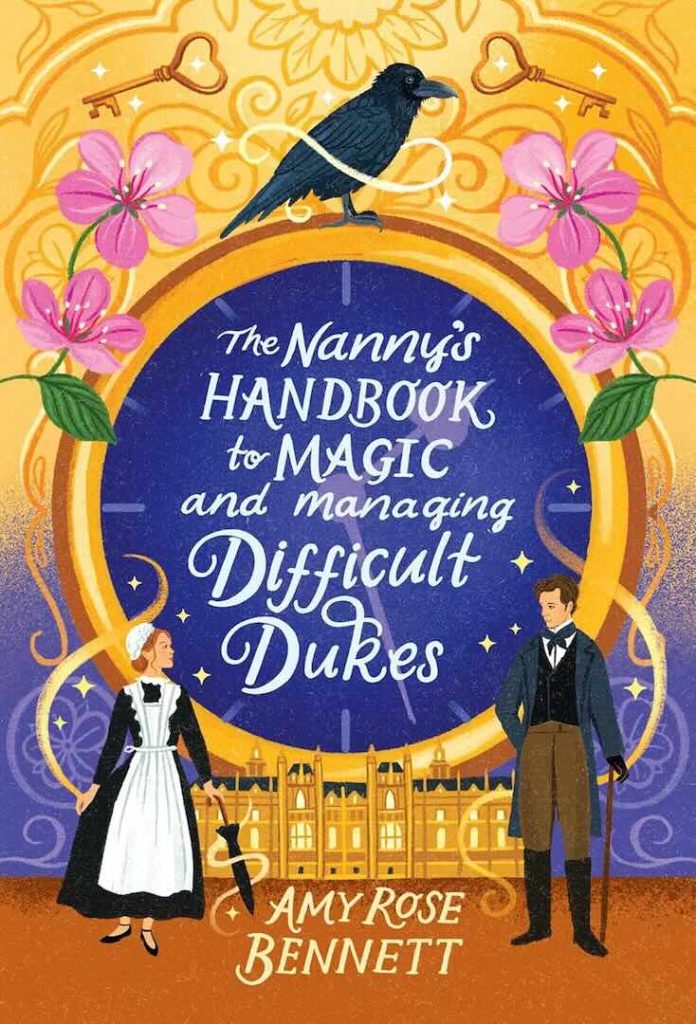
Amy Rose Bennett’s debut into romantic fantasy, The Nanny’s Handbook to Magic and Managing Difficult Dukes, is precisely the literary confection readers need—a delightful blend of Mary Poppins’ whimsy and Bridgerton’s romantic tension, wrapped in Victorian charm and sprinkled with genuine magic. This inaugural volume of the Parasol Academy series establishes Bennett as a formidable voice in the growing romantasy genre, crafting a world where practical magic meets historical romance with remarkable finesse.
A Heroine Worth Her Weight in Magical Dust
Emmeline Chase, our twenty-five-year-old widow and newly graduated Parasol Academy nanny, immediately captivates with her perfect balance of propriety and rebellion. Bennett has created a protagonist who embodies the era’s expectations while subverting them—Emmeline may teleport via wardrobe and conjure items from her magical pockets, but she’s also driven by very human concerns: supporting her incarcerated father and proving her worth in a profession that demands both supernatural skill and unshakeable discretion.
The author’s characterization shines particularly in how Emmeline’s magical mishaps mirror her emotional journey. Her botched teleportation onto Duke Xavier’s rooftop—which kickstarts the entire narrative—serves as both comedic relief and metaphor for how love often arrives when we least expect it, leaving us breathless and slightly discombobulated.
An Autistic Hero Handled with Remarkable Sensitivity
Xavier Mason, the Duke of St. Lawrence, represents something rare in historical romance: a neurodivergent hero portrayed with authentic compassion rather than stereotypical tragedy. Bennett, drawing from her professional background as a speech pathologist and personal experiences with neurodivergent family members, crafts a character who is brilliant, kind, and worthy of love exactly as he is.
Xavier’s passion for horology and his quest to design the Westminster Palace clock provides both plot momentum and character depth. His struggles with social interaction and sensory sensitivities are presented not as flaws to overcome but as integral parts of his identity. The romance succeeds because Emmeline sees Xavier’s true worth from their first encounter, appreciating his precision, dedication, and gentle nature rather than trying to “fix” him.
The secondary character of young Harriet, also on the autism spectrum, adds another layer of representation that feels organic rather than performative. Bennett avoids the trap of making neurodivergence either a superpower or a burden, instead presenting it as one facet of richly developed characters.
A Magical System with Victorian Sensibilities
The Parasol Academy’s magical framework is Bennett’s greatest worldbuilding triumph. The concept of Fae-trained nannies with access to teleportation, befuddling potions, and decalamitifying dust feels both whimsical and practical. These aren’t earth-shaking magics but rather the everyday tools of capable women dedicated to protecting children—perfectly suited to the domestic sphere that Victorian society assigned to women while secretly empowering them.
Bennett establishes clear rules and consequences for magic use, particularly the Academy’s strict prohibition against revealing magical abilities to employers. This creates genuine tension when Emmeline must choose between following regulations and saving lives, ultimately leading to satisfying character growth and the revelation of the Academy’s “True Love Clause”—a delightful twist that rewards authentic emotion over rigid adherence to rules.
Supporting Characters That Sparkle
The three Mason children—Harriet, Bartholomew, and Gareth—avoid the pitfall of being mere plot devices or saccharine obstacles. Each child has distinct personality and legitimate trauma from losing their parents, yet they feel like real children rather than miniature adults. Their gradual acceptance of Emmeline and eventual plea to call her “Mama” provides some of the novel’s most emotionally resonant moments.
Horatio, Xavier’s talking raven companion, could have been a gimmicky addition but instead serves as both comic relief and emotional bridge between the reserved duke and his household. The raven’s cheeky observations and protective instincts toward his master add warmth without overwhelming the human relationships.
Romance That Balances Heat and Heart
Bennett crafts a slow-burn romance that respects both characters’ backgrounds and personalities. The attraction between Emmeline and Xavier builds naturally through shared conversations about horology, mutual concern for the children, and quiet moments of understanding. Their relationship develops through meaningful interactions rather than superficial encounters, making their eventual declaration of love feel earned rather than inevitable.
The author handles the physical aspects of their relationship with tasteful sensuality appropriate to the genre and time period. More importantly, she demonstrates how true intimacy grows from accepting and celebrating each other’s differences rather than despite them.
Plot Mechanics and Pacing
The central mystery involving Xavier’s clock competition and the attempts to sabotage his work provides steady momentum throughout the narrative. Sir Randolph Redvers and Algernon Mason emerge as compelling antagonists with believable motivations—jealousy, greed, and social ambition—rather than mustache-twirling villainy.
Bennett weaves together multiple plot threads—the romance, the clock competition, the children’s integration into Xavier’s household, and the sabotage attempts—with considerable skill. The pacing occasionally slows during the middle sections as domestic life settles into routine, but the author compensates with character development and romantic tension.
The climactic sequence, featuring fire, kidnapping, and magical intervention, feels appropriately dramatic without becoming overwrought. Emmeline’s decision to use magic openly demonstrates her growth from rule-following graduate to confident woman willing to fight for her family.
Areas for Improvement
While The Nanny’s Handbook to Magic and Managing Difficult Dukes succeeds admirably in most respects, certain elements could benefit from refinement. The worldbuilding, though charming, occasionally feels shallow—readers hungry for deeper exploration of the Fae realm or the Academy’s history may find themselves wanting more substantial foundation for future installments.
Some secondary plot threads, particularly Emmeline’s financial concerns about her father’s debts, resolve perhaps too neatly. The transformation of the three children from “rumbustious ruffians” to well-behaved angels happens quickly enough to strain credibility, even accounting for Emmeline’s magical abilities and genuine care.
The villain’s motivations, while understandable, trend toward the predictable. Sir Randolph’s jealousy and Algernon’s greed provide adequate conflict but lack the complexity that would elevate them beyond stock antagonists.
Writing Style and Technical Merit
Bennett demonstrates considerable skill in capturing Victorian voice and sensibilities without falling into overly formal or stilted prose. Her dialogue feels natural while maintaining period authenticity, and she has a particular gift for witty banter between Emmeline and various characters, especially the irrepressible Horatio.
The author’s background in speech pathology becomes apparent in her nuanced handling of communication—both in Xavier’s careful, precise speech patterns and in the children’s distinct voices. She avoids the common historical romance trap of modern characters in period dress, instead creating people who genuinely feel products of their time while remaining accessible to contemporary readers.
Thematic Depth
Beneath its frothy exterior, The Nanny’s Handbook to Magic and Managing Difficult Dukes explores themes of acceptance, family formation, and the courage required to be authentically oneself. Emmeline’s journey from rigid rule-follower to woman who chooses love over convention mirrors Xavier’s growth from isolated duke to engaged family man. Both characters learn that true worth lies not in meeting society’s expectations but in embracing their authentic selves and those they love.
The novel’s treatment of found family resonates particularly strongly, as both Emmeline and Xavier create the supportive relationships they’ve always needed through their union and commitment to the children. Bennett suggests that the most powerful magic isn’t supernatural at all—it’s the transformative power of unconditional love and acceptance.
Comparative Context and Genre Positioning
Within the growing romantasy genre, Bennett’s work stands out for its gentle approach to both magic and romance. Unlike the high-stakes fantasies dominating current trends, The Nanny’s Handbook to Magic and Managing Difficult Dukes offers readers a cozier alternative that prioritizes character development and emotional satisfaction over epic battles or world-ending threats.
Readers of Heather Fawcett’s academic fantasies or Olivia Atwater’s Regency fairy tales will find familiar pleasures here, while those who enjoy Julia Quinn’s historical romances will appreciate Bennett’s skill with period detail and romantic development. The novel occupies a sweet spot between pure historical romance and full fantasy, making it accessible to readers from both camps.
Series Potential and Future Prospects
As the opening installment of the Parasol Academy series, The Nanny’s Handbook to Magic and Managing Difficult Dukes, establishes a rich foundation for future stories. The Academy setting provides endless possibilities for new heroines and magical mishaps, while the broader world of Fae politics and Victorian society offers room for expansion and deepening complexity.
Bennett wisely concludes this volume with satisfying resolution while leaving tantalizing hints about future adventures. Readers will undoubtedly want to return to this world to discover what other Parasol Academy graduates might encounter in their own romantic adventures.
Similar Reads for Enchanted Romance Lovers
Readers who fall under the spell of Bennett’s magical nannies should seek out:
- The Ten Thousand Doors of January by Alix E. Harrow – for atmospheric portal fantasy with romantic elements
- The Invisible Life of Addie LaRue by V.E. Schwab – for magical realism and epic romance
- The Regency Faerie Tales series by Olivia Atwater – for similar cozy fantasy with historical settings
- The Thursday Murder Club series by Richard Osman – for ensemble cast mysteries with heart
- The House in the Cerulean Sea by TJ Klune – for found family themes and magical caregivers
- Sorcery and Cecelia by Patricia Wrede and Caroline Stevermer – for Regency magic and wit
- The Parasol Protectorate series by Gail Carriger – for steampunk Victorian fantasy with romance
Final Verdict
The Nanny’s Handbook to Magic and Managing Difficult Dukes succeeds brilliantly at what it attempts: creating a warm, witty, magical escape that celebrates love, family, and the courage to be oneself. Amy Rose Bennett has crafted a delightful debut in romantic fantasy that respects both its genre conventions and its readers’ intelligence.
While the novel may not revolutionize the romantasy genre, it doesn’t need to—sometimes the greatest magic lies in perfect execution of beloved tropes with fresh perspective and genuine heart. Bennett has created a world readers will eagerly return to, populated with characters who feel like cherished friends by story’s end.
This enchanting tale proves that the most powerful spells are often the simplest ones: love, acceptance, and the belief that everyone deserves their own happily ever after. For readers seeking romance with a touch of whimsy and characters who stay with you long after the final page, The Nanny’s Handbook to Magic and Managing Difficult Dukes delivers exactly what its title promises—pure magic.







