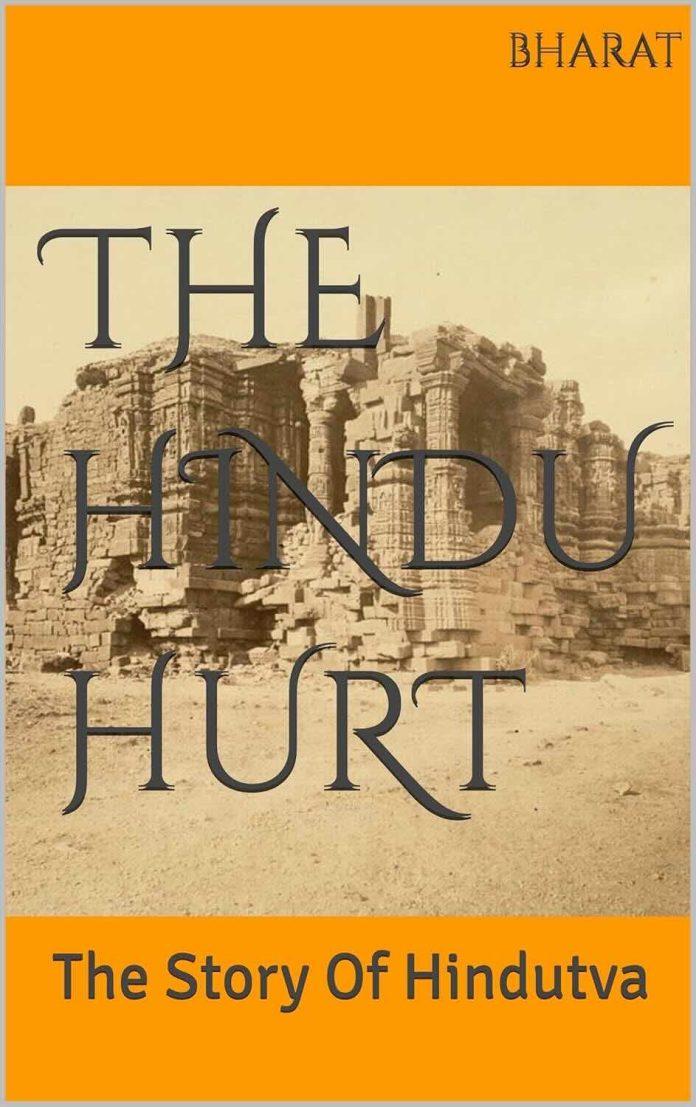
In an era where political ideologies are often reduced to soundbites and social media debates, Bharat’s The Hindu Hurt: The Story of Hindutva arrives as a substantial work that refuses to shy away from complexity. Published in 2025, this ambitious volume spanning 22 chapters and over 150 references presents itself as both a historical excavation and an ideological defense. The book attempts something rarely seen in contemporary Indian political discourse—a systematic tracing of Hindu Nationalism from its medieval origins through to its present-day manifestations and controversies.
What makes this work particularly noteworthy is its refusal to engage in mere polemics without documentation. The author, writing under the pen name Bharat, structures the narrative across three distinct sections, each building upon the other to construct a comprehensive understanding of what the book terms the “Hindu Hurt” and its transformation into the political ideology of Hindutva.
Historical Documentation as Foundation
The opening section of the book establishes its historical foundation with considerable scholarly apparatus. Bharat draws extensively from primary sources, including medieval Muslim chroniclers such as the authors of Tarikh Yamini, Taju-l Ma-Asir, and Malfuzat-i-Timuri. This methodological choice proves significant—by relying on accounts from the invaders themselves rather than solely on Hindu sources, the author attempts to establish credibility that transcends accusations of partisan interpretation.
The book opens with Will Durant’s oft-quoted assessment that the Mohammedan conquest of India represents “probably the bloodiest story in history.” From this provocative beginning, Bharat methodically documents what he identifies as the five pillars of the Hindu Hurt:
- Mass killings spanning centuries from Mahmud of Ghazni through the Mughal period
- Systematic temple destruction across the subcontinent
- Imposition of the discriminatory jizya tax
- Large-scale forced religious conversions
- The establishment of slave trade networks
The chapter on the Kashmiri Pandits brings the historical narrative into the contemporary period, connecting medieval persecution patterns with the 1990 ethnic cleansing that displaced over 250,000 Hindus from the Kashmir Valley. This bridge between historical and contemporary events serves the author’s central thesis—that the conditions which gave rise to Hindutva remain relevant.
Intellectual Genealogy of Hindu Nationalism
The second section transitions from historical documentation to ideological analysis, tracing the intellectual development of Hindutva through its principal architects. Beginning with Shivaji’s concept of Hindavi Swarajya in the seventeenth century, Bharat traces a continuous thread of Hindu political consciousness that culminates in the formal ideology articulated by V.D. Savarkar in his 1923 work Essentials of Hindutva.
The treatment of Savarkar proves particularly nuanced. Rather than presenting him as a monolithic figure, Bharat emphasizes Savarkar’s role as a social reformer who fought against untouchability and championed temple entry for Dalits. The author quotes extensively from Savarkar’s speeches and writings, including his address to the Hindu Mahasabha in 1939 where he affirmed the principle of “one man one vote” regardless of religion.
The analysis of M.S. Golwalkar’s Bunch of Thoughts occupies substantial space, with Bharat arguing that critics have selectively quoted from this work to misrepresent its contents. The author presents what he considers exculpatory passages that demonstrate Golwalkar’s respect for religious pluralism while acknowledging the more controversial statements that have drawn criticism.
Deendayal Upadhyaya’s “Integral Humanism” receives treatment as the culmination of Hindutva’s ideological evolution. Bharat presents Upadhyaya’s philosophy as a synthesis that rejected both Western capitalism and Soviet communism in favor of an indigenous Indian approach to governance and social organization.
Engaging the Critics
The third section constitutes perhaps the most provocative portion of the book. Here, Bharat directly engages with prominent critics of Hindu Nationalism, including historian Ramachandra Guha, novelist Pankaj Mishra, and politician Shashi Tharoor. The author examines specific articles, op-eds, and books from these intellectuals, offering detailed rebuttals to their characterizations of Hindutva.
The methodology here involves close textual analysis. When addressing Shashi Tharoor’s Why I Am a Hindu, Bharat identifies what he considers selective quotation and contextual misrepresentation. The author presents parallel passages from original sources to demonstrate alleged discrepancies between the critics’ characterizations and the primary texts.
The chapters on “cow vigilantism” and “anti-Christian acts” examine specific incidents that have been cited as evidence of rising Hindu extremism. Bharat presents statistics and investigative findings that, in his view, challenge the prevailing narrative of systematic religious persecution under BJP governance.
Narrative Voice and Approach
The author’s personal voice emerges throughout the text, lending the work a quality distinct from purely academic treatments. Bharat recounts his own experiences visiting temples destroyed during medieval invasions, his frustration with having articles rejected by mainstream publications, and his sense of intellectual suppression. These personal interjections serve to humanize what might otherwise remain abstract ideological argumentation.
The writing maintains accessibility despite the scholarly apparatus. Complex historical events receive clear exposition, and the author frequently pauses to summarize key points before advancing to new territory. This pedagogical approach suggests an intended audience beyond academic specialists—the book clearly aims to reach general readers seeking to understand the historical and ideological foundations of contemporary Indian politics.
Contextual Considerations
Readers approaching this work should recognize its explicitly partisan perspective. Bharat writes as an advocate for Hindu Nationalism, and the book makes no pretense of neutral academic detachment. This transparency about ideological positioning, while potentially off-putting to some readers, at least allows for informed engagement with the arguments presented.
The extensive documentation through footnotes and references enables readers to trace claims back to original sources. This scholarly apparatus distinguishes the work from purely rhetorical treatments of similar themes and provides a foundation for critical evaluation of the author’s interpretations.
Similar Books for Further Reading
Those interested in exploring these themes from multiple perspectives might consider:
- Hindu Temples: What Happened to Them by Sita Ram Goel—detailed documentation of temple destruction
- Negationism in India by Koenraad Elst—examines historical suppression claims
- The Story of Civilization: Our Oriental Heritage by Will Durant—foundational historical work cited throughout
- Bunch of Thoughts by M.S. Golwalkar—primary source for understanding RSS ideology
Final Assessment
The Hindu Hurt represents a substantial contribution to the ongoing discourse surrounding Hindu Nationalism in India. Whether readers ultimately agree with Bharat’s interpretations or not, the book demands engagement rather than dismissal. Its combination of historical documentation, ideological explication, and contemporary commentary provides a comprehensive—if partisan—introduction to a subject that continues to shape Indian politics and society.
For readers seeking to understand the intellectual foundations and historical grievances that animate Hindu Nationalism, this work offers a detailed roadmap. For those approaching from different ideological positions, the book presents arguments that require considered response rather than reflexive rejection. In either case, The Hindu Hurt succeeds in its evident aim of forcing serious engagement with questions that remain central to India’s democratic future.







