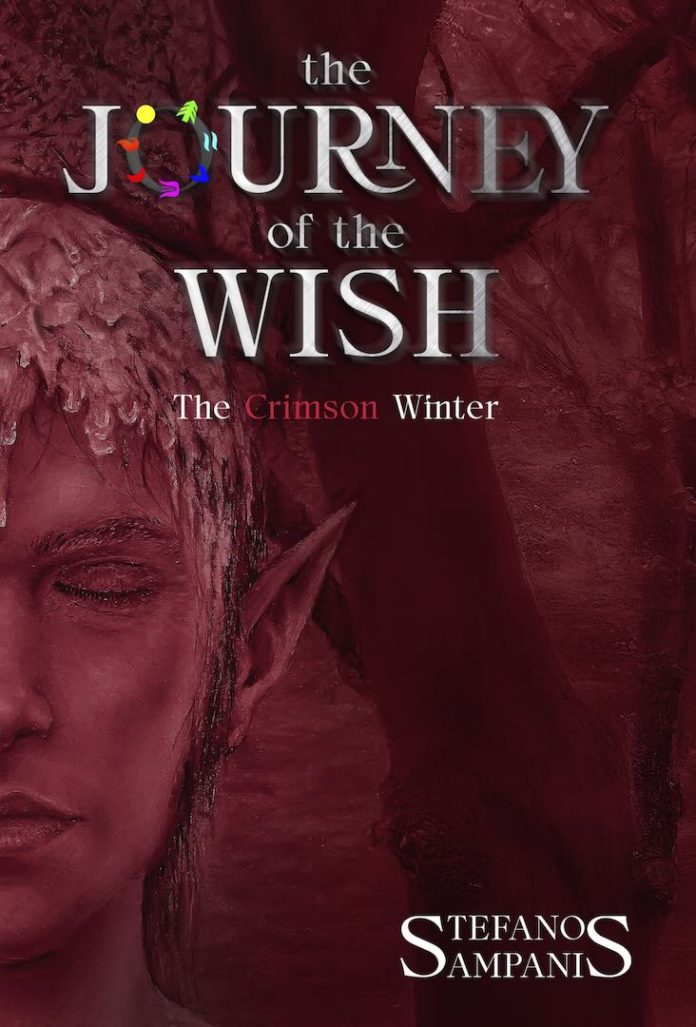
Some fantasy sagas expand outward, adding maps and armies with every volume. Others grow inward, deepening what they already built until the reader feels the weight of it in their chest. The Crimson Winter by Stefanos Sampanis belongs firmly to the second kind. The novel picks up the tale of Glimm, a blind fairy-child enslaved among the creatures of Winter, and pushes him into a season stained with blood, law, and terrible questions about who deserves to be called family.
Translated from Greek by Lucas Petroulakis, this second installment in The Journey of the Wish saga follows The Grey Winter of the Enslaved, where readers first met the Mount, its hooded King, and the hail-clad slaves who serve him. If the first book taught Glimm how to survive, this one teaches him something far harder: how to live with what survival costs.
The Story: A Mission, A Murder Charge, A Mystery
The book opens at the Equinox. Spring’s creatures sink into their half-year Slumber, Winter’s creatures wake, and the White Lord himself descends upon the Mount with orders. Elves have crossed into Winter’s territory, and twelve Enslaved must answer for it. Glimm, an Elf by blood, is sent to fight his own kind alongside creatures who distrust him, including an Orc he has every reason to hate.
What follows spans three distinct movements. The first is a war story, tense and mercilessly paced, set in the poisoned depths of the Jungle Accursed. The second shifts registers entirely, carrying Glimm to Crystal City, Winter’s frozen capital, where he must stand before the Court of Ice and its strange instruments of judgement. The third movement returns to the Mount for a battle fought not with black ice swords but with words, riddles, and seven dangerous questions.
Sampanis reveals nothing cheaply. Every answer arrives wrapped in another mystery, and the King of the Mount remains one of the most unreadable figures in modern fantasy, a parent and a jailer in the same green cloak.
Why the Structure Works
- The Jungle campaign grounds the book in physical stakes, with silence, traps, and poison turning every step into a decision.
- The Crystal City trial opens the world wide, showing markets, taverns, Vassals, and the uneasy place the Enslaved hold in regular society.
- The final dialogue distills everything into philosophy, asking what stands between Gods and creatures, and whether a Wish can ever be safely granted.
Characters Carved from Hail and Stone
Glimm remains a remarkable protagonist precisely because he is so often wrong. His rage is understandable, his choices are frequently reckless, and his growth is earned one painful lesson at a time. Watching him wrestle with vengeance, guilt, and belonging gives The Crimson Winter by Stefanos Sampanis its emotional spine.
The supporting cast is equally memorable, and the author gives each member of the doomed company a distinct voice:
- Fawke, the Dwarf mentor whose battlefield pragmatism hides a heart he refuses to show, and whose decisions carry the harshest moral weight in the novel
- Than, the stone Giant whose loyalty needs no words, only a raised fist and a thunderous groan
- Semela, the King of the Mount, whose punishments read like cruelty until a second look reveals something closer to a father’s severe design
- Kalin, a cheerful Dwarf of Crystal City whose kindness lands on Glimm like sunlight on skin that has forgotten warmth
- The Golem, a helpless newcomer whose innocence becomes a quiet test of every other character’s conscience
None of these figures exist as decoration. Each one pressures Glimm toward a choice, and the parable of the appropriate father, told deep in the middle chapters, gives the entire saga a moral framework that lingers long after the final page.
A Mythology That Feels Ancient
The worldbuilding here deserves particular praise. Sampanis has constructed a cosmology of Seven Gods, Eternal Beings, and seasonal law that operates with the internal logic of genuine myth. Winter and Spring alternate like breathing, each season’s creatures sleeping while the other’s wake. The Enslaved perceive the world blind, through a grey mental sense called Clarity, a device that shapes the prose itself. Sight, color, and perception become the book’s central metaphors, and the crimson of the title carries meaning on several levels at once.
The Court of Ice sequence stands out as one of the most original stretches of fantasy trial writing in recent memory. Sand poured into a Construct of Judgement measures the time each accused is granted, because the Gods do not gift every creature equal time to live or to be judged. Details like this fill every chapter, and they accumulate into a world that feels excavated rather than invented.
The Craft of the Prose
The writing style favors long, deliberate sentences that mirror Glimm’s careful Perception of his surroundings. Petroulakis’s translation preserves a distinctly Greek storytelling sensibility, formal and fable-like, with songs and verse woven into the narrative at moments of grief and transformation. Readers who enjoy prose with texture and patience will find plenty to admire.
A Note on Reading Order
New readers should begin with The Grey Winter of the Enslaved. The sequel rewards familiarity with the first Winter’s events, and the saga is clearly designed to mature with each installment, exactly as the author’s own blurb promises.
Who Will Love This Book
The Crimson Winter by Stefanos Sampanis will appeal most strongly to readers who prefer their fantasy morally complicated and mythically grounded. Consider it if you enjoy:
- Dark, atmospheric epic fantasy where survival has a price
- Mentor and student relationships tested by impossible choices
- Original mythologies with Gods who take an active, frightening interest in mortals
- Coming of age arcs built on grief, identity, and hard-won belonging
- Courtroom tension and political undercurrents inside a secondary world
Similar Books Worth Exploring
If this saga speaks to you, these titles walk neighboring roads:
- The Devils by Joe Abercrombie, for morally tangled characters and brutal pragmatism
- Assassin’s Apprentice by Robin Hobb, for a lonely boy shaped by a stern, secretive mentor
- Gardens of the Moon by Steven Erikson, for soldiers bound to service in a god-haunted world
- The Fifth Season by N. K. Jemisin, for enslaved outsiders with powers the world both uses and fears
- A Wizard of Earthsea by Ursula K. Le Guin, for mythic prose and a hero learning the true cost of his own anger
About the Author and the Saga
Stefanos Sampanis is a Greek fantasy author, and The Journey of the Wish is his flagship saga, presented in his own words as a tale disguising truth, one that matures with each page turned. The Grey Winter of the Enslaved introduced this world and its unforgiving seasons, and the present volume expands it in every direction that matters. The series title itself points toward what lies ahead, a Journey and a Wish whose rules readers begin to glimpse here for the first time.
Final Verdict: A Sequel That Cuts Deeper
The Crimson Winter by Stefanos Sampanis is that rare second book which surpasses its foundation, trading none of the first volume’s mystery while multiplying its emotional stakes. It is a story about blood in the snow, yes, but more truly a story about family, the ones we lose, the ones forced upon us, and the ones we finally choose. Readers who step into this grey world should prepare to see it bleed crimson, and to care deeply about every drop.







