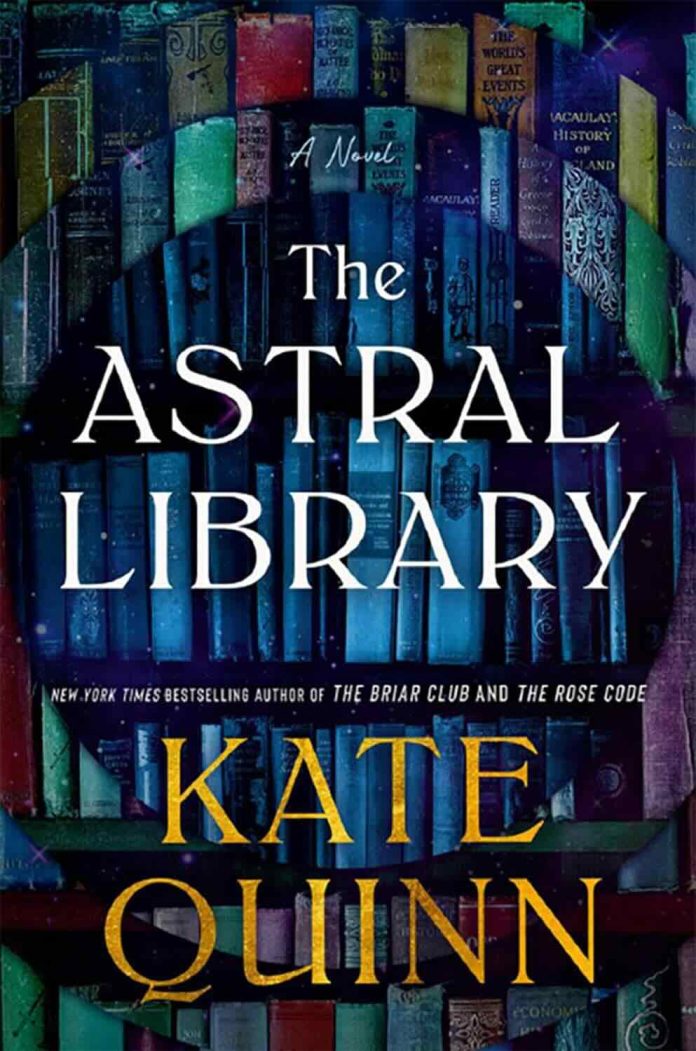
In a daring departure from her beloved historical fiction repertoire, Kate Quinn transforms the Boston Public Library’s iconic Reading Room into a portal to infinite possibilities. The Astral Library by Kate Quinn asks a question every book lover has pondered: what if you could actually live inside your favorite story? The answer Quinn provides is both enchanting and surprisingly ferocious, wrapped in a love letter to libraries that doubles as a battle cry for their preservation.
Where Books Choose Their Readers
Alexandria “Alix” Watson exists in that precarious space many young adults recognize all too well: juggling three soul-crushing jobs, nursing a bank account with double digits, and clinging to the edges of survival. A product of the foster care system, Alix has learned one ironclad truth—people disappoint, but books never do. When a hidden door materializes in her beloved Boston Public Library Reading Room, she stumbles into the Astral Library, a liminal space where desperate readers can escape into the worlds they’ve always dreamed of inhabiting.
Quinn’s protagonist carries the sharp edges of someone who’s been ground down by life’s indifferences. Alix’s voice crackles with sardonic wit and barely suppressed rage, a defense mechanism forged through years of being nobody’s first choice. The Astral Library by Kate Quinn shines brightest when channeling Alix’s perspective, her observations laced with pop culture references and a refreshing lack of patience for pretension. She’s the reader who knows her fantasy tropes inside and out, who spots the Hero’s Journey beats before they arrive, who questions why she can’t just transform into a dragon and solve her problems with teeth and fire.
The Librarian and Her Living Books
Enter the Librarian: an ageless, acerbic guardian with rectangular spectacles, sensible brogues, and the ability to transform into an emerald-scaled dragon. She’s no Gandalf offering gentle wisdom—this mentor figure snaps at sentimentality, rolls her eyes at heroic presumptions, and runs her mystical repository with bureaucratic efficiency tempered by genuine care for her Patrons. The dynamic between Alix’s desperate hope and the Librarian’s crusty pragmatism generates some of the novel’s most entertaining exchanges.
The Astral Library itself emerges as a character, its books fluttering with sentience, clustering protectively around those who need shelter, and yes, occasionally eating those who threaten their sanctuary. Quinn’s world-building establishes clear rules: no copyrighted material, no changing the story, no replacing the protagonist. You enter as a side character in someone else’s tale, living the life the Library deems you’ve been “aching to have.”
Literary Tourism with Consequences
The novel’s middle section transforms into a breathless chase through literature’s greatest hits. Alix margin-travels (the Library’s term for book-hopping) from Sherlock Holmes’s foggy London to Jay Gatsby’s champagne-soaked parties, from Jane Austen’s Regency drawing rooms to the gaming worlds of Downton Abbey. Quinn clearly delights in these literary pit stops, peppering them with knowing winks about adaptations getting details wrong and the gap between beloved books and their Hollywood versions.
These sequences showcase Quinn’s research chops—she’s as comfortable describing the mechanics of Regency dress as she is capturing the grimy authenticity of Victorian wharves. The prose moves with cinematic energy, Alix’s first-person narration keeping pace with mounting danger as a shadowy enemy pursues her across fictional worlds. Yet here The Astral Library by Kate Quinn occasionally stumbles under its own ambition. With so many worlds to visit and so much plot to advance, some settings blur together in the rush, serving more as backdrops than fully realized spaces.
Where the Novel Wavers
The book’s central conflict—a Library Board attempting to “modernize” and monetize this mystical space—provides sharp social commentary about real-world threats to libraries. Elizabeth, the primary antagonist, embodies bureaucratic evil with her clipboards, bylaws, and corporate doublespeak about “essential modernization” and “monetized programming.” Quinn’s fury at book banning, budget slashing, and the reduction of libraries to “one-quarter books” pulses through every confrontation.
However, this messaging occasionally overwhelms the narrative. The Library Board members read more as allegorical representations than fully dimensional characters—the book banner, the rule-follower, the corporate climber. While this serves Quinn’s thematic purposes, it flattens what could have been more complex villains. The revelations about Alix’s mother and Elizabeth’s manipulations, though emotionally resonant, arrive with somewhat predictable timing.
The pacing also shows strain. After the propulsive opening third, the middle meanders through multiple book worlds before snapping back into focus for the climactic Board meeting confrontation. Readers seeking Quinn’s signature historical detail may find the rapid-fire world-hopping too breathless; fantasy readers might wish for deeper immersion in any single setting.
A Love Letter Written in Fire
Where The Astral Library by Kate Quinn truly succeeds is in its understanding of why people need stories. The Patrons Alix encounters aren’t escaping reality on a whim—they’re fleeing abuse, discrimination, impossible circumstances. The fourteen-year-old living permanently in Neverland ran from an abusive mother. The woman who became a Bride of Dracula escaped a violent marriage. Libraries, Quinn argues passionately, serve the desperate and the lost, offering sanctuary when nowhere else will.
This emotional core elevates what could have been a simple “books are magic” premise into something more urgent. Quinn writes with the authority of someone who understands libraries as vital public spaces, not just book repositories. The climactic battle isn’t just about saving one magical library—it’s about preserving the idea that public institutions should serve people’s needs rather than profit margins or political agendas.
Technical Craft and Style
Quinn’s transition from historical fiction to magical realism proves mostly successful. Her prose maintains the polish readers expect—sentences flow with practiced ease, dialogue sparkles with wit, and emotional beats land with precision. The meta-textual commentary about story structure and reader expectations adds playful layers without becoming too clever by half.
Key strengths that shine through:
- Sharp, authentic dialogue that captures distinct character voices
- Vivid sensory details that ground fantastical elements
- Seamless integration of literary references without pretension
- Genuine emotion beneath the snark and pop culture riffs
Areas where the execution falters:
- Compressed middle section sacrifices depth for breadth
- Antagonists lack the complexity of Quinn’s historical villains
- Some plot revelations arrive on schedule rather than surprising
- The resolution, while satisfying, wraps up perhaps too neatly
The Verdict: A Flawed but Passionate Defense
The Astral Library by Kate Quinn won’t satisfy every reader seeking either Quinn’s meticulous historical detail or a fully immersive fantasy world. The novel tries to accomplish multiple goals—social commentary, literary adventure, found family narrative, magical world-building—and occasionally strains under that weight. Some readers may find Alix’s narrative voice too contemporary, the villain too one-dimensional, or the messaging too overt.
Yet for those who’ve ever found refuge in library stacks, who’ve viewed reading as survival rather than hobby, who’ve watched funding slashed and books banned with mounting horror—this novel speaks directly to that fury and heartbreak. Quinn’s passion for libraries as sanctuaries blazes through every page. The books that flutter, protect, and yes, occasionally devour those who threaten them become symbols of stories’ power to fight back against those who would silence or commodify them.
The novel earns its emotional catharsis through Alix’s journey from defeated to defiant, from believing nobody chooses her to realizing she can choose herself. Beau, the costume designer who becomes her unexpected ally, provides the found family warmth that balances Alix’s prickly exterior. Their friendship, built on mutual respect and creative collaboration, feels genuinely earned rather than conveniently plotted.
Quinn’s first foray into magical realism demonstrates her versatility while maintaining her core strengths: meticulous research, sharp prose, and deep empathy for marginalized characters fighting systems designed to crush them. Though imperfect, The Astral Library by Kate Quinn succeeds as both entertaining escapism and impassioned advocacy—a reminder that libraries remain beacons in the dark, and some battles are worth fighting even if victory seems impossible.
If You Loved This, Try These:
For readers drawn to literary magic and metafiction:
- The Invisible Library by Genevieve Cogman—librarian spies collecting rare books across parallel worlds
- The Midnight Library by Matt Haig—infinite lives explored through a metaphysical library
- Mr. Penumbra’s 24-Hour Bookstore by Robin Sloan—mystery and magic in San Francisco book culture
For found family narratives with sharp-tongued protagonists:
- The House in the Cerulean Sea by TJ Klune—bureaucrat discovers chosen family at magical orphanage
- The Ruthless Lady’s Guide to Wizardry by C.M. Waggoner—scrappy con artist navigates magical society
And for books about books and readers who live for stories:
- Inkheart by Cornelia Funke—characters who can read people out of books
- Among Others by Jo Walton—Welsh teenager finds refuge in science fiction
- The Starless Sea by Erin Morgenstern—underground library of stories and secrets







