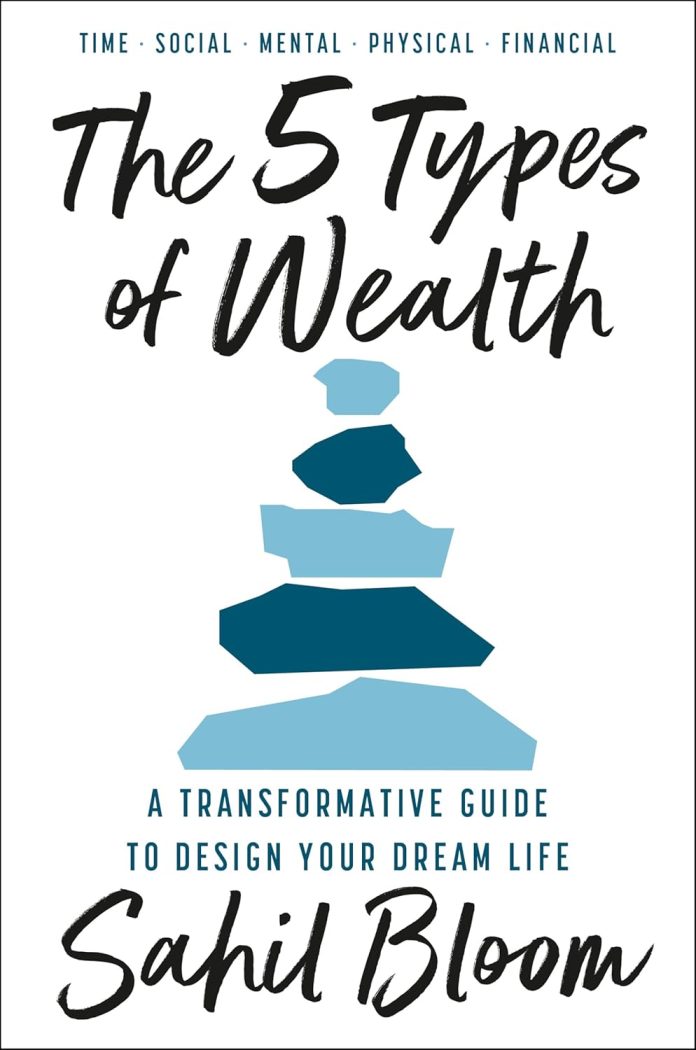
In a world where success is measured by zeros in bank accounts and material possessions, Sahil Bloom’s The 5 Types of Wealth arrives as a necessary corrective to our collective obsession with financial metrics. This isn’t just another self-help book promising overnight transformation—it’s a methodical deconstruction of how we’ve been taught to measure a life well-lived, followed by a compelling blueprint for something far more meaningful.
Bloom, the Stanford-educated entrepreneur behind the popular “Curiosity Chronicle” newsletter, brings a unique blend of analytical rigor and storytelling prowess to what could have been a dry treatise on life optimization. Instead, he delivers a framework that feels both intellectually robust and deeply personal, grounded in real stories of people who’ve discovered that true wealth extends far beyond their net worth.
The Uncomfortable Truth About Modern Success
The book opens with a gut-punch moment that sets the tone for everything that follows. During a casual dinner conversation, a friend tells Bloom he’ll only see his aging parents fifteen more times before they die. This stark mathematical reality becomes the catalyst for a complete life redesign—one that many readers will find uncomfortably relatable.
Bloom’s central thesis is deceptively simple yet profound: we’ve been measuring the wrong things. His five-pillar framework redefines wealth across Time Wealth (control over how you spend your hours), Social Wealth (depth of relationships), Mental Wealth (purpose and growth), Physical Wealth (health and vitality), and Financial Wealth (yes, money still matters, but in context).
What distinguishes this framework from other life philosophy books is its practical architecture. Each type of wealth is broken down into measurable components with specific “pillars” that support them. Time Wealth, for instance, rests on awareness (understanding time’s finite nature), attention (focusing on what matters), and control (owning your schedule). This systematic approach prevents the framework from becoming another feel-good platitude.
Where Bloom Excels: The Art of Accessible Complexity
Bloom’s greatest strength lies in his ability to synthesize complex ideas into digestible frameworks without dumbing them down. His background in economics and public policy from Stanford shows in how he structures arguments, while his experience as a content creator ensures the material remains engaging. The writing style is conversational yet substantive, peppered with historical anecdotes (from ancient Greek philosophy to Viking time-keeping) that illuminate rather than distract.
The book shines brightest in its practical systems sections. Rather than offering vague advice like “be more present,” Bloom provides specific tools: the Energy Calendar for tracking time usage, the Two-List Exercise for prioritization, and the Anti-Procrastination System for breaking through paralysis. These aren’t revolutionary concepts, but they’re presented with the kind of clarity that makes implementation feel achievable rather than overwhelming.
Particularly compelling is Bloom’s treatment of Social Wealth, where he introduces the concept of “Front-Row People”—those who would sit in the front row at your funeral. This morbid but effective framing forces readers to confront the quality versus quantity debate in relationships. His exploration of “earned status” versus superficial social positioning feels especially relevant in our social media-saturated age.
The Wealth Score: Ambitious but Problematic
One of the book’s most ambitious elements is the “Wealth Score”—a quantified assessment tool that asks readers to rate themselves across all five wealth dimensions. On paper, this systematic approach to life evaluation seems invaluable. In practice, it reveals some of the framework’s limitations.
The scoring system, while comprehensive, can feel reductive. Complex life circumstances don’t always fit neatly into numbered responses, and the tool risks turning life optimization into yet another metric to obsess over. There’s an irony in creating a scoring system for a book that criticizes our over-quantified approach to success.
More problematically, the book occasionally falls into the trap it seeks to escape: treating life like a optimization problem to be solved. Bloom’s engineering mindset serves him well in creating clear frameworks, but life’s messiness often resists such systematic approaches. The tension between accepting life’s natural seasons and constantly working to improve across all five dimensions isn’t fully resolved.
Missing Nuances and Oversimplifications
While Bloom acknowledges that his framework should adapt to “life seasons,” the book doesn’t fully grapple with how dramatically circumstances can alter these equations. A single parent working multiple jobs to support their family faces fundamentally different Time Wealth challenges than a Stanford graduate with venture capital access. The book’s examples, while diverse, skew toward people with significant existing privilege and flexibility.
The Financial Wealth section, despite Bloom’s obvious expertise, feels somewhat perfunctory compared to the more innovative sections on Time and Mental Wealth. His investment advice is sound but unoriginal—the kind of low-cost index fund wisdom that’s become standard in financial literature. Given his background in venture capital, readers might expect more sophisticated insights into wealth building.
Similarly, the Physical Wealth section, while emphasizing important fundamentals like sleep and movement, doesn’t break significant new ground. The advice is evidence-based and practical, but those seeking cutting-edge health optimization strategies will find the content somewhat basic.
The Power of Personal Narrative
Where Bloom’s book transcends typical self-help territory is in its honest examination of his own journey. His decision to leave California for the East Coast to be closer to aging parents—and the subsequent positive ripple effects on his marriage, health, and career—provides a compelling case study in how the framework operates in real life.
These personal elements prevent the book from feeling purely theoretical. When Bloom describes holding his newborn son while reflecting on an elderly stranger’s advice about how quickly childhood passes, the abstract concept of Time Wealth becomes viscerally real. This ability to ground theoretical frameworks in lived experience elevates the material considerably.
Implementation Challenges
The book’s practical ambitions are both its strength and potential weakness. Bloom provides so many systems and tools that readers might feel overwhelmed by choice. The “Systems for Success” sections at the end of each wealth type offer valuable resources, but implementing even a fraction of them would require significant time investment—itself a challenge to Time Wealth.
The framework’s comprehensiveness also raises questions about prioritization. Should someone struggling financially really be spending significant time on Mental Wealth activities like meditation retreats? Bloom acknowledges these trade-offs but doesn’t provide enough guidance on sequencing or situational adaptation.
Cultural and Philosophical Depth
One of the book’s unexpected pleasures is its historical and cultural perspective. Bloom traces concepts from ancient Greek philosophy to Viking mythology, showing how different civilizations have grappled with similar questions about meaningful living. These sections demonstrate intellectual depth beyond typical business book fare and provide valuable context for why our current metrics of success feel inadequate.
The philosophical underpinning—that balance across multiple life dimensions creates more sustainable fulfillment than single-minded financial pursuit—feels both ancient in wisdom and urgently contemporary in application. Bloom successfully argues that our current success paradigm is both historically recent and culturally specific, opening space for alternative approaches.
Comparison to Similar Works
The 5 Types of Wealth occupies interesting territory in the crowded life design space. It’s more systematic than Four Thousand Weeks by Oliver Burkeman but less philosophically rigorous. It’s more practical than The Top Five Regrets of the Dying by Bronnie Ware but less emotionally powerful. Compared to classics like Your Money or Your Life by Vicki Robin, it offers broader scope but less financial depth.
The book most closely resembles The 4-Hour Workweek by Tim Ferriss in its systematic approach to life design, but with greater emphasis on relationships and meaning over pure efficiency. Unlike Ferriss’s focus on lifestyle arbitrage, Bloom argues for sustainable, values-based decision making across all life dimensions.
The Verdict: Valuable Despite Its Limitations
The 5 Types of Wealth succeeds in its primary mission: providing a compelling alternative to purely financial definitions of success. Bloom’s framework offers genuine utility for anyone feeling trapped in the “Red Queen Effect”—running faster and faster just to stay in place. The book’s systematic approach makes abstract concepts actionable, while its personal narrative elements prevent it from feeling coldly mechanical.
The framework’s limitations—its potential for over-quantification, its assumptions about privilege and flexibility, its occasionally overwhelming scope—don’t negate its core value. Most readers will find at least one or two wealth types where Bloom’s insights genuinely shift their perspective or provide practical tools for improvement.
For readers already familiar with life design literature, the book offers valuable synthesis and a useful organizational framework rather than revolutionary insights. For those new to thinking beyond financial metrics, it provides an excellent introduction to more holistic approaches to success and fulfillment.
Who Should Read This Book
The 5 Types of Wealth will resonate most strongly with high-achieving professionals who’ve achieved financial success but feel something is missing. Entrepreneurs, executives, and knowledge workers—particularly those in their thirties and forties—will find Bloom’s framework especially relevant as they navigate the tension between career advancement and other life priorities.
The book also serves college graduates and young professionals well, offering a framework for making career and life decisions with broader perspective than pure salary optimization. Parents will appreciate Bloom’s thoughtful treatment of time scarcity and relationship prioritization.
However, readers seeking purely financial advice, those facing immediate economic hardship, or anyone looking for quick-fix solutions should look elsewhere. This is a book for people with enough baseline financial stability to contemplate broader questions of life design and meaning.
Similar Books Worth Considering
For readers interested in related themes, consider these complementary works:
- Atomic Habits by James Clear – For systematic habit formation across life domains
- Digital Minimalism by Cal Newport – For deeper exploration of attention and focus
- The Power of Moments by Chip Heath and Dan Heath – For creating meaningful experiences
- Range by David Epstein – For arguments against narrow specialization
- The Geometry of Wealth by Brian Portnoy – For integrated thinking about money and meaning
- Meditation For Mortals by Oliver Burkeman – For philosophical perspective on time limitations
- Happier Hour by Cassie Holmes – For research-based approaches to time satisfaction
Final Thoughts
Sahil Bloom has written a book that arrives at precisely the right cultural moment. As increasing numbers of people question whether traditional career success delivers promised fulfillment, The 5 Types of Wealth offers both validation of those doubts and a practical framework for alternative approaches.
The book’s enduring value lies not in any single insight but in its comprehensive approach to life design. By providing language and structure for concepts many people intuitively understand but struggle to articulate, Bloom enables more intentional decision making across all life dimensions.
While the framework won’t solve every life challenge or eliminate all difficult trade-offs, it does provide a more sophisticated scorecard for measuring progress toward a genuinely fulfilling existence. In a world obsessed with financial metrics, that broader perspective alone makes The 5 Types of Wealth a worthwhile investment of time—perhaps the most precious wealth of all.







