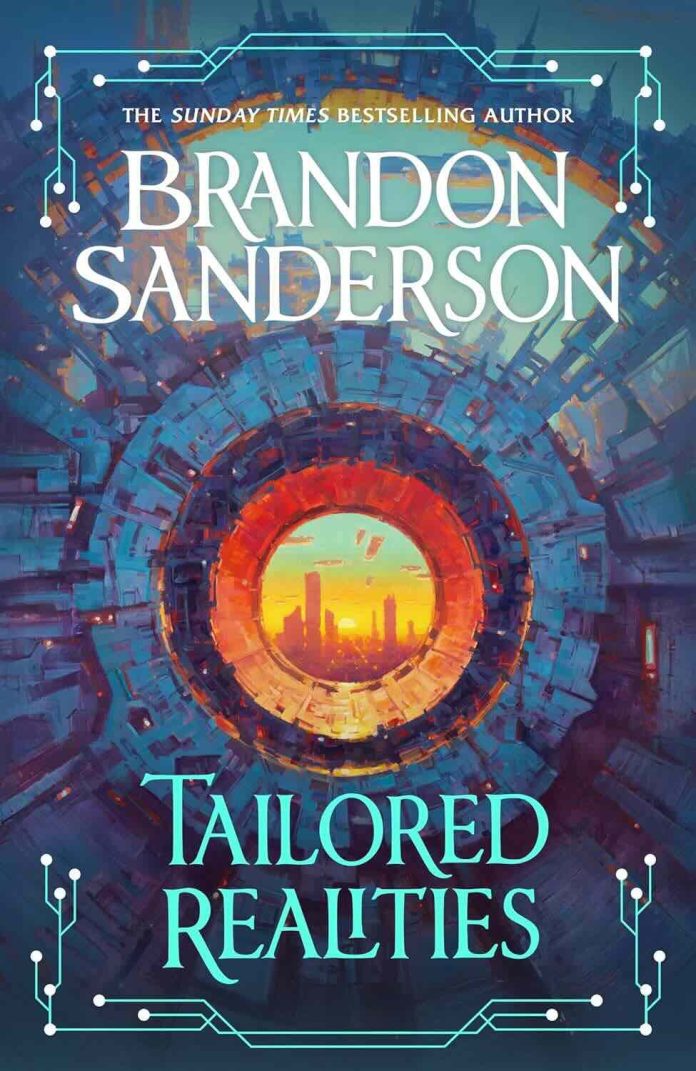
Brandon Sanderson has built his reputation on intricate magic systems and sprawling epic fantasies within his Cosmere universe. Yet some of his most daring storytelling exists outside those familiar boundaries. Tailored Realities assembles ten stories spanning twenty-five years of creative evolution, offering readers a window into the experimental playground where Sanderson tests narrative techniques that eventually shape his larger works.
Beyond the Cosmere: Stories That Push Boundaries
Tailored Realities deliberately steps away from the interconnected mythology that defines much of Sanderson’s bibliography. Instead, these standalone pieces explore science fiction concepts, philosophical questions about consciousness and reality, and genre-blending experiments that reveal an author comfortable taking risks. The absence of familiar Cosmere elements becomes the collection’s strength, forcing Sanderson to construct entirely new frameworks for each story while maintaining the precision readers expect from his worldbuilding.
The title story “Snapshot” exemplifies this approach through its noir-influenced detective narrative. Detectives Anthony Davis and Chaz navigate a perfect recreation of a single day, an underground simulation where they solve crimes by literally revisiting the past. Sanderson constructs a morally complex scenario where millions of artificial people populate this recreated city, existing only to be destroyed when the simulation ends. Davis struggles with the ethical weight of his work, questioning whether actions in a Snapshot carry genuine moral consequences. The story’s tension derives not from action sequences but from Davis’s internal conflict as he recognates the humanity of people the system defines as temporary and expendable.
Sanderson’s prose in “Snapshot” demonstrates his evolution toward leaner, more economical storytelling. Where his epic fantasies luxuriate in detailed magic systems and political machinations, this novella trusts readers to grasp concepts quickly. The Snapshot technology remains partially mysterious, its mechanics less important than its philosophical implications. This restraint marks a significant departure from the exhaustive explanations characteristic of his Cosmere works.
The Crown Jewel: Moment Zero’s Temporal Complexity
The centerpiece of Tailored Realities, the never-before-published novella “Moment Zero,” represents Sanderson’s most ambitious short-form narrative structure. Two detectives approach the same apocalyptic event from opposite temporal directions: Lisa Sterling moves backward from a devastated future while Andrew Dane investigates forward from the past. Their separate timelines converge on “Moment Zero,” the instant when a scientist’s experiment fractured reality itself.
Sanderson orchestrates this dual-timeline narrative with remarkable precision, alternating between Lisa’s post-apocalyptic desperation and Dane’s pre-disaster investigation. Each chapter heading counts hours toward or away from the central moment, creating mounting tension as both protagonists race against time itself. The structure demands careful attention from readers, but Sanderson provides enough contextual anchors to prevent confusion.
What elevates “Moment Zero” beyond clever temporal mechanics is its exploration of partnership dynamics. Lisa and Dane represent former detective partners whose relationship has frayed, their communication restricted to phone calls across fractured timelines. Sanderson writes their deteriorating connection with unexpected emotional depth, using the apocalypse as backdrop for examining how professional partnerships evolve and sometimes necessarily end. The story refuses the expected reconciliation, instead honoring the realistic outcome where two people simply grow incompatible despite mutual respect.
Philosophical Depth in Perfect State
“Perfect State” tackles questions about consciousness, achievement, and the nature of heroism through God-Emperor Kairominas, who rules a fantasy world designed exclusively for him. Every citizen exists as programming; every quest serves to reinforce his sense of accomplishment. When Kai meets Sophie, a revolutionary from another simulated world, both confront the hollowness underlying their greatest achievements.
Sanderson uses this premise to interrogate modern gaming culture and virtual existence without heavy-handed moralizing. Kai’s heroism feels genuine to him, even when revealed as orchestrated gameplay on the easiest difficulty setting. Sophie’s revolutionary accomplishments ring hollow because her world was intentionally designed without the rights she fought to establish. The story asks whether subjective fulfillment matters when objective circumstances undermine those feelings.
The narrative’s twist—revealing Sophie as an elaborate deception—initially seems to reduce her agency to a plot device. However, Sanderson’s revised ending restores her complexity by suggesting layers of manipulation extending beyond Kai’s awareness. The result examines power structures within seemingly utopian systems, questioning who benefits from giving everyone their perfect world.
Range and Experimentation
The collection’s remaining stories demonstrate Sanderson’s willingness to experiment with form and genre:
- “Defending Elysium” serves as the Cytoverse’s origin story, introducing biological faster-than-light travel and questioning humanity’s place in a galactic community. Written in 2001, it showcases Sanderson’s early attempts at dense, idea-driven science fiction that influenced his later Skyward series.
- “Mitosis” returns to the Reckoners universe with David Charleston facing an Epic who multiplies endlessly. The story balances superhero action with David’s characteristic humor, providing a complete arc for existing fans while remaining accessible to newcomers.
- “Dreamer” explores body-swapping mechanics through a horror lens, examining how people might abuse consequence-free existence. Though brief, it effectively disturbs through implications rather than explicit content.
- “Firstborn” presents military strategy through the lens of nature versus nurture, asking whether genius derives from genetics or environment. The clone of history’s greatest military commander becomes an ordinary man, suggesting potential originates from circumstances rather than inherent capacity.
Technical Excellence and Style Adaptation
Sanderson’s technical proficiency shines throughout these varied narratives. His signature clear prose serves different purposes across genres—building dread in horror pieces, establishing noir atmosphere in detective stories, and maintaining propulsive pacing in action sequences. The author’s distinctive ability to construct logical systems appears even in stories like “Perfect State,” where the “rules” governing simulated realities create narrative structure.
Tailored Realities benefits from generous author postscripts following each story, providing context about composition, revision decisions, and how individual pieces influenced later works. These annotations transform the reading experience into a master class in craft, revealing Sanderson’s evolution from unpublished writer to genre-defining author.
Minor Imperfections Within Excellence
Not every story achieves the same impact. “Brain Dump” and “I Hate Dragons” function more as creative exercises than fully realized narratives. “Probability Approaching Zero” compresses its concepts into flash fiction that may leave readers wanting more development. These shorter pieces feel like sketches rather than finished paintings, though Sanderson’s postscripts acknowledge their experimental nature.
The collection’s genre diversity, while demonstrating range, may challenge readers seeking consistent tone. Moving from “Snapshot’s” noir melancholy to “I Hate Dragons'” absurdist humor requires mental gear-shifting. However, this variety arguably represents the collection’s intention—showcasing an author refusing creative stagnation.
Essential Reading for Sanderson Enthusiasts
Tailored Realities offers something beyond typical short story collections. It functions as both retrospective and creative laboratory, demonstrating how constraints breed innovation. Sanderson’s willingness to experiment outside his established universe reveals an artist continuously evolving his craft. The stories succeed not despite their differences from Cosmere works but because those differences illuminate approaches that eventually enhance everything Sanderson writes.
For readers familiar only with Sanderson’s epic fantasies, this collection provides fresh perspective on his versatility. Those already appreciating his science fiction will find “Moment Zero” and “Defending Elysium” particularly rewarding. The collection earns its place among Sanderson’s essential works, proving that sometimes creative freedom flourishes most when working outside familiar boundaries.
Similar Books Worth Exploring
- Stories of Your Life and Others by Ted Chiang – Philosophical science fiction examining consciousness and reality
- The Paper Menagerie and Other Stories by Ken Liu – Genre-blending speculative fiction with emotional depth
- Exhalation by Ted Chiang – More explorations of time, consciousness, and existence
- Pump Six and Other Stories by Paolo Bacigalupi – Dark science fiction examining societal collapse
- How Long ’til Black Future Month? by N.K. Jemisin – Diverse speculative fiction showcasing range and experimentation