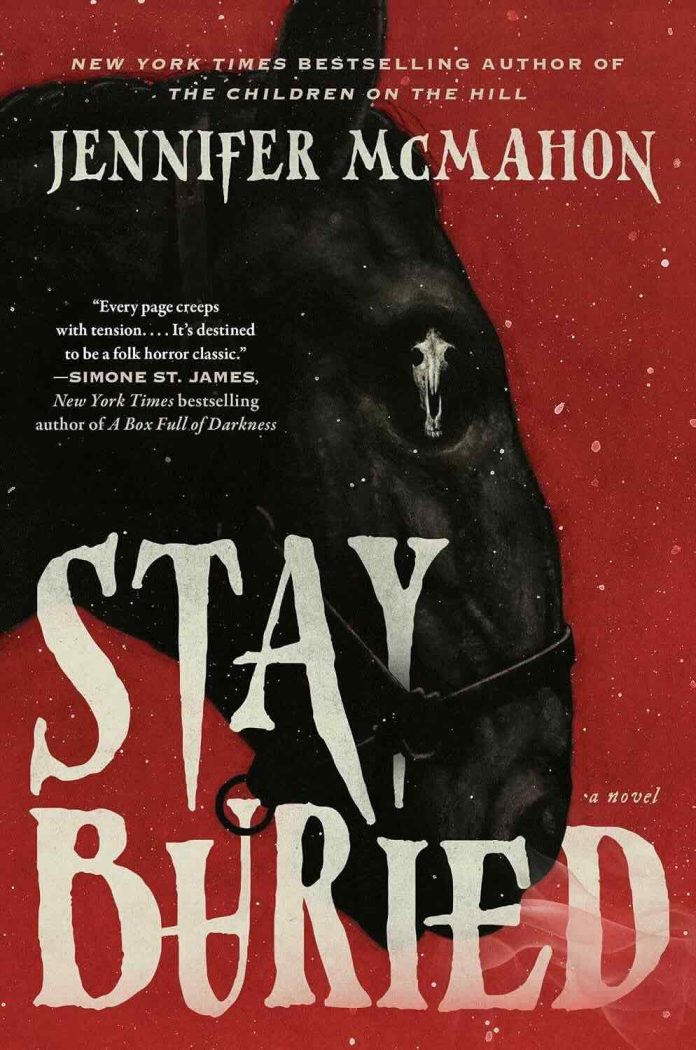
The horses go first. On the ninth of March 1919, five of them are found torn apart in a Vermont paddock, and the only survivor is chewing her own foreleg. That is page one of Stay Buried by Jennifer McMahon, and by the following afternoon every horse in Boone’s Ferry is dead, shot, or loose in the woods. The doctor calls it rabies because it is the nearest word he owns. It is not rabies. Within a week the same sickness is inside the people, and the town has decided it knows whose fault that is.
Four Days in March, and a Century of Payments
The 1919 chapters are narrated by Frankie O’Massey, eighteen, orphaned, taken in by the town doctor and trained as his apprentice. She wears her uncle’s cast-off trousers and boots, smokes a pipe with the men at the pub, is regularly mistaken for a boy, and has never bothered to correct anyone. She is also secretly, ruinously in love with Pearl Stoddard, the factory owner’s daughter, and the two of them meet in a derelict house at the edge of the woods that they have privately decided is their home.
The other timeline is 2016. Ashley Flanders, who dropped out of medical school after her mother’s disappearance broke something in her, inherits a house in Boone’s Ferry she never knew her family owned, along with a tenant paying one dollar a month. She and her brother drive up to a village that does not appear on the map, where the road literally dead-ends, and where a nine-year-old named Mini has just broken the only rule that matters: she looked at the knackerman.
The Sickness Is the Best Thing in the Book
McMahon has clearly done the reading, and it shows. The illness in Stay Buried by Jennifer McMahon behaves like a real pathogen and not like a plot device: jaundice, wet lungs, an unmistakable smell of rotten fruit scorched in a fire, then an apparent death so convincing that two trained observers cannot find a pulse, then something afterwards that walks. The novel never once uses the word zombie. It does not need to. It stays inside 1919 medicine and lets the reader do the arithmetic, and the effect is far nastier than an explanation would have been. Anyone who reads about zoonotic disease will recognise the shape of what is happening long before Dr Endicott can name it, which only makes his notebooks more painful.
The real horror, though, is what the neighbours do. Offerings appear on doorsteps. Herbs are hung in windows. Men who have known each other since childhood start walking the woods at night with rifles, shooting the sick to save their souls. McMahon has said Shirley Jackson was on her mind, and it is visible in the best possible way: the violence is procedural, communal and entirely reasonable to the people committing it. The headstone they eventually raise over their scapegoat is blank polished granite, chosen so that anyone who visits will see themselves in it. That is the whole novel in one object.
What Works
Four things make Stay Buried by Jennifer McMahon worth the hardback.
- Frankie. A superb narrator: clinical, funny, frightened, precise, taking notes on the worst day of her life because writing a thing down makes it bearable. She is the best character McMahon has written.
- The love story. Frankie and Pearl are given real weight and real want, and the book never turns them into a lesson. A late chapter from Pearl’s point of view, dated 1956, is quietly devastating.
- Mini. A nine-year-old who counts times tables to stay calm and finds people harder to read than crickets. She is never once written as adorable, which is why she works.
- Sad Willy. The town drunk with a prosthetic foot turns out to hold the book’s cruellest secret, and the reveal is earned rather than sprung.
Where It Drags
Four things keep Stay Buried by Jennifer McMahon off the very top shelf, and all of them live in the present day.
- The 2016 half runs a familiar route. Unhelpful desk clerk, records conveniently destroyed by fire, dead phone line, stolen truck battery, locked cellar. Each beat arrives exactly when you expect it.
- Malcolm is a bundle of tics. Manifestation seminars, an ayahuasca retreat, a new business scheme every chapter, and a structural job that is mostly to disbelieve his sister.
- The supernatural question is dodged. The book raises whether something genuinely came back and then declines to answer. Deliberate, and still likely to irritate.
- The villagers blur. The shopkeeper, the waitress, the motel owner and half the 1919 mob are functions rather than people, which weakens a novel whose argument is that ordinary people did this.
Content, and Who This Is For
A Word on Content Warnings
Considerable animal suffering, on the page and early: horses shot, horses tearing each other apart, one chewing its own leg. A childhood memory of a duckling deliberately suffocated. A man burned alive at length, described in full. An autopsy in clinical detail. A suicide by firearm. A body exhumed. A child in serious danger. Mob violence, homophobia and enforced secrecy, a gunshot wound treated at home, epidemic illness with children among the dead, psychiatric hospitalisation and hallucination.
Who Should Read Stay Buried by Jennifer McMahon
Reach for it if you like folk horror where the ritual has a paper trail, if you want a historical narrator worth the whole book, or if the phrase the town decided it was his fault makes the back of your neck prickle. Skip it if animal harm is a hard line, or if you need a mystery whose supernatural element is finally either confirmed or ruled out.
What to Read After Stay Buried by Jennifer McMahon
- Something in the Walls by Daisy Pearce. The closest neighbour on our shelves: a village, a folk belief, and an outsider who should have gone home.
- Gothictown by Emily Carpenter. For readers here mainly for the town with a bargain it will not discuss.
- Country People by Daniel Mason. If the 1919 chapters are the draw, for rural New England rendered with the same care.
- The Winter People by Jennifer McMahon. Her own best-known novel, and the obvious next stop: another Vermont town, another thing that will not stay dead.
- The Lottery by Shirley Jackson. McMahon names it in the acknowledgements, and it remains the blueprint for everything this novel does with a crowd.
The Last Word on Stay Buried by Jennifer McMahon
What lifts this above a competent dual-timeline chiller is that the 1919 sections are not merely the answer key to the 2016 mystery. They are the better novel, and McMahon knows it. Frankie is watching her town invent a devil in real time because a devil is easier to shoot than a disease, and she is clear-eyed enough to notice that she has been tolerated on exactly the same terms as the man they burn. The modern half is more predictable, and its villains are more familiar than its historical ones. But the last hundred pages land three separate blows, one of which is a letter written in 1956 by a woman still leaving a light on in the window, and none of them are cheap. A town buried a man and told a story over the grave for a hundred years. The story is the thing that kept eating.