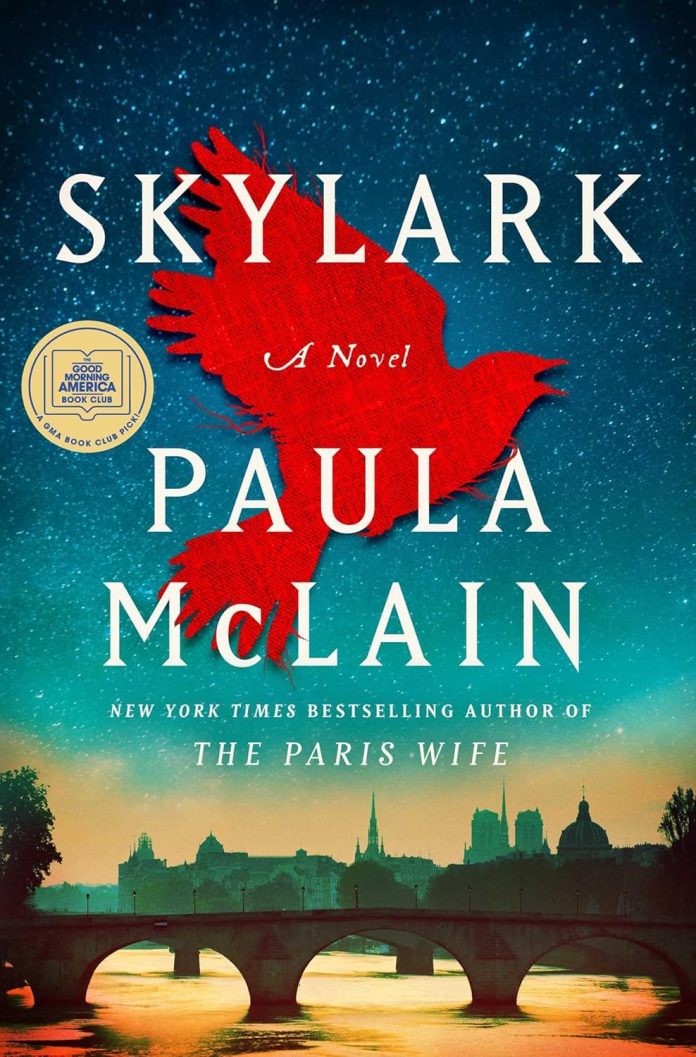
Paula McLain has built a distinguished career excavating the lives of remarkable women obscured by history, from Hadley Richardson in The Paris Wife to Beryl Markham in Circling the Sun. With Skylark by Paula McLain, she ventures into more ambitious territory, weaving dual timelines across centuries to explore how resistance manifests in women who refuse to be silenced. This sprawling historical novel splits its attention between seventeenth-century Paris and the German occupation of the 1940s, finding unexpected connections in the city’s underground passages and the human impulse toward defiance.
The Architecture of Color and Courage
In 1664, Alouette Voland labors in the shadow of the Gobelin Tapestry Works, where her father René serves as a master dyer. McLain renders Alouette’s world with painterly attention to the alchemy of color—how woad transforms green to blue when exposed to air, how cochineal and tin create scarlet fire, how recipes passed down through generations become acts of preservation and power. Alouette dreams not merely of escape but of creation, of claiming the artistry that guild law and social hierarchy deny her. When her father faces imprisonment for allegedly withholding his dyeing formula, Alouette’s desperate attempt to clear his name leads to her own confinement in the notorious Salpêtrière asylum, where thousands of women languish under diagnoses of hysteria and moral corruption.
Nearly three centuries later, Kristof Larson completes his psychiatric residency at Hôpital Sainte-Anne as Nazi forces tighten their grip on Paris. His neighbors, the Brodsky family—Polish Jewish refugees who fled Warsaw—become the anchor that keeps him tethered to humanity as the occupation transforms the city into something unrecognizable. When mass arrests tear Jewish families from their homes in the summer of 1942, Kristof finds himself harboring teenage Sasha Brodsky and three other displaced adolescents. His unlikely path to resistance runs through the Paris catacombs, those limestone tunnels beneath the city where revolutionaries once carved their manifestos and where, now, a new generation seeks sanctuary.
Where Light and Shadow Converge
Skylark by Paula McLain succeeds most powerfully in its excavation of Paris itself as a character—not merely the glittering city of monuments and boulevards, but the forgotten warren of quarries, sewers, and crypts that mirror the world above. McLain clearly invested considerable research into these subterranean spaces, and her descriptions pulse with tactile immediacy. When Alouette escapes Salpêtrière through medieval tunnels, or when Kristof guides terrified teenagers through the catacombs, the reader feels the weight of limestone overhead, smells the mineral dampness, senses the vertiginous possibility of getting lost forever in the dark.
The author demonstrates particular skill in rendering the slow suffocation of occupied Paris through accumulating detail rather than grand proclamation. Ration cards that promise only survival. Radio sets surrendered to police stations. Jewish-owned businesses marked with yellow signs. Young Sasha Brodsky finding solace in Ovid’s Metamorphoses, seeing in the myth of Echo a reflection of her own reduction to a single identity—a yellow star stitched to her clothing. These quiet observations accumulate into a devastating portrait of how totalitarian power operates through the mundane, the bureaucratic, the incremental erasure of human dignity.
Threads That Strain to Connect
Yet for all its ambition, Skylark by Paula McLain occasionally struggles under the weight of its dual narrative structure. The two timelines, while thematically resonant, feel more parallel than genuinely interwoven. Both stories explore women’s confinement, institutional cruelty, and underground spaces as sites of resistance—but the connections remain largely metaphorical rather than structural. Readers seeking the satisfaction of timelines that ultimately converge may find themselves disappointed by how separately these narratives unfold.
The pacing, too, proves uneven. Alouette’s sections often pause for extended passages about dyeing techniques—the chemistry of mordants, the properties of madder versus weld—that, while beautifully rendered, can slow momentum during crucial dramatic moments. McLain writes with genuine passion about the craft of color-making, treating it as both art and rebellion, yet some readers may wish for tighter editing that preserves the poetry while maintaining narrative drive. The extensive attention to period-appropriate detail, though admirable for its historical accuracy, occasionally reads more like research displayed than story told.
Similarly, Kristof’s sections sometimes feel overly deliberate in their emotional processing. His internal struggles with “magical thinking” versus genuine courage, his guilt about his deceased sister, his philosophical conversations with fellow resisters—these psychological explorations add depth but can feel repetitive across the novel’s substantial page count. The reader may find themselves wishing McLain trusted her characters’ actions to reveal their interior lives more efficiently.
Character Studies in Crimson and Shadow
The novel’s greatest strength lies in its portrait of Alouette, a character who burns with the same intensity as the dyes she creates. McLain gives us a young woman whose genius manifests not in spite of her circumstances but through them—she learns to read the Bièvre River’s poisoned waters for the minerals that might yield unexpected hues, to study the interplay of light and pigment with the precision of a chemist and the soul of an artist. Her relationships within Salpêtrière—particularly with Marguerite, a former nurse documenting the asylum’s abuses, and the enigmatic Henriette, who may or may not be her long-lost mother—reveal how women forge community even in spaces designed to break them.
The supporting cast in Kristof’s timeline proves equally compelling:
- Sasha Brodsky, who finds in classical literature both escape and mirror for her own transformation
- Alesander, Kristof’s friend whose resistance activities hide behind a Vichy uniform
- The Brodsky family, whose small rituals of normalcy—Felix’s Go games, Rachel’s mending—become radical acts of persistence
McLain handles the Jewish experience during the occupation with appropriate gravity, drawing on primary sources including Maurice Rajsfus’s accounts and Hélène Berr’s journals to ground fictional events in historical truth.
Technical Craftsmanship and Thematic Resonance
Where Skylark by Paula McLain truly distinguishes itself is in its meditation on transformation—how individuals change form rather than disappear under pressure. Alouette, stained crimson from her fall into the dye vat, becomes a “creature of red and rage” rather than a victim. Sasha, reduced by Nazi policy to a yellow star, finds in Ovid’s metamorphoses a template for survival through change rather than erasure. The underground itself transforms from escape route to hiding place to pathway for resistance, its darkness becoming not absence of light but presence of possibility.
The prose throughout demonstrates McLain’s gift for sensory immersion. She writes about color with the precision of someone who has studied the craft: “It isn’t cobalt oxide, or manganese, or the copper compounds that give Chartres blue its fame. It bears no resemblance to the commercial smalt the other ateliers have begun to use. It is older than she is, older than this glass. Storied. Complex.” This attention to the specific elevates the novel beyond conventional historical fiction into something closer to historical poetry.
For Readers Who Will Appreciate This Journey
This ambitious work will resonate most strongly with readers who value:
- Atmospheric historical fiction that prioritizes mood and setting over plot velocity
- Feminist narratives exploring women’s creative agency in restrictive societies
- Dual timeline structures that emphasize thematic parallels over direct connections
- Literary prose with attention to sensory detail and lyrical rhythm
- Stories of resistance that find heroism in survival rather than grand gestures
Readers seeking page-turning suspense or tightly plotted thrillers may find themselves impatient with McLain’s more meditative approach. The novel demands patience, rewards close reading, and trusts its audience to appreciate complexity over convenience.
Companions on the Shelf
For those who find themselves captivated by Skylark by Paula McLain, these novels offer similar pleasures:
- All the Light We Cannot See by Anthony Doerr—for its dual World War II timelines and exquisite prose
- The Invisible Woman by Erika Robuck—another story of women’s resistance during the occupation
- The Nightingale by Kristin Hannah—French sisters navigating Nazi-occupied France
- The Paris Architect by Charles Belfoure—Paris underground spaces used for hiding refugees
- The Perfume Thief by Timothy Schaffert—occupied Paris through the lens of artistry and survival
- The Lost Notebook by Jillian Cantor—dual timelines connecting Vienna and contemporary Los Angeles
Paula McLain’s earlier works, particularly The Paris Wife and Circling the Sun, share this novel’s interest in historical women who challenged convention, though those books maintain tighter focus on single protagonists.
Skylark by Paula McLain stands as an impressive if imperfect achievement—a novel that reaches for grandeur and largely grasps it, even when its ambitions occasionally exceed its execution. McLain has crafted a meditation on how art becomes resistance, how underground spaces offer both literal and metaphorical refuge, and how women across centuries have transformed oppression into creative force. The result is a literary experience that lingers in the imagination long after the final page, much like the blue Alouette creates—complex, storied, and impossible to dismiss.







