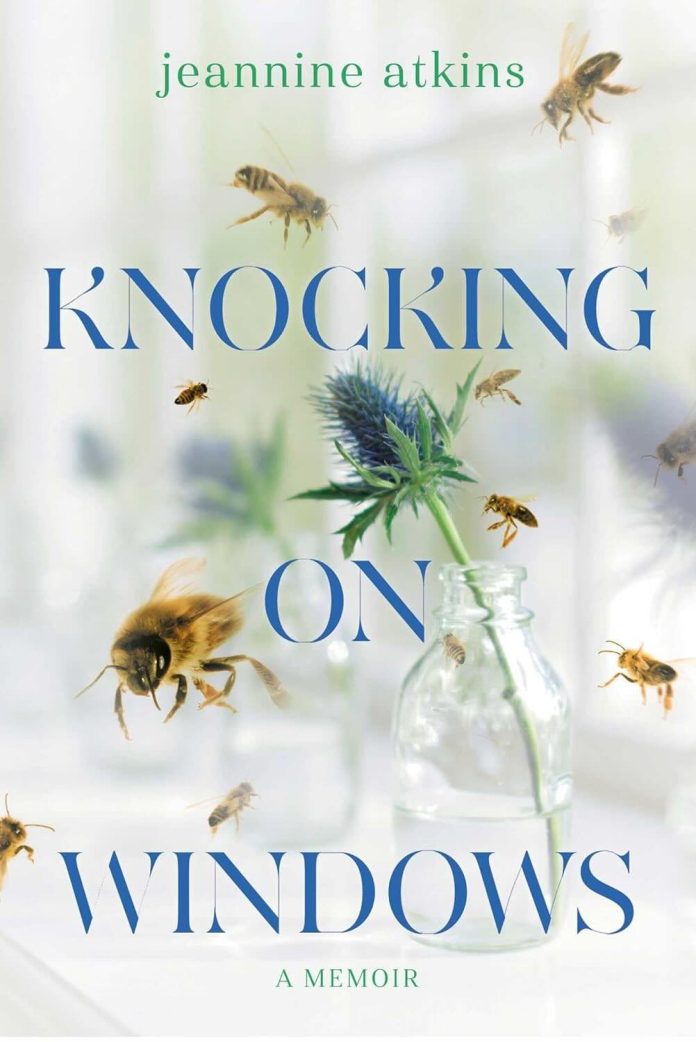
Jeannine Atkins, celebrated author of biographical works for young readers including Finding Wonders and Stone Mirrors, ventures into deeply personal territory with Knocking on Windows, a memoir-in-verse that chronicles her journey from trauma to triumph as a writer. This isn’t just another coming-of-age story—it’s a masterclass in how literature can literally save lives.
The book opens with eighteen-year-old Jeannine returning to her childhood bedroom after just six weeks of college, carrying the weight of an unspeakable trauma. What follows is an unflinching exploration of sexual assault’s aftermath, told through verse that alternates between whisper-soft vulnerability and thunderous rage. Atkins doesn’t simply recount events; she excavates them with the precision of an archaeologist, revealing how memory layers like sediment, shifting and reshaping with each examination.
The Architecture of Memory
Atkins constructs her narrative through seven distinct parts—”Edges,” “Safety Pins and Shears,” “Turning and Turning,” “Telling,” “Paper Birds,” “Breaking Light,” and “Bee Colors”—each representing different phases of her healing and artistic development. This structural approach mirrors the way trauma survivors often experience recovery: not as a linear progression, but as a spiral that revisits familiar territory from new vantage points.
The verse memoir format proves particularly effective for capturing the fragmented nature of traumatic memory. Atkins writes in accessible free verse that reads more like intimate conversation than formal poetry, allowing readers to witness her thought processes in real time. Lines break at natural speech patterns, creating rhythm that mirrors the hesitation and rush of someone learning to speak their truth again.
Her language shifts dramatically throughout the book, evolving from the sparse, careful diction of early trauma to the rich, confident voice of an established writer. This linguistic journey becomes a character arc in itself, demonstrating how finding one’s voice as a writer often means first finding the courage to speak at all.
Literary Mentors as Healing Guides
Perhaps the most compelling aspect of Knocking on Windows is Atkins’ relationship with literary figures, particularly Sylvia Plath, Maya Angelou, and Emily Dickinson. Rather than simply drawing inspiration from their work, Atkins engages in direct dialogue with these writers through letter-poems, creating an imagined community of support across time and death.
Her correspondence with Plath proves especially complex and haunting. Atkins recognizes dangerous parallels in their experiences while desperately trying to forge a different ending. The book’s title itself references this knocking—the desperate plea for acknowledgment, help, and human connection that these writers embedded in their work. When Atkins writes, “You couldn’t save me. I couldn’t save you. / You weren’t meant to show me a way to an end / —there are no endings—but to sometimes / stand side by side knocking on windows, / asking for help,” she articulates the profound responsibility and limitation of literary influence.
This interweaving of personal narrative with literary biography creates a unique reading experience that operates on multiple levels simultaneously. Readers learn about these iconic writers while witnessing how their work functions as both mirror and lamp for someone navigating similar darkness.
Academic Gatekeeping and Gender Politics
Atkins doesn’t shy away from critiquing the literary establishment of the 1970s, particularly its treatment of women writers. Her depiction of university creative writing workshops reveals the casual misogyny that pervaded academic spaces, where male students could dismiss women’s experiences as “too confessional” while their own work was celebrated for its “universal” themes.
The book effectively demonstrates how the personal-is-political framework applies specifically to literary spaces. When Atkins writes about professors who favored “difficult” experimental work over accessible narrative, or classmates who rolled their eyes at “women’s writing,” she illuminates the systemic barriers that have historically kept certain voices from being heard or taken seriously.
These scenes gain additional power from their historical context. Atkins was writing during second-wave feminism’s peak, yet still encountered resistance to women’s stories that feels depressingly familiar today. Her persistence in continuing to write despite this resistance becomes its own form of activism.
Craft and Construction
From a technical standpoint, Atkins demonstrates masterful control over pacing and disclosure. She reveals information strategically, allowing readers to piece together her story at roughly the same rate she was able to process it herself. This creates genuine suspense in a memoir where the broad outlines are established early.
The book’s greatest strength lies in its specificity. Atkins grounds abstract emotional states in concrete details: the red linoleum kitchen floor, the shriveled orange from her former roommate, the hiking boots with red laces. These objects become anchors for memory and meaning, demonstrating how writers transform personal experience into universal truth through attention to particular details.
However, the book occasionally suffers from its own thoroughness. Some sections, particularly those dealing with academic politics and literary theory discussions, feel less essential to the central narrative. While these elements establish important context about Atkins’ intellectual development, they sometimes interrupt the emotional momentum.
Therapeutic Writing vs. Artistic Achievement
One of the book’s most significant achievements is its demonstration of how therapeutic writing can transform into art without losing its healing power. Atkins never sacrifices honesty for literary effect, yet the book succeeds as both personal testimony and crafted narrative.
The writing process itself becomes a character in the story. Readers witness Atkins discovering that she can transmute pain into something beautiful and useful for others. Her descriptions of sitting at her blue typewriter, “reaching for a moment when paper seems like glass,” capture the transcendent potential of artistic creation.
The book argues convincingly that survival narratives deserve space in literature not despite their emotional intensity, but because of it. Atkins proves that “confessional” writing can be just as formally sophisticated and culturally significant as any other mode of expression.
Final Verdict
Knocking on Windows succeeds as both memoir and manifesto, offering readers a blueprint for how literature can function as both refuge and resistance. Atkins has created a work that honors the complexity of survival while refusing to sanitize or sentimentalize the experience.
The book will particularly resonate with readers interested in the intersection of trauma, creativity, and healing. Its honest portrayal of academic misogyny makes it essential reading for anyone involved in literary education or publishing. Most importantly, it offers hope to survivors seeking their own voices.
While the book occasionally gets bogged down in academic detail, its overall impact is undeniable. Atkins has written a memoir that manages to be simultaneously deeply personal and broadly applicable, proving once again that the most specific stories often speak most powerfully to universal human experiences.
Similar Reads
For readers drawn to Knocking on Windows, consider these related works:
- Speak by Laurie Halse Anderson – A groundbreaking novel about finding voice after sexual assault
- The Body Keeps the Score by Bessel van der Kolk – Clinical insights into trauma recovery
- Wild by Cheryl Strayed – Another memoir exploring healing through writing and self-discovery
- The Chronology of Water by Lidia Yuknavitch – A raw memoir-in-fragments about survival and art
- I Know Why the Caged Bird Sings by Maya Angelou – The classic memoir that influences Atkins’ work
- Letters to a Young Poet by Rainer Maria Rilke – On the relationship between suffering and artistic creation
Knocking on Windows stands as a testament to literature’s power to heal, connect, and transform. It’s a book that will stay with readers long after the final page, continuing to knock on the windows of memory and meaning.







