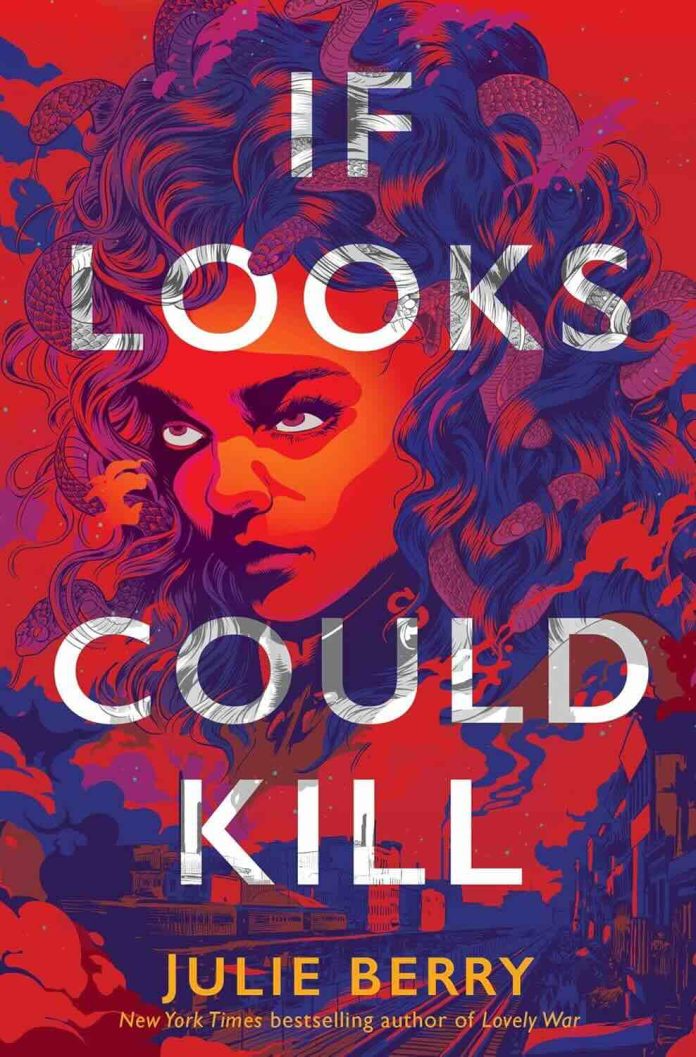
Julie Berry has built her reputation on bold narrative experiments—from the WWI love story narrated by Aphrodite in Lovely War to the medieval persecution tale in The Passion of Dolssa. With If Looks Could Kill, the Printz Honor winner ventures into her most audacious territory yet, weaving ancient Greek mythology into the gas-lit alleys of 1888 Manhattan. The result feels less like historical fiction and more like a fever dream where Jack the Ripper flees across the Atlantic only to discover that some women refuse to remain victims.
The premise alone demands attention: after terrorizing London’s Whitechapel district, the infamous killer encounters a Medusa—yes, the snake-haired woman of legend—who attempts to turn him to stone. When her power fails, something far more sinister occurs: Jack’s touch gains the ability to transform other women into Medusas. He flees to New York, and the hunt begins anew on American soil.
The Unlikely Heroines of the Bowery
Berry anchors this fantastical premise through two Salvation Army volunteers working Manhattan’s notorious Lower East Side. Tabitha Woodward arrives from upstate New York armed with wit, wanderlust, and a wry sense of humor that punctures the solemnity of missionary work. Her partner Pearl Davenport—a farm girl who takes everything with stone-cold seriousness—provides the perfect foil. Their brittle partnership crackles with tension from the opening pages, two young women thrown together by circumstance rather than affection, united only by their tambourines and matching navy uniforms.
The author’s depiction of their Salvation Army work reveals meticulous historical research. The Army’s early American presence beneath Steve Brodie’s saloon on the Bowery, their “Hallelujah Sprees,” and their street-corner evangelism all feel authentically rendered. Berry understands that these young women weren’t naive do-gooders but complex individuals wrestling with genuine questions about faith, class, and their place in a world that offered women precious few avenues for meaningful work. Tabitha’s constant self-examination—her doubts about her calling, her jealousy of Pearl’s certainty, her attraction to Irish bartender Mike—reads as refreshingly honest rather than anachronistic.
When Pearl undergoes her shocking transformation into a Medusa, the story shifts from historical fiction into something far stranger and more primal. Berry’s description of Pearl’s first change captures both the horror and the power of the metamorphosis. Golden serpents erupt from her scalp, her eyes burn red, fangs pierce her gums, and suddenly this pious farm girl becomes an instrument of vengeance. The moment when cabbie falls unconscious from merely glimpsing her new form announces that the rules have fundamentally changed.
The Monster as Social Commentary
Berry’s Medusas function on multiple levels. On the surface, they’re creatures of myth transplanted into Victorian America. But they also serve as potent metaphors for women’s rage against a patriarchal system that treats them as disposable. The novel’s prologue honors the five canonical victims of Jack the Ripper by name, reminding readers that these weren’t “East End prostitutes” (a label Berry’s author’s note challenges) but human beings—Mary Ann Nichols, Annie Chapman, Elizabeth Stride, Catherine Eddowes, and Mary Jane Kelly.
The Medusa’s power—to paralyze men with fear, to exact vengeance for violence against women—becomes a dark wish fulfillment fantasy. When Pearl discovers she can petrify abusive men, “If Looks Could Kill” asks difficult questions about justice versus revenge, about the cost of becoming the monster that hunts monsters. Berry doesn’t offer easy answers. Pearl’s internal struggle between her Christian faith and her desire to punish evil men forms the novel’s moral center, and the author wisely refuses to resolve this tension neatly.
The supporting cast enriches this exploration. Miss Stella, an elderly Medusa living in Greenwich Village, represents what Pearl might become if she embraces her powers fully—isolated, bitter, yet formidable. Aspiring journalist Freyda fights for recognition in a male-dominated profession. Cora and other brothel workers navigate survival in a system designed to exploit them. Even Mike, the Irish bartender who aids Tabitha’s increasingly dangerous rescue mission, must reconcile his attraction to her with the supernatural horrors unfolding around them.
The Ripper Reimagined
Berry makes the provocative choice to give Jack the Ripper a name and face: Francis Tumblety, a real historical suspect whose connection to the murders remains unproven. The author’s note acknowledges this creative license while detailing the extensive research behind her choice. Her Tumblety is neither glamorized nor cartoonishly evil—he’s disturbingly ordinary, a fussy, self-absorbed man whose hatred of women manifests in unspeakable violence.
The greatest strength of If Looks Could Kill lies in demythologizing the Ripper. Rather than treating him as a fascinating puzzle or criminal mastermind, Berry presents him as a coward who preys on vulnerable women. His scenes are deliberately unpleasant, written to make readers uncomfortable rather than titillated. When he flees detection in London and arrives in New York, he brings not just his knives but his pathetic rationalizations—claiming his murders serve some higher purpose, some twisted quest for immortality through theosophical experiments.
The final confrontation between Pearl and Jack unfolds in a burning cellar, a descent into literal and figurative hell where vengeance and mercy collide. Berry writes this sequence with operatic intensity, Pearl’s serpents hissing as flames consume the building, Jack cowering before the manifestation of all his victims’ rage. Yet in the moment when Pearl could end him, she hesitates. The reason for her hesitation—her concern for how Tabitha would view her if she became a killer—adds unexpected emotional weight to what could have been a straightforward revenge fantasy.
Where the Serpents Tangle
The novel’s ambitions occasionally exceed its execution. The plot sprawls across two continents and multiple narrative threads, and not all receive equal development. The rescue mission involving Cora and Freyda from a Bowery brothel, while thematically relevant, feels somewhat disconnected from the main Jack-versus-Medusa storyline. Some readers may find the pacing uneven, with long stretches of Salvation Army work and character development punctuated by bursts of supernatural violence.
Berry’s prose, while often lovely, sometimes strains under the weight of her multiple narrative modes. The book shifts between Tabitha’s first-person present-tense narration, Pearl’s more formal third-person sections, and chapters following Jack that adopt his disturbing perspective. While this approach allows for varied viewpoints, the constant shifting can be disorienting, particularly in the novel’s crowded middle section where numerous plot threads compete for attention.
The mythology underlying the Medusa curse remains somewhat murky. How exactly does one become a Medusa? Why do some women transform while others don’t? What are the rules governing their powers? Berry provides partial answers through Miss Stella’s explanations, but readers seeking a fully-realized magical system may feel frustrated by the ambiguity. This vagueness serves the novel’s mythic quality—ancient magic shouldn’t necessarily follow logical rules—but it occasionally creates confusion about what’s possible and what’s at stake.
The Historical Tapestry
Where Berry truly excels is in rendering 1888 Manhattan in all its grimy, vibrant detail. The Bowery comes alive with its dime museums, concert saloons, and tenement buildings. Characters navigate through Five Points, past the Curiosity Musée with its sideshow attractions (including “Giselle the Gorgon of Gotham,” a delicious meta-textual touch), and into spaces where immigrants, workers, and criminals collide. The author’s research into the Salvation Army’s early American presence, the living conditions of the urban poor, and the daily realities of 1880s New York enriches every scene.
Berry also demonstrates impressive restraint in her historical detail. Rather than overwhelming readers with period-specific information, she lets details emerge naturally through character observations. Tabitha’s outsider perspective allows for occasional explanations without feeling like a history lesson. The inclusion of real historical figures—Co-Commanders Ballington and Maud Ballington Booth, brothel madam “Mother” Rosie Hertz—grounds the supernatural elements in documented history.
A Love Song to Sisterhood
Beneath the mythology and murder, If Looks Could Kill is fundamentally about female friendship and solidarity. Tabitha and Pearl’s relationship evolves from mutual irritation to grudging respect to something approaching genuine care. They learn to see past their surface differences—Tabitha’s irreverence versus Pearl’s piety, wit versus seriousness—to recognize their shared determination to make a difference in an indifferent world.
The most moving moments in If Looks Could Kill occur not during supernatural confrontations but in quieter scenes of women supporting one another. Tabitha’s dogged determination to save Pearl despite not understanding what she’s become. Miss Stella’s grief over her lost daughter. Freyda’s ambition to tell women’s stories rather than sensationalize their suffering. Cora’s resilience in the face of exploitation. These relationships form the novel’s emotional foundation, suggesting that true power comes not from serpentine hair but from women refusing to abandon one another.
The Verdict on Vengeance
If Looks Could Kill is an imperfect but undeniably ambitious novel that refuses easy categorization. It’s part historical fiction, part mythology, part feminist reimagining of true crime, and part coming-of-age story about two young women discovering their capacity for both faith and fury. Berry’s willingness to blend genres and challenge expectations won’t satisfy every reader—those seeking straightforward historical fiction or traditional fantasy may find the hybrid approach frustrating—but adventurous readers will appreciate the author’s audacity.
The novel works best when read as a thought experiment: What if women’s rage could manifest as literal power? What if victims could fight back against their victimizers? What if mythology wasn’t dead but merely sleeping, waiting for the right moment to awaken? Berry explores these questions with intelligence and passion, even when her execution doesn’t quite match her vision.
Readers familiar with Berry’s previous work—particularly Lovely War with its mythological narrators and The Passion of Dolssa with its historical persecution—will recognize her signature blend of meticulous research and imaginative flights. Those new to her writing should prepare for prose that shifts between conversational and lyrical, for plots that zigzag rather than march in straight lines, and for characters who grapple with moral complexity rather than embodying simple virtue or vice.
For Readers Who Crave
Similar journeys through myth and history:
- Circe by Madeline Miller – another reimagining of a mythological woman’s story
- The Mermaid and Mrs. Hancock by Imogen Hermes Gowar – historical London meets the fantastical
- Gods of Jade and Shadow by Silvia Moreno-Garcia – mythology colliding with the modern world
- The Invisible Life of Addie LaRue by V.E. Schwab – deals made with powerful entities across centuries
- The Midnight Bargain by C.L. Polk – women’s agency in historical fantasy settings
Other Julie Berry titles worth exploring:
- Lovely War – WWI romance narrated by Greek gods
- The Passion of Dolssa – medieval France and religious persecution
- All the Truth That’s in Me – a girl who lost her voice finds her story
The Publisher’s Bargain
In the spirit of transparency that Tabitha herself would approve, I should note something about how this review of If Looks Could Kill came to be. Simon & Schuster extended their hand across the publishing chasm, offering a review copy in exchange for honest thoughts. Like a character in Berry’s novel accepting help from an unexpected source, I accepted—no serpents required, no souls bargained, just the simple transaction of books for words. The opinions herein are my own, influenced only by the text itself and perhaps by one too many late nights reading by lamplight, imagining golden snakes writhing in the shadows.







