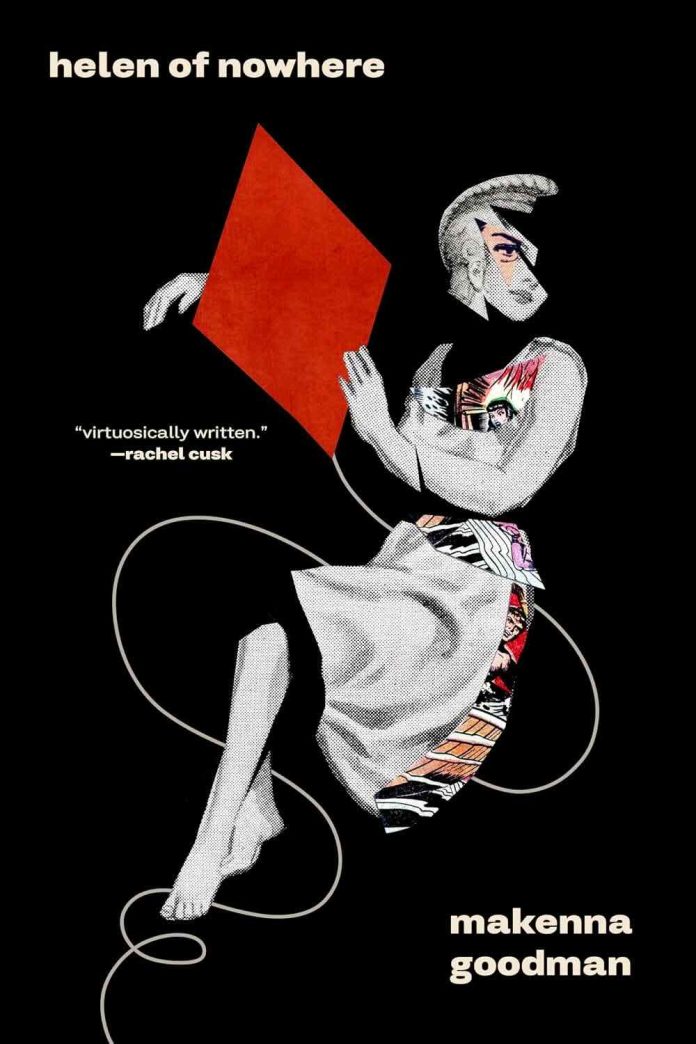
A man in a wool vest drives all day to look at a house he probably cannot afford, in a part of the country he has never lived in, because everything else in his life has been taken away from him. That is the entire premise, and it is enough. Helen of Nowhere by Makenna Goodman is 140 pages long, has four characters, opens with a cast list and divides itself into six acts, and is the most formally fearless book on this year’s Booker Prize 2026 longlist.
Goodman’s second novel, after The Shame in 2020, arrived from Coffee House Press in the United States before Fitzcarraldo Editions brought it to the UK in January 2026. Fitzcarraldo is the right home for it. This is a book that treats the novel as a container it has no particular loyalty to.
What Helen of Nowhere Is Actually About
The man is never named. He is listed simply as MAN, late fifties, and he used to run a celebrated university programme in nature writing until a younger generation of women colleagues took his methods apart and he lost the department, the reputation and, eventually, the wife. He has come to find the real thing, having decided the city’s green spaces are mere gestures.
The realtor meets him at the house and begins to talk. She talks about Helen, the elderly woman who owned it and now lives in assisted living. She talks about the built-in couch, the poppies, the aunt who bought the place after the war. And she talks about industrial agriculture for what feels like an hour. And then, somewhere in the third act, she stops selling him the house at all and offers him something else entirely, for which the price is not money.
Saying more would spoil a book that depends on the reader not knowing where the floor is. What can be said is that Helen of Nowhere by Makenna Goodman keeps moving the floor, and that the last two acts do something this reviewer did not see coming and has not stopped thinking about.
A Man Explaining Himself
The first act is a single sustained performance of self-exculpation, and it is a masterclass. The man tells us he has nothing against women. He tells us he loved women, worked hard for women his entire life. He tells us he is not a bad man, “Nowhere near it,” and then reports, without appearing to notice, that he once longed for someone to eradicate his critics.
Goodman never editorialises. She lets him keep talking, and every defence becomes evidence. He explains that he noticed a student’s beauty only objectively. He explains that his wife’s beauty was withering rather than ripening, concedes this was unfair, and keeps going. The comedy sits in the gap between what he thinks he is telling us and what he is telling us, and the gap never closes.
The set piece that carries the whole book is a colleague’s theory about takers and doers, which he recounts at length in order to dismiss. A taker, she has told him, is someone who already has enough and will not share, and who must look like a doer for the taking to work. He relays this with mounting irritation, entirely unaware that he is delivering his own charge sheet. It is very funny and genuinely uncomfortable, which is the register Goodman is best at.
What Works
- The voice discipline. Helen of Nowhere runs on four speakers with four completely distinct rhythms. The realtor’s rolling, digressive salesmanship could not be mistaken for the professor’s careful self-defence, and neither could be mistaken for Helen’s flat, unhurried authority.
- The pond parable. In the fourth act a story is told about lending a swimming pond to a neighbour’s son, and what it costs. It runs a few pages, it is completely deadpan, and it is the sharpest thing about generosity, property and self-regard that I have read this year.
- The nerve of the ending. The final act performs a manoeuvre that recasts everything preceding it. Not a twist in the thriller sense, but a relocation. It should not work. It works.
- Comic timing in a serious book. A three-legged dog tears around a room in tightening circles at exactly the moments the prose is at its most portentous, and the effect is to keep puncturing the mysticism the book is otherwise flirting with.
Where It Stumbles
- The agriculture lecture. The realtor’s account of how chemical companies captured farming after the war runs for several pages, and for those pages she stops being a character and becomes a delivery system for an argument. The argument is decent. Helen of Nowhere stops dead.
- The wellness chapter goes flat. The channeling session in the third act is written in deliberate self-help banality, all “baby” and energy and ego, which is the point. Deliberate flatness is still flat, and a stretch of it tests the patience.
- The play framing overpromises. A cast list, six acts, a form that invites the question of whether this is a novel or a script. In practice the book is interior monologue rather than dialogue, and the theatrical apparatus flatters the experiment more than it shapes it.
- The man arrives fully diagnosed. By the end of act one there is very little left to learn about him. What follows is structurally surprising but psychologically settled, and readers who want a character to move will find only the frame moving around him.
Nature in Helen of Nowhere, and Who Gets to Stand In It
Underneath the comedy is a real argument, and Goodman is careful to give the best of it to the people the professor dismisses. His entire career rested on the idea that within nature exists the divine, and that the work of a teacher is to strip away human construction until being is possible. His student takes this apart in a single presentation: that any purity in nature is imposed by people who need it as a shield from their own complicity, and that what he was really looking for was not nature but an absence of politics.
He never recovers from that, and the novel is largely the record of a man refusing to. Even his birds get taken from him. The realtor tells him that sapsuckers drill living trees until they die and that hummingbirds follow them to feed on the wounds, so nobody is innocent, and that a murmuration of starlings is beautiful precisely because it also looks like a plague coming for you. Nature is not a refuge in this book. It is simply another place where things eat each other.
Who This Is For
Reach for Helen of Nowhere by Makenna Goodman if you like novels that are mostly voice, if the phrase “a novel in six acts” is an enticement rather than a warning, and if you enjoy watching a narrator convict himself while believing he is mounting a defence. Skip it if you need plot, warmth or a character to root for. There is not one, and that is deliberate.
At 140 pages it asks little of your week and a great deal of your attention, and it improves on a second reading, mostly because the first is spent working out what kind of object you are holding.
Read These Next
- Outline by Rachel Cusk. The obvious ancestor, and Cusk blurbed this one. A narrator who mostly listens while other people talk themselves into revelation.
- Universality by Natasha Brown. Short, cold and forensic about who controls a story and what they get out of controlling it.
- Disgrace by J.M. Coetzee. The other great novel of an academic man who cannot understand why the ground has moved. Harder, sadder, less funny.
- Happiness Forever by Adelaide Faith. For the same interest in therapy as a place where people go to be told stories about themselves.
- The Shame by Makenna Goodman. Her 2020 debut, about envy between women and the risks people take to avoid the risks that matter.
The Last Word on Helen of Nowhere
Helen of Nowhere by Makenna Goodman is a short book with a very long reach. It is a satire of a certain kind of literary man, an argument about what nature writing has been used to hide, a ghost story that may not have a ghost in it, and a piece of formal mischief that earns its cleverness in the final pages rather than announcing it on the first.
It is not flawless. The middle sags where the polemic takes over, and readers who want more than a voice will find the man himself a closed case from early on. But the ambition is real, the jokes land, and the last act is the boldest thing on the Booker Prize 2026 longlist so far.
He came looking for a simpler life. What he gets is an accounting.







