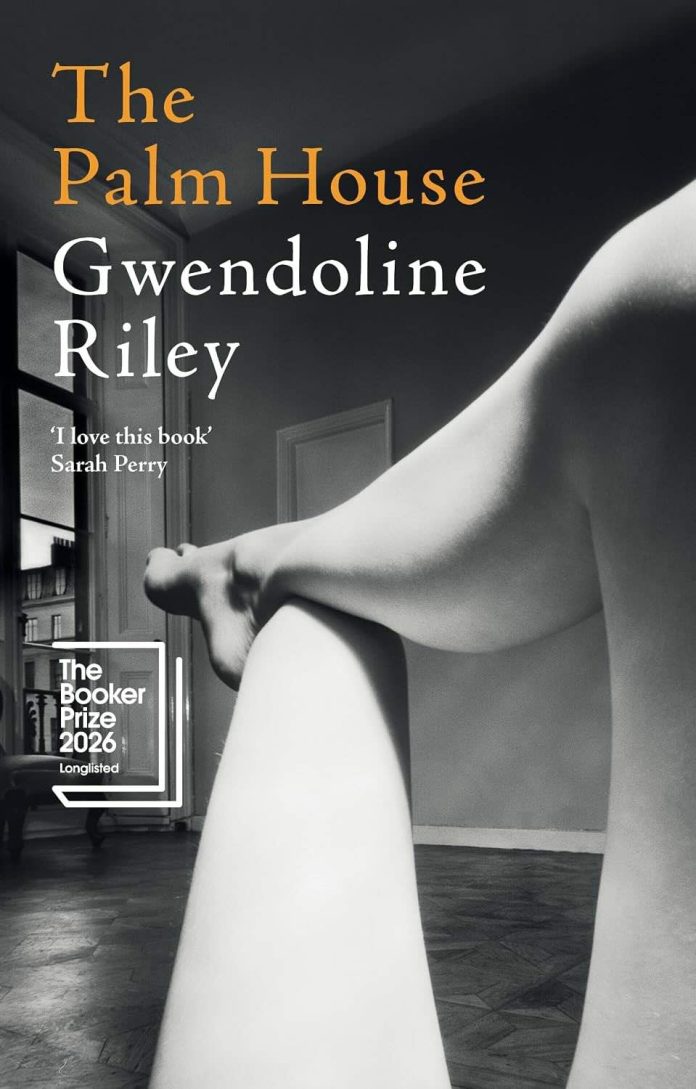
Two friends are sitting outside a pub on Bankside under a yellow sky, and the sky is yellow because a hurricane has carried Saharan sand and Iberian wildfire ash over London. They eat salt and vinegar crisps out of a split bag. They talk about a boy one of them knew at school forty years ago. Nothing else occurs. It is one of the best openings I have read this year, and The Palm House by Gwendoline Riley spends the next 130 pages proving that this is all a novel needs.
Riley’s eighth book arrives from Picador in April 2026 and onto the Booker Prize 2026 longlist, where the judges reached for the highest compliment available in this line of work: they said it contains some of the best dialogue this side of Henry Green. That is a large claim. It is also, I think, correct.
What Happens in The Palm House, Which Is Almost Nothing
Laura Miller is a writer in her forties, working her way through a series of London jobs: a lurid popular history magazine, then the BFI. Edmund Putnam is her friend of twenty-odd years, forty-nine, deputy editor of a small serious magazine called Sequence, where he has worked since 1992.
Two things happen to Putnam in the same year. His father Martin dies, slowly and badly. And Sequence gets a new editor, Simon Halfpenny, who insists everyone call him Shove, who has come across from a sports title, and whose stated ambition is to make Sequence “a sort of London version of the New Yorker”.
Putnam resigns. Then he suffers, at length, in pubs, at his friends. That is the plot of The Palm House by Gwendoline Riley, and around it Laura assembles her own life in pieces: a Wirral childhood with a brisk, deflecting mother and a grandmother who once got mistaken for Myrna Loy, a father in Warrington she visits every few years, a run of men in London who are all, in different ways, absent while present.
The Dialogue in The Palm House Really Is That Good
Most of this novel is two people talking, and Riley does something with dialogue that almost nobody else manages: she writes speech that is simultaneously very funny and a complete X-ray of the speaker.
Putnam is a magnificent creation. He is cultured, principled, kind to children and to elderly contributors, genuinely good at a job that matters to him, and he is also, in grief, an absolute menace to be around. He works his own misfortune like a jeweller. “Not a dicky bird,” he says, triumphantly, of the job offers he has not received, having applied for nothing. Laura’s private image for this phase is that Putnam has taken to wearing a coffin out to the pub and daring his friends to mention it.
Shove, meanwhile, is drawn almost entirely through reported speech and two editorial sentences, one of which begins by explaining who wrote that April is the cruellest month. He never becomes a villain. He becomes something worse, which one character nails precisely: loudly enthusiastic, and without a scrap of curiosity.
What Works
- Comic precision. The Palm House is very funny in a way that never breaks character. A colleague’s newsletter christened The Pitt Take. A nickname for Shove that derives from how he wears his jeans. A vegetarian dinner where every spice sits in its own ramekin because that is how they did it on television.
- The mother. Laura’s mother is a small masterpiece of characterisation by catchphrase. Faced with a Spanish waiter asking after an ex-boyfriend she cannot be bothered to explain, she simply reports that he has died, and then orders patatas bravas.
- Objects that do the work. The split crisp bags, the postcards on a corkboard, a Lemsip gone cold on a bedside table. Riley trusts things to carry feeling and almost never explains them.
- The title pattern. Palms recur throughout: a palmist’s hands, Putnam’s eczema-split palms, and the Kew palm house he keeps meaning to visit with his father and never does. It is beautifully done and never once pointed at.
Where It Stumbles
- You must be content with very little event. A man leaves a magazine, is unpleasant about it for a year, and the magazine recovers. If you need narrative propulsion, The Palm House is not the book.
- The world is narrow. Small-magazine London, its drinks, its board, its Private Eye leaks. The satire is expert and the stakes will feel minute to anyone outside that ecosystem.
- Laura stays behind glass. She is a superb noticer and an almost total withholder. That is the design, but readers who want interiority from a first-person narrator will spend the book locked out.
- Threads are picked up and dropped. A lodging arrangement in the last third builds a real, low hum of menace, then simply ends. Deliberate, I am sure. Still frustrating.
The Chapter in Part Two
There is a long section in the second part of the novel in which Laura describes being fifteen and becoming a fan of a stand-up comedian, sending him recorded tapes, being put on the guest list, and eventually travelling alone to his flat in London.
I am not going to describe what happens there. What I will say is that Riley writes it in exactly the same flat, unhurried register she uses for pub conversation and crisp packets, and that this decision is the most devastating thing in the book. There is no music under it. There is no adult narrator arriving to name the crime. And there is a girl who does not have the words, a dictionary her mother told her to use, and a chemist’s counter.
It sits in the middle of The Palm House and is never returned to, which is itself the point. Readers should know it is coming, and readers for whom that material is difficult should take that seriously. If any of it lands close to home, Rape Crisis England and Wales has plain, useful information about what child sexual abuse is and where support exists.
A Word on Content Warnings
Child sexual abuse, including the grooming of a minor and its physical aftermath, described plainly. Also: parental cruelty, terminal illness, bereavement, alcohol dependency, disordered eating around a body, and a sustained portrait of depression.
Who This Is For
Reach for The Palm House by Gwendoline Riley if you love talk, if you have ever loved an institution that was captured by someone unequal to it, if you admire writing that refuses to tell you how to feel. Skip it if you want plot, resolution, or characters who explain themselves.
It is short. It is not light. And it is the sort of novel where the last page arrives and you realise she has been building something the entire time out of crisps and weather.
Read These Next
- My Phantoms by Gwendoline Riley. Her previous novel, shortlisted for the Rathbones Folio Prize, and the best place to go next for her particular mode of a daughter watching a parent perform.
- Loving by Henry Green. The comparison the judges made, and worth testing yourself. Green wrote servants’ hall dialogue that behaves like weather.
- Open, Heaven by Seán Hewitt. Another spare, English, backward-looking novel about longing and what a young person cannot yet say.
- Confessions by Catherine Airey. For the braiding of a woman’s present with a childhood that will not stay in the past.
- The Things We Never Say by Elizabeth Strout. Also on this year’s longlist, also about a decent person carrying something unnamed, and a useful contrast in how differently two quiet novels can be built.
The Last Word on The Palm House
Late in the book, Putnam explains that his neighbour’s courtyard jungle thrives on neglect, and then corrects himself: not total neglect, not abandonment. That is the whole novel in a sentence, and Riley is far too disciplined to say so.
The Palm House by Gwendoline Riley is the most accomplished piece of writing on the Booker Prize 2026 longlist. It is also the one most likely to be underestimated, because its surfaces are so calm and its subject appears to be a man being tiresome about his job. Underneath that is a book about the people who hold things up, and what it costs them, and how rarely anybody notices in time.
He kept meaning to go and see the old cycad at Kew. That is the kind of thing this novel knows how to break your heart with.







