The Complexity of Human Connection
We like to think we know our loved ones completely. That the bonds of family transcend all barriers. But what if the person closest to you—your child, your sibling, your spouse—had a rich inner world you’d never accessed? What if your assumptions about their capabilities and desires were fundamentally wrong? And how far would you go to bridge that gap in understanding, especially when a life hangs in the balance?
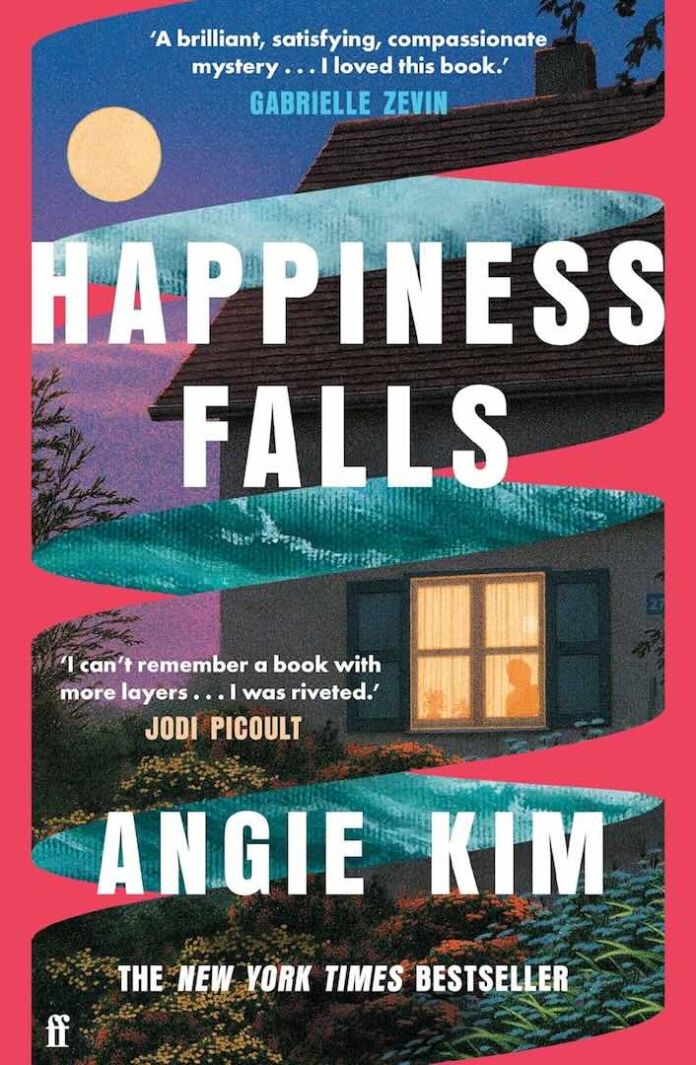
These are the profound questions at the heart of Angie Kim’s masterful new novel, Happiness Falls. On the surface, it’s a missing person thriller that will keep you furiously turning pages. But Kim uses the framework of that mystery to craft a deeply moving exploration of family, disability, cultural identity, and the very nature of human connection.
A Family Upended
“Happiness Falls” centers on the Parkson family—biracial Korean-American parents Hannah and Adam, their 20-year-old twins Mia and John, and 14-year-old Eugene, who has a rare genetic condition called Angelman syndrome that prevents him from speaking. When Adam disappears during a walk in the park with Eugene, the family’s desperate search forces them to confront painful truths about themselves and each other.
Kim structures the novel primarily from Mia’s first-person perspective, and her voice is one of the book’s greatest strengths. Mia is hyperanalytical, irreverent, and achingly human in her flaws and insecurities. Her narrative is punctuated by footnotes and digressions that offer both comic relief and deeper insight into her character. Through Mia’s eyes, we see the family’s history unfold in a series of flashbacks, building a rich tapestry of memories, conflicts, and unspoken tensions.
Unraveling the Mystery
The plot unfolds over an intense 48-hour period as the Parksons frantically search for Adam. Kim ratchets up the suspense masterfully, dropping tantalizing clues and shocking revelations that keep the reader guessing until the very end. We learn of a mysterious woman in Adam’s life, a secret bank account, and troubling experiments Adam was conducting related to happiness and expectations.
But the true heart of the mystery lies with Eugene. As the only witness to Adam’s disappearance, Eugene holds the key to solving the case. Yet his inability to speak presents a seemingly insurmountable barrier. The family’s struggle to communicate with Eugene—and their dawning realization that they may have drastically underestimated his comprehension and inner life—forms the emotional core of the novel.
The Power of Language
Kim, whose background includes a linguistics degree, delves deep into questions of language and communication. Through Eugene’s journey, she explores fascinating theories about innate language capabilities, alternative communication methods, and the profound impact of being unable to express oneself.
One of the novel’s most powerful scenes involves Eugene using a specialized letterboard to painstakingly spell out his account of what happened to Adam. The excruciating slowness of the process—each letter taking minutes to indicate—creates almost unbearable tension. It’s a masterful depiction of the frustration of having complex thoughts trapped inside with no easy way to convey them.
Cultural Identity and Family Dynamics
As in her debut novel Miracle Creek, Kim brings nuanced insight to the immigrant experience and the complexities of biracial identity. Hannah and Adam’s different cultural backgrounds create subtle but important tensions in their parenting approaches and family dynamics. Mia and John’s struggles to reconcile their Korean and American identities add another layer of depth to the story.
The novel also offers a poignant exploration of sibling relationships, particularly between neurotypical siblings and those with disabilities. Mia’s conflicted feelings towards Eugene—love mixed with resentment, protectiveness tinged with fear—ring achingly true. Her journey towards truly seeing and understanding her brother is one of the book’s most moving arcs.
Philosophical Depths
While the plot moves at a thriller’s pace, Kim interweaves profound philosophical inquiries throughout. Adam’s obsession with quantifying and maximizing happiness raises fascinating questions about the nature of human contentment. Can we engineer our own happiness through careful management of expectations and baselines? Or does the very act of trying to control it doom us to dissatisfaction?
The novel also grapples with heavy existential themes around free will, the limits of human understanding, and what truly constitutes communication and connection. Kim doesn’t offer easy answers, instead inviting the reader to wrestle with these complex ideas alongside her characters.
A Twist That Changes Everything
Without spoiling anything, there is a major revelation near the end of the novel that forces both the characters and the reader to reevaluate everything that came before. It’s a risky narrative move, but Kim pulls it off brilliantly. The twist deepens the story’s philosophical inquiries while adding new layers of emotional resonance to the family’s journey.
Standout Elements
Vivid Characters
Kim excels at creating complex, flawed characters that leap off the page:
- Mia’s sharp wit and penetrating self-awareness make her a compelling narrator
- Adam’s well-intentioned but misguided attempts to quantify happiness are both touching and tragic
- Hannah’s guilt and fierce protectiveness as Eugene’s mother feel painfully real
- John’s relentless optimism serves as an interesting foil to Mia’s cynicism
- Eugene emerges as the novel’s most fascinating figure, his rich inner world slowly revealed
Immersive Setting
The novel’s Virginia setting is vividly rendered, from the lush trails of River Falls Park to the claustrophobic tension of the family home during the search. Kim has a knack for sensory details that bring each scene to life.
Pacing and Structure
Kim masterfully balances the forward momentum of the missing person investigation with carefully placed flashbacks that deepen our understanding of the characters and their relationships. The tension builds relentlessly towards a climax that is both shocking and emotionally satisfying.
Thought-Provoking Themes
Some of the big ideas the novel tackles include:
- The limits of human understanding and communication
- Nature vs. nurture in shaping personality and capabilities
- The impact of cultural background on family dynamics
- Ethical questions around treatment of disabilities
- The psychology of happiness and managing expectations
Minor Criticisms
While Happiness Falls is an exceptional novel overall, there are a few minor quibbles:
- Some readers may find Mia’s voice overly precocious or her digressions occasionally distracting
- The philosophical musings, while fascinating, occasionally slow the narrative momentum
- A few plot points rely on somewhat implausible coincidences
These are small complaints, however, in a work of such ambition and emotional power.
Comparisons and Context
Fans of Kim’s debut novel Miracle Creek will find much to love here. She brings the same keen insight into immigrant families and moral complexity, but Happiness Falls feels like a significant step forward in terms of narrative ambition and thematic depth.
The novel’s blend of page-turning suspense and weighty philosophical inquiry brings to mind works like Celeste Ng’s Everything I Never Told You or Marilynne Robinson’s Home. Kim’s nuanced portrayal of disability and family dynamics also echoes elements of Mark Haddon’s The Curious Incident of the Dog in the Night-Time.
Final Verdict
Happiness Falls is that rare novel that works on every level—as a gripping mystery, a moving family drama, and a work of serious philosophical inquiry. Kim’s prose is sharp and often beautiful, with moments of startling insight and emotional truth. The characters will linger in your mind long after you turn the final page, and the book’s profound questions about human connection and understanding may change the way you view your own relationships.
This is a novel to savor, discuss, and return to. It cements Angie Kim’s place as one of the most exciting and thoughtful voices in contemporary fiction. Highly recommended for book clubs, as it offers rich material for discussion on topics ranging from family dynamics to disability rights to the very nature of happiness itself.







