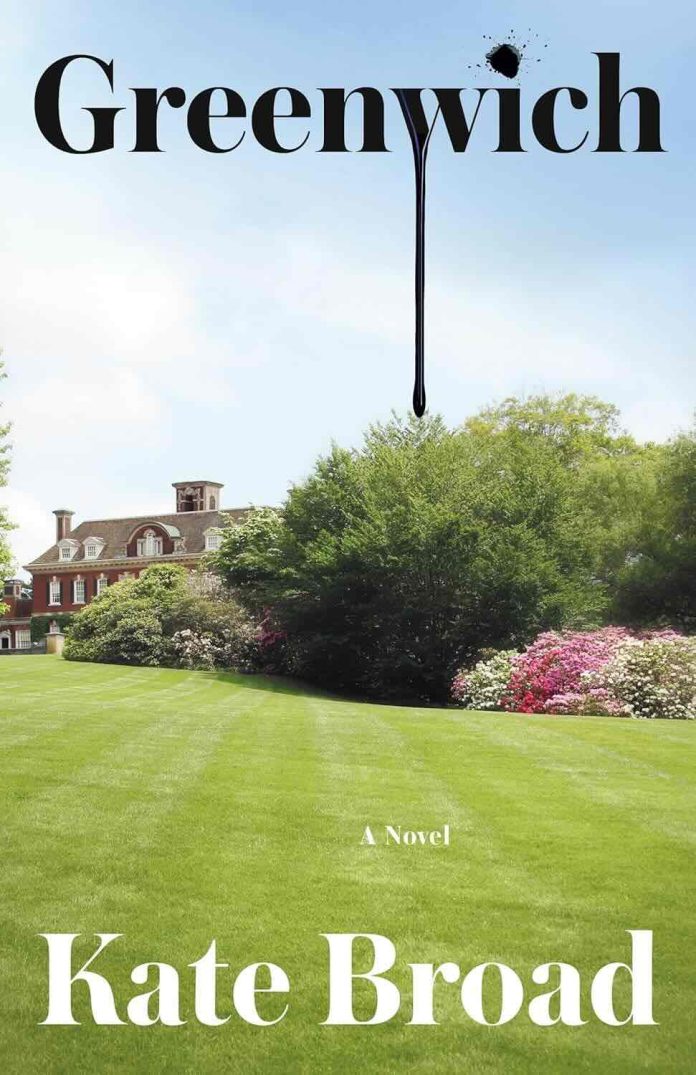
Kate Broad’s debut novel Greenwich arrives like a perfectly timed indictment of privilege in America, wrapped in the seductive prose of a coming-of-age story that refuses to offer easy absolution. Set against the backdrop of Connecticut’s most affluent enclave during the summer of 1999, this is a book that understands how wealth and whiteness conspire to protect their own, even when—especially when—the cost is devastating.
The Heart of Darkness in America’s Gilded Suburb
The story follows seventeen-year-old Rachel Fiske, who arrives at her aunt and uncle’s Greenwich mansion seeking redemption from her own teenage mistakes, only to become complicit in something far worse. What begins as a languid summer of pool days and stolen moments with Claudia, the live-in babysitter, transforms into a moral labyrinth when three-year-old Sabine falls to her death from a third-floor window.
Broad’s genius lies in how she structures this tragedy. The accident itself—Sabine climbing onto a chair to see through a torn window screen, falling while calling for attention from the adults below—feels both inevitable and preventable. It’s the kind of split-second catastrophe that haunts every parent’s nightmares, yet Broad demonstrates how systemic inequality transforms personal tragedy into institutional injustice.
The Architecture of Complicity
The novel’s most devastating insight concerns how quickly the Corbin family mobilizes their considerable resources to deflect blame onto Claudia, a young Black woman whose only crime was being present when tragedy struck. Laurent Corbin’s connections, Ellen’s political aspirations, and the family’s embedded social capital create an ecosystem where wealth buys not just comfort, but the power to rewrite narrative itself.
Broad captures this process with surgical precision. The media coverage, the legal maneuvering, the way Rachel’s testimony is shaped and weaponized—all of it feels unnervingly authentic. The author’s background in English literature serves her well here; she understands how stories become truth through repetition and institutional backing.
Rachel’s Moral Labyrinth
Rachel emerges as one of the most complex protagonists in recent literary fiction. Neither innocent nor malicious, she embodies the particular moral blindness of privileged youth. Her attraction to Claudia—both romantic and aspirational—complicates her eventual betrayal in ways that feel genuinely tragic rather than melodramatic.
The novel’s structure, moving between the summer of 1999 and Rachel’s adult reckoning nineteen years later, allows Broad to explore how complicity calcifies over time. Adult Rachel, now a doctor, carries the weight of her choices while still struggling to fully comprehend their impact. Their final confrontation, when Rachel attempts an apology that Claudia rightfully rejects, demonstrates Broad’s refusal to offer cheap redemption.
Language as Sharp as a Scalpel
Broad’s prose possesses an understated elegance that recalls the best of literary fiction while maintaining the page-turning momentum of domestic suspense. Her descriptions of Greenwich’s manicured perfection feel simultaneously seductive and sinister:
“The houses were damp and stacked with used paperbacks and thousand-piece puzzles of Bavaria or water lilies or a family of tigers.”
This is writing that understands place as character, where every detail—from Ellen’s “buttery leather and buttery cheeses both flown in from France” to the “chili lights” strung along working-class docks—reinforces the novel’s themes of economic and social stratification.
Where the Novel Stumbles
Despite its considerable strengths, Greenwich by Kate Broad occasionally suffers from the weight of its own ambitions. Some of the secondary characters, particularly Laurent, veer toward caricature rather than complex portraiture. The novel’s political messaging, while important, sometimes overwhelms the more subtle emotional truths Broad excavates so skillfully elsewhere.
The dual timeline structure, while thematically resonant, creates pacing issues that may frustrate readers seeking more traditional narrative satisfaction. Broad’s commitment to moral ambiguity, admirable in its refusal of easy answers, sometimes leaves readers grasping for emotional purchase.
A Mirror to Contemporary America
What makes Greenwich by Kate Broad particularly relevant is how it anticipates our current moment of racial reckoning and growing awareness of systemic inequality. Written before the protests of 2020, the novel feels prophetic in its examination of how privileged families deploy their resources to avoid accountability.
The book’s exploration of sexual awakening and identity within this framework adds another layer of complexity. Rachel’s attraction to Claudia represents not just personal desire but a yearning for authenticity in a world built on carefully maintained facades.
Literary Lineage and Contemporary Relevance
Greenwich by Kate Broad joins a distinguished tradition of novels examining American privilege, from Edith Wharton’s gilded age satires to more recent works like Jess Walter’s Beautiful Ruins and Rumaan Alam’s Leave the World Behind. Broad’s particular contribution lies in her focus on how tragedy becomes commodity in the hands of those with enough money to buy their preferred version of truth.
The novel particularly resonates with readers of Celeste Ng’s Everything I Never Told You and Little Fires Everywhere, both of which explore how race and class intersect in seemingly progressive communities. However, Broad’s work possesses a harder edge, less interested in reconciliation than in exposing the mechanisms of systemic protection.
The Verdict: A Necessary and Powerful Debut
Greenwich by Kate Broad succeeds as both an absorbing character study and a scalding social critique. While it may not offer the emotional catharsis some readers seek, it provides something perhaps more valuable: a clear-eyed examination of how privilege operates to protect itself at the expense of the vulnerable.
Broad has crafted a novel that lingers long after the final page, its moral questions echoing in our contemporary moment. This is the kind of book that demands discussion, that resists easy consumption in favor of difficult truths.
For readers willing to engage with its moral complexity, Greenwich offers rewards commensurate with its ambitions. It announces Kate Broad as a novelist capable of tackling the most pressing issues of our time with both literary sophistication and emotional honesty.
Similar Books Worth Reading
If Greenwich by Kate Broad resonates with you, consider these related titles:
- Celeste Ng – “Little Fires Everywhere“ – Another examination of privilege and race in an affluent community
- Jess Walter – “So Far Gone“ – Explores how wealth and power shape narrative
- Rumaan Alam – “Leave the World Behind” – Contemporary anxiety about class and race in America
- Tana French – “In the Woods” – Psychological exploration of childhood trauma and adult consequences
- Lauren Groff – “Fates and Furies” – Marriage and privilege examined through dual perspectives
- Brit Bennett – “The Vanishing Half“ – Race, identity, and the weight of family secrets







