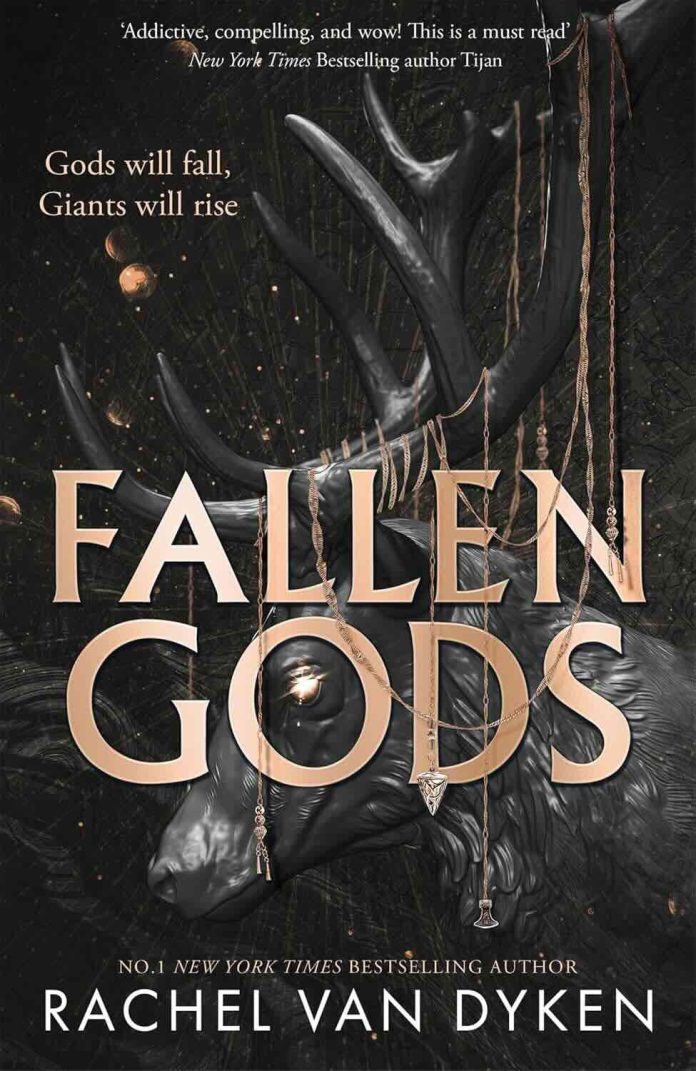
Rachel Van Dyken ventures into romantasy territory with Fallen Gods, transforming Norse mythology into a contemporary tale where ancient deities walk university corridors and legendary hammers rest beneath mortal skin. This debut entry into her mythology-infused series delivers an emotionally charged enemies-to-lovers romance wrapped in divine conspiracies, though it occasionally stumbles under the weight of its own ambitious world-building.
A Mythology Reimagined for Modern Sensibilities
Van Dyken constructs a world where Gods and Giants exist not as distant legends but as prisoners trapped in mortal forms following the destruction of the Bifrost. Endir University becomes the stage for this divine drama, where Rey Stjerne—daughter of Odin—must steal Mjolnir from the Erikson family to save her stepmother Laufey. The premise crackles with potential: what happens when those who shaped mythology must navigate college orientation, assigned group projects, and dorm room politics while their true identities sleep beneath protective runes?
The author’s personal connection to Norse mythology shines through the narrative. Growing up with her Norwegian grandfather’s stories, Van Dyken brings an authenticity to the mythological framework that elevates the story beyond typical fantasy romance fare. Her creative liberties with the source material feel intentional rather than ignorant—she’s not retelling the Eddas but rather asking “what if?” in ways that honor the original spirit while crafting something distinctly her own. The concept of Gods having their memories suppressed and powers locked away creates fascinating tension, particularly as characters begin to “awaken” and remember truths that contradict everything they’ve been told.
The Architecture of Betrayal
Where Fallen Gods by Rachel Van Dyken truly excels is in its intricate plotting around deception and revelation. Van Dyken structures the narrative like a chess game played by immortals, where every piece holds secrets and allegiances shift like storm clouds. Rey arrives at Endir believing she understands her mission, only to discover layer after layer of manipulation. Her father Odin doesn’t simply want Mjolnir retrieved—he’s orchestrated an elaborate scheme where his daughter serves as both pawn and potential sacrifice.
The dual perspective narration between Rey and Aric Erikson proves essential to the story’s impact. Rey’s chapters pulse with desperate determination as she struggles between her mission and her growing feelings for the enemy. Aric’s perspective offers something rarer in romantasy: a male protagonist genuinely grappling with trauma, grief, and the terrifying sensation of powers he cannot fully control. When frost appears unbidden at his fingertips or lightning answers his rage, Van Dyken captures the visceral fear of becoming the monster everyone expects.
The reveals hit with genuine force, particularly the identity of Rey’s trusted companion Rowen as Thor himself, and Aric’s brother Reeve as Loki. These aren’t cheap gotcha moments but carefully constructed revelations that recontextualize earlier scenes. The reader can return to seemingly innocent exchanges and recognize the double meanings lurking beneath casual conversations. Loki’s elevator confrontation with Rey transforms from mysterious threat to chilling foreshadowing once his true nature emerges.
Romance Forged in Frost and Fire
The enemies-to-lovers romance between Rey and Aric provides the emotional core that anchors the mythological machinations. Van Dyken understands that the best antagonistic romances require both characters to be right in their anger and wrong in their assumptions. Aric has every reason to hate Rey—his parents died after his brief encounter with her on a beach, apparently because he rejected Odin’s offer involving his daughter. Rey carries justified resentment for being reduced to a tool in her father’s games while simultaneously recognizing the genuine affection she feels for her target.
Their connection manifests through small, intimate moments that contrast beautifully with the epic stakes. Rey’s habitual sleepwalking into Aric’s room becomes an unexpected sanctuary where both can drop their guards. The tenderness of waking in each other’s arms, pretending normalcy in the harsh morning light, offers respite from the weight of destiny and duty. These scenes demonstrate Van Dyken’s romance writing expertise—she knows when to let characters simply exist together rather than always advancing plot.
The sexual tension builds organically from their forced proximity in class assignments and dorm living arrangements. When they finally succumb to their attraction, the scenes balance raw passion with emotional vulnerability. Van Dyken doesn’t shy from explicit content, but neither does she let it overwhelm the story. The intimacy serves character development, revealing how both Rey and Aric use physical connection to express feelings they cannot safely voice aloud.
Supporting Cast and Missed Opportunities
The supporting characters present both strengths and weaknesses in Fallen Gods by Rachel Van Dyken. Laufey emerges as a quietly powerful presence despite limited page time. Her bedtime stories for Rey contain hidden truths and warnings, motherly love expressed through mythology. The revelation of her Giant heritage and her role protecting Mjolnir’s location adds welcome complexity to what could have been a simple damsel-in-distress figure.
Ziva, Rey’s dorm neighbor, injects much-needed levity with her irreverent observations about campus social dynamics. Her immunity to Rey’s Aethercall gift—the power to unconsciously repel or attract people—makes her refreshingly genuine. However, she remains somewhat underdeveloped, existing primarily to provide comic relief and exposition rather than having her own meaningful arc.
The treatment of Loki/Reeve proves more problematic. His trickster nature translates well to the modern setting, but his motivations shift inconsistently. The revelation of his role in Thor’s death feels rushed, lacking the emotional weight such a betrayal deserves. Similarly, Sigurd Erikson, Aric’s grandfather and university president, operates as a plot device more than a fully realized character. His convenient knowledge and timely interventions suggest omniscience without adequate explanation.
Pacing and Structural Challenges
Van Dyken’s background in contemporary romance occasionally shows in the story’s structure. The middle section, where Rey must awaken Aric’s dormant Giant powers through proximity and specific runes, follows a somewhat predictable pattern. Each rune activation provides an opportunity for relationship development, but the formulaic approach dulls some of the urgency. The story gains momentum again once major betrayals surface, but those middle chapters test patience with their repetitive “mission of the week” feel.
The mythology exposition, while generally well-integrated, sometimes overwhelms the narrative flow. Van Dyken employs various techniques—Rey studying her father’s dossier, Laufey’s bedtime stories, character conversations about legendary artifacts—but information dumps still occur. The complexity of relationships between Gods and Giants, the history of the Bifrost’s destruction, and the properties of Mjolnir all demand explanation, yet readers may find themselves occasionally lost in mythological genealogy when they’d rather return to the central conflict.
World-Building Worth Exploring
Despite pacing issues, the world Van Dyken constructs intrigues sufficiently to carry readers through slower passages. The concept of ancient runes acting as both prison and protection for sleeping deities provides elegant internal logic. Endir University itself becomes a character—its archways carved with Norse symbols, its founding tied directly to concealing Mjolnir, its very existence a conspiracy spanning centuries.
The author’s handling of divine powers impresses in its specificity. Aric’s frost generation isn’t merely aesthetic; it responds to his emotional state, spreads uncontrollably when he loses focus, and carries the weight of three Giants’ combined abilities after his parents sealed their power within him. Rey’s Aethercall operates subtly, influencing people’s desire to approach or avoid her without obvious supernatural manifestation. These powers feel like natural extensions of character rather than arbitrary abilities granted by plot convenience.
The university setting grounds the fantasy elements effectively. Van Dyken understands that mythology becomes most compelling when it intersects with mundane reality. Gods still need to attend orientation, complete group projects, and navigate cafeteria politics. This juxtaposition of ancient and contemporary creates delightful moments—Odin planning to attend the Wild Hunt dressed “like a God,” Loki masquerading as a frat-boy archetype, Thor working as a bodyguard.
Themes of Agency and Worthiness
Beneath the romance and mythology, Fallen Gods by Rachel Van Dyken explores questions of agency and predetermined destiny. Rey constantly struggles against her role as Odin’s weapon, seeking to carve space for her own choices within his machinations. Her journey toward recognizing her own worthiness—not as Odin’s daughter but as herself—culminates in the climactic moment when Mjolnir responds to her specifically. The hammer chooses her not because of bloodline alone but because of who she’s chosen to become.
Aric’s arc mirrors this theme from a different angle. He spends much of the narrative fearing the monster he might become, the Giant heritage that manifests in destructive power. His parents literally made him a vessel for the world’s most powerful weapon, giving him no choice in that destiny. Yet his worthiness of Mjolnir stems not from birth but from how he chooses to wield that power—protecting rather than dominating, loving rather than conquering.
The question of what makes someone “worthy” receives nuanced treatment. Van Dyken rejects simple answers, showing that worthiness emerges from choices made under pressure rather than inherent virtue. Both Rey and Aric make mistakes, hurt each other, and act from selfish motives at times. Their worthiness comes from acknowledging those failures and choosing differently when it matters most.
The Price of Epic Stakes
Van Dyken doesn’t shy from consequences in her narrative. Characters die, trust shatters, and victories come with permanent costs. The climactic battle sequence delivers satisfying action and emotional payoff, though some readers may find the resolution regarding Odin somewhat anticlimactic after his extended buildup as an overwhelming threat.
The ending sets up clearly for a series continuation, with Reeve’s warning that “the party’s just getting started” and revelation that Gods are awakening across campus. This choice may frustrate readers seeking more complete closure, though it’s standard for contemporary fantasy series. The central romance reaches a satisfying conclusion even as larger mythological conflicts remain unresolved.
Final Verdict: A Promising Foundation
Fallen Gods represents Rachel Van Dyken’s successful expansion into romantasy territory. While it doesn’t revolutionize either the mythology retelling or enemies-to-lovers romance subgenres, it combines both with enough skill and heart to create an engaging experience. The romance satisfies with its emotional depth and genuine chemistry. The mythology intrigues with creative reinterpretations and questions about truth versus propaganda in ancient stories. The plot delivers enough twists to keep pages turning even when pacing falters.
Readers should approach this novel understanding it’s series fiction—questions remain unanswered, conflicts continue unresolved. Those seeking standalone satisfaction may feel frustrated. However, those willing to invest in a longer journey will find a world worth exploring and characters worth following into whatever chaos the Gods have planned next.
Van Dyken’s evident love for Norse mythology elevates material that could have felt derivative. Her willingness to question traditional narratives—suggesting perhaps the Gods aren’t heroes and the Giants aren’t monsters—adds welcome complexity. The romance burns with genuine heat while maintaining emotional authenticity. If subsequent books can tighten pacing and develop secondary characters more fully, this series could become a standout in the crowded romantasy market.
For fans of mythology reimagined through modern sensibilities and romances that don’t sacrifice stakes for sweetness, Fallen Gods delivers a compelling entry point into Rachel Van Dyken’s divine universe. Just don’t expect all your questions answered—some truths, like the Gods themselves, take time to fully awaken.
If You Loved This, Read These
Readers who enjoyed Fallen Gods by Rachel Van Dyken will find similar pleasures in these mythology-infused romantasy novels:
- The Cruel Prince by Holly Black – Features enemies-to-lovers romance in a faerie court setting with similar themes of political manipulation and forbidden attraction
- A Court of Thorns and Roses by Sarah J. Maas – Offers mythology reimagined, forced proximity romance, and a heroine discovering her own power
- Neon Gods by Katee Robert – Modern Greek mythology retelling with steamy romance and family betrayal
- The Shadows Between Us by Tricia Levenseller – Enemies-to-lovers with a protagonist infiltrating enemy territory for ulterior motives
- From Blood and Ash by Jennifer L. Armentrout – Epic fantasy with forbidden romance and major identity revelations







