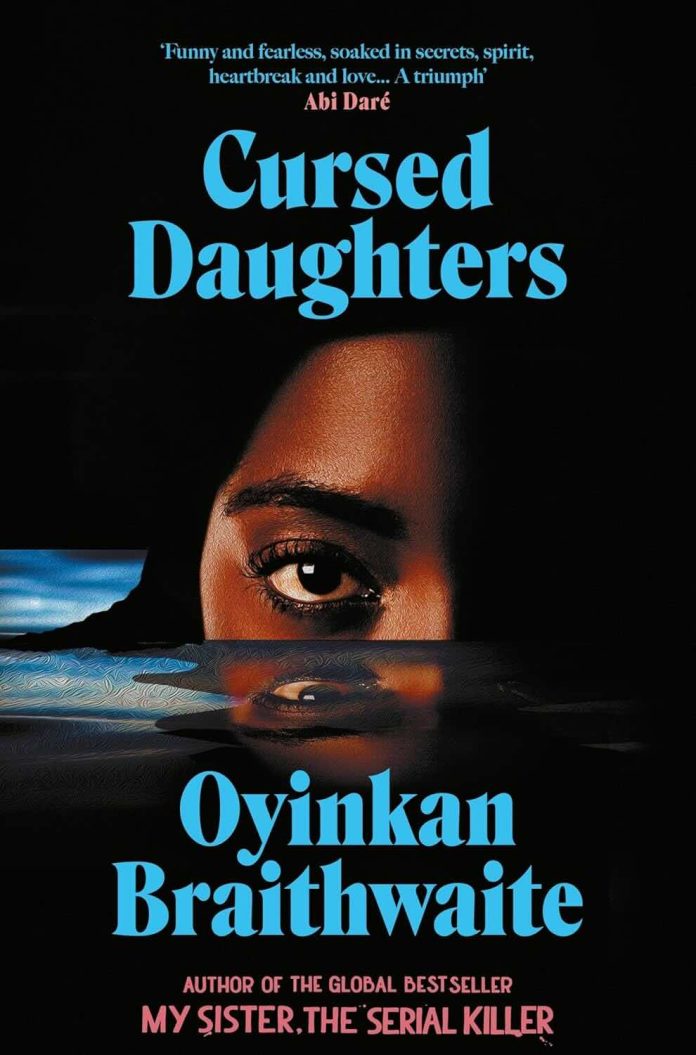
Oyinkan Braithwaite made waves in the literary world with her debut, My Sister, the Serial Killer, a razor-sharp dark comedy that earned widespread acclaim for its biting wit and unflinching examination of sisterly devotion. With Cursed Daughters, Braithwaite ventures into more complex territory, weaving together generational trauma, supernatural belief, and romantic longing into a narrative that is both haunting and unexpectedly tender. The result is a novel that expands her range considerably, though it demands more patience from readers than her tightly wound debut.
The story opens with a striking image. A baby girl named Eniiyi is born on the very day her cousin Monife is buried. The resemblance between the infant and the dead woman is uncanny, right down to the scars on their thighs. From this moment, the family begins whispering what everyone thinks but nobody wants to say aloud. The child is the reincarnation of the deceased. She has returned.
The Architecture of Inherited Pain
Braithwaite constructs her narrative across two timelines that echo and illuminate each other. In the past, we follow Monife, a young woman studying law in Lagos, desperately in love with a man called Golden Boy. In the present, Eniiyi returns home after completing her education abroad, only to find herself falling for a man she pulls from the ocean. The parallels between their stories grow tighter and more suffocating as the novel progresses.
At the heart of both timelines lies the Falodun family curse, a malediction supposedly placed generations ago by a jealous first wife upon her rival. The curse is elegantly simple and devastatingly effective in its execution. No man will call your house home. And if they try, they will not have peace. Generation after generation of Falodun women have lived and loved in vain, always returning to the ancestral home, always ending up alone.
The brilliance of Braithwaite’s approach lies in her refusal to confirm or deny the supernatural elements. The curse could be a self-fulfilling prophecy, a psychological inheritance passed down through generations of women who expect abandonment and thus create the conditions for it. Or it could be genuinely supernatural. Braithwaite lets readers decide for themselves, and this ambiguity gives the novel its unsettling power.
Characters Who Breathe and Bleed
Eniiyi emerges as a protagonist caught between two impossible positions. She cannot accept that she is simply another woman living under the shadow of an old curse, yet she cannot entirely dismiss the eerie similarities between herself and her dead aunt. Braithwaite renders her internal struggle with precision, capturing the way identity can feel borrowed when everyone around you insists on seeing someone else in your face.
The older generation of Falodun women provides essential counterweight to Eniiyi’s modern skepticism. Her grandmother and great-aunt, referred to as Grandma East and Grandma West, offer contrasting perspectives on family history and supernatural belief. They are by turns infuriating and endearing, their interference well-meaning but suffocating. Braithwaite captures the particular dynamic of multigenerational households where love and control become impossibly entangled.
Ebun, Eniiyi’s mother, represents perhaps the most complex position in the novel. She has spent her daughter’s entire life trying to protect her from the family mythology while being unable to escape it herself. Her fierce denial of the reincarnation narrative stems from genuine love, though her methods often cause more harm than good. One particular scene involving physical violence lands with uncomfortable force, refusing to let readers dismiss the damage that fear can inflict even with loving intentions.
Lagos as Living Presence
The novel benefits enormously from Braithwaite’s intimate knowledge of Lagos. The city pulses through every page, from the boat clubs where characters share asun and cocktails to the crowded streets where okada riders weave through traffic. The Falodun family home itself becomes almost a character, with its creaky floors, swinging doors, and rooms that hold decades of accumulated memories.
Braithwaite peppers her prose with Yoruba phrases and cultural touchstones that enrich the reading experience without becoming didactic. The naming ceremony for Eniiyi, where relatives purchase the right to bestow names upon the newborn, offers a window into traditions that will shape the child’s entire existence. The names chosen carry prophetic weight, as names often do in cultures where words hold power beyond mere description.
Where the Spell Wavers
For all its strengths, Cursed Daughters occasionally stumbles under the weight of its own ambition. The dual timeline structure, while thematically resonant, sometimes disrupts narrative momentum. Readers may find themselves impatiently rushing through one storyline to return to the other. The balance tips particularly in the novel’s middle sections, where the parallel structure begins to feel more mechanical than organic.
Additionally, the romantic elements occasionally veer toward the melodramatic. The intensity of feeling between lovers sometimes eclipses characterization, leaving relationships that feel more symbolic than lived-in. When Eniiyi declares she would peel off her lover’s skin just to be closer to him, the sentiment reads as more unsettling than romantic, though perhaps that is precisely Braithwaite’s intention.
The novel’s ending may frustrate readers who prefer clean resolutions. Braithwaite opts for ambiguity over closure, which feels thematically appropriate but emotionally unsatisfying in places. Some narrative threads are left deliberately loose, suggesting that breaking generational patterns is messy work that cannot be neatly concluded within the pages of a single book.
The Craft Beneath the Curse
Braithwaite’s prose style remains one of her greatest assets. She writes with economy and precision, her sentences landing with the force of incantations. Consider how she describes the moment of birth that opens the novel, or the haunting scenes set on Lagos beaches at night. There is poetry in her directness, beauty in her refusal to over-explain.
The incorporation of notebook entries and search queries adds textural variety to the narrative. When Eniiyi types desperate questions into search engines, trying to determine whether she might be a reincarnation, the vulnerability cuts through any ironic distance. We have all asked the internet questions we would never voice aloud. Braithwaite understands this peculiar modern intimacy.
Final Thoughts: A Curse Worth Catching
Cursed Daughters represents a significant evolution for Oyinkan Braithwaite. It is messier than My Sister, the Serial Killer, more ambitious in scope, and occasionally unwieldy in execution. Yet it is also deeper, more emotionally resonant, and more willing to sit with difficult questions without offering easy answers.
The novel asks what it means to inherit not just genetics but expectations, not just family history but family trauma. It explores how love can become a trap when it arrives bearing the weight of generational patterns. And it suggests, tentatively but persistently, that breaking free is possible, even if the breaking hurts.
For readers willing to surrender to its rhythms, Cursed Daughters offers genuine rewards. It is a novel that lingers, its questions echoing long after the final page. The curse may be fiction, but the patterns it describes feel uncomfortably real.
Key Highlights
- Dual timeline narrative exploring past and present with parallel love stories
- Rich Lagos setting that functions as more than mere backdrop
- Complex female characters navigating tradition and modernity
- Exploration of reincarnation without confirming or denying supernatural elements
- Themes of generational trauma and the possibility of breaking inherited patterns
Similar Books to Explore
Readers who appreciate the blend of cultural specificity and supernatural elements in Cursed Daughters might also enjoy:
- My Sister, the Serial Killer by Oyinkan Braithwaite
- The Death of Vivek Oji by Akwaeke Emezi
- Freshwater by Akwaeke Emezi
- Stay With Me by Ayobami Adebayo
- An Orchestra of Minorities by Chigozie Obioma
- The Secret Lives of Church Ladies by Deesha Philyaw
- Transcendent Kingdom by Yaa Gyasi
- The Famished Road by Ben Okri







