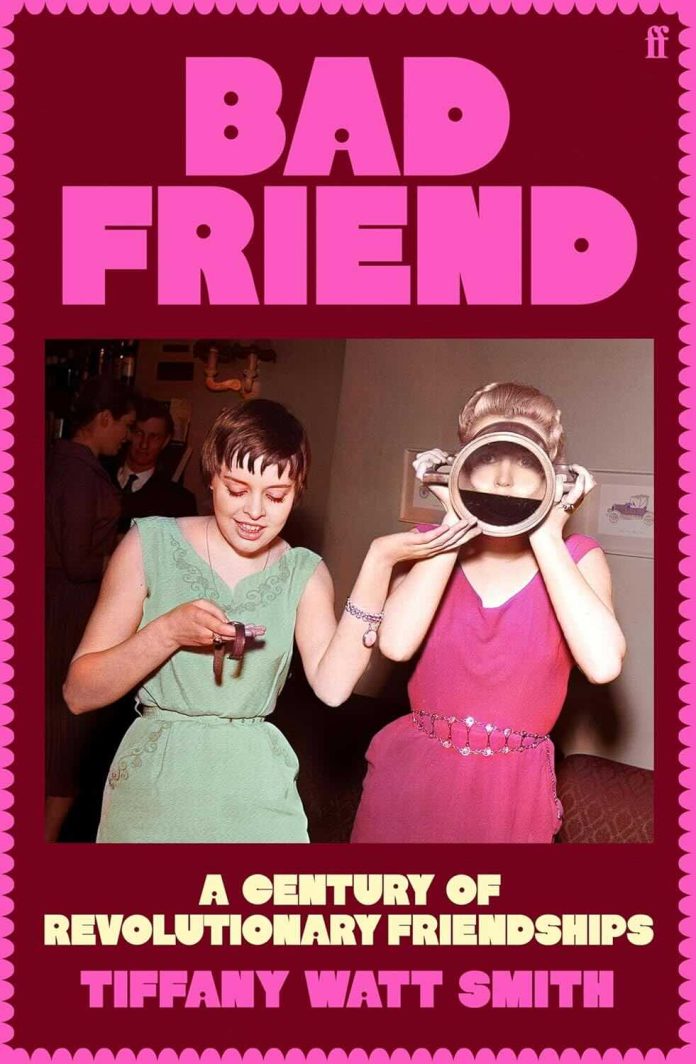
In her groundbreaking new book Bad Friend, cultural historian Tiffany Watt Smith delivers a deeply personal and intellectually rigorous examination of female friendship across the centuries. Drawing on historical archives, interviews, and her own experiences, Smith dismantles the glossy, Instagram-ready image of female friendship that has dominated our cultural conversation, revealing something far more complex, messy, and ultimately liberating beneath.
Unlike her previous works on human emotions (The Book of Human Emotions) and schadenfreude, Smith’s latest offering feels more urgent and intimate. She has written what she describes as “an unusual sort of love letter to friendship,” one that rejects the idealized narratives of “grand gestures” in favor of “puny failures… attempts rather than successes… tender openings rather than glossily packaged and indestructible images of perfection.”
The Personal as Historical
What makes Bad Friend so compelling is Tiffany Watt Smith’s willingness to interrogate her own friendships alongside her historical research. The book opens with a haunting account of a friendship that “burned very bright and then, like a dying star, exploded.” This relationship with a woman she calls Sofia serves as a touchstone throughout the book, allowing Smith to explore the shame and confusion that accompany friendship breakdowns.
Smith writes with unflinching honesty about her own moments as a “bad friend” – from her intense infatuation with a flatmate named Liza that ended in betrayal when she slept with Liza’s best friend, to her gradual ghosting of Sofia years later when their lives diverged in ways that made their once-close connection increasingly painful. These personal revelations never feel gratuitous; rather, they illuminate the paradoxes and complexities that define friendships between women.
A History of Control and Rebellion
Smith organizes her book into three chronological sections – “Entanglements” (1900-1940), “Separations” (1940-1980), and “Pacts” (1980-2020) – tracing the evolution of female friendship from the passionate schoolgirl “crushes” of the early twentieth century to contemporary elder co-housing communities.
Throughout, she reveals how women’s friendships have been persistently policed and pathologized. In one of the book’s most fascinating chapters, Smith examines how the intense romantic friendships between schoolgirls that were celebrated in the Victorian era became objects of suspicion in the 1910s and 20s, as psychological theories about “sexual inversion” gained traction. As Smith notes, “The more freedoms women won, the more urgent became the sense that their friendships needed containing and controlling.”
Beyond the BFF Myth
Smith’s most valuable contribution may be her deconstruction of the “perfect friend” ideal that has left so many women feeling inadequate. Through interviews with women living in co-housing communities, she discovers that even these supposedly evolved relationships involve “disappointments – the friendships that had once been close and then had suddenly cooled off without explanation… stories about jealousy and the shame it causes… stories that captured the myths we hold about each other, and the pleasure we take in destroying them.”
Rather than viewing these difficulties as failures, Smith suggests they are inherent to friendship itself. As one ninety-two-year-old woman with a lifelong best friend tells her, the secret to lasting friendship is simply: “you just keep asking yourself ‘what can I do for her?’ And then you try to do it.”
Strengths and Insights
Bad Friend by Tiffany Watt Smith excels in several key areas:
- Historical depth: Smith uncovers fascinating histories of female friendship, from medieval Beguines living in religious communities to the chaotic friendships of 1970s New York artists like Nan Goldin and Cookie Mueller.
- Cross-cultural perspective: Though primarily focused on Western examples, Smith incorporates perspectives from Japan, India, Central Africa, and beyond, showing how friendship norms vary dramatically across cultures.
- Interdisciplinary approach: Drawing on psychology, sociology, history, and literary analysis, Smith creates a richly textured understanding of friendship’s complexities.
- Challenging dominant narratives: The book powerfully critiques how friendship has been commodified and flattened in contemporary culture, arguing for a more capacious, realistic vision.
Limitations and Missed Opportunities
Despite its many strengths, Bad Friend by Tiffany Watt Smith occasionally falls short:
- While Smith acknowledges the importance of cross-racial friendships and features Black feminist thinkers like Audre Lorde, the book could have more deeply explored how racism shapes friendship dynamics.
- The section on digital friendships feels somewhat underdeveloped compared to the nuanced historical analysis elsewhere.
- Smith sometimes presents her personal experiences as more universal than they perhaps are, particularly regarding class privilege and educational background.
- At times, the book’s organization feels slightly disjointed as it moves between historical analysis, memoir, and interview material.
A New Paradigm for Friendship
What emerges from Bad Friend by Tiffany Watt Smith is a paradigm of friendship that rejects perfectionism in favor of effort and intention. Smith writes: “Friendship is not a permanent state one arrives at. It is something we do. It is a process of negotiating our endlessly changing selves, a process of uncertainty and of learning.”
This vision is both challenging and liberating. It invites us to let go of the false idea that friendship should be effortless and unchanging, and instead embrace what Smith calls “a messier, more capacious, more flexible notion of what friendship can be, and where we find it.”
Comparisons and Literary Context
Bad Friend sits comfortably alongside recent works exploring female friendship like Aminatou Sow and Ann Friedman’s Big Friendship and Kayleen Schaefer’s Text Me When You Get Home. However, Smith’s historical approach and willingness to embrace ambivalence distinguish her work from these more celebratory texts.
The book also recalls the British writer Deborah Levy’s “living autobiography” trilogy in its blend of personal reflection and cultural criticism, though Smith’s focus remains more consistently on friendship rather than broader questions of female identity.
Final Assessment: A Necessary Complication
In an era of simplified self-help and Instagram captions about “toxic people,” Bad Friend offers something far more valuable: permission to be human within our friendships. Smith writes, “I am not trying to be a perfect friend. There really is no such thing. But sometimes I think I have become a better one as a result of this long process of detangling.”
This “detangling” is what Smith offers readers – a chance to untie the knots of expectation, guilt, and idealization that have made friendship itself into something of a burden. By reclaiming the “bad friend” – the rebel, the intensely devoted, the one who sometimes fails despite best intentions – Smith creates space for a more authentic, sustainable practice of friendship.
Bad Friend by Tiffany Watt Smith is ultimately a hopeful book, suggesting that by accepting the limitations and complexities of friendship, we might paradoxically experience deeper, more enduring connections. As Smith concludes: “There will be times in a friendship where you struggle to make sense of how the other has changed. Or wonder if you have misjudged, and expected too much or given too little… Mostly you will keep wondering how you can help each other. And that is more than good enough.”
For anyone who has ever felt inadequate as a friend or puzzled by the shifting dynamics of female relationships, this book offers not just solace but liberation – a chance to reimagine friendship beyond the impossible standards that have made it so difficult to practice and sustain.