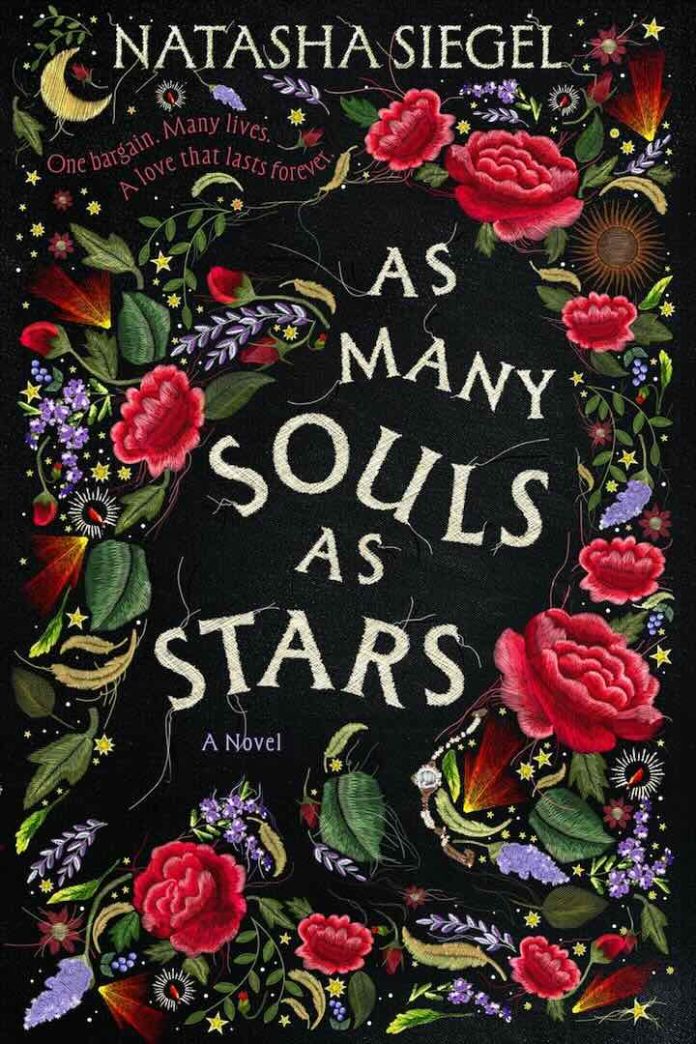
Natasha Siegel has built her reputation on writing lush historical fiction that explores forbidden love against sweeping backdrops. With As Many Souls as Stars, she ventures into darker, more fantastical territory, delivering a gothic romance that spans centuries and challenges what it means to be human, to be monstrous, and to be desperately, devastatingly in love.
An Immortal Bargain
The novel opens in Elizabethan England, where Cybil Harding lives trapped within her family’s crumbling estate, cursed as a First Daughter whose very presence invites catastrophe. When her father’s occult obsessions attract the attention of Miriam Richter, a creature of shadow who consumes mortal souls for sustenance, Cybil faces an impossible choice. Miriam offers reincarnation in exchange for her soul, and what follows is an elaborate pursuit across multiple lifetimes as both women become irrevocably bound to one another.
The premise draws obvious comparisons to Faustian bargains and tales of immortal love, yet Siegel infuses the familiar framework with fresh energy. Rather than a straightforward predator-prey dynamic, the relationship between Cybil and Miriam evolves into something far more complicated, a constant negotiation of power where neither woman fully holds the upper hand.
Writing That Bleeds Gothic Atmosphere
Siegel’s prose in this novel marks a departure from her previous historical works. The language here is deliberately ornate, dripping with sensory detail that evokes both beauty and decay. Descriptions of souls burning like light within chests, of shadows that whisper and hunger, create an atmosphere thick with tension. The writing excels particularly during moments of confrontation, where dialogue crackles with double meanings and barely restrained violence.
However, this same stylistic choice occasionally becomes the novel’s weakness. Certain passages veer into overwrought territory, with metaphors piling atop one another until the emotional impact dulls rather than sharpens. Readers who prefer leaner prose may find themselves wishing for more restraint, particularly during the middle sections where the pacing occasionally stagnates beneath the weight of its own language.
Characters Forged in Shadow and Flame
The true achievement of As Many Souls as Stars lies in its characterisation. Cybil, who transforms across her incarnations as Esther and then Rosamund, maintains a consistent core of defiance and loneliness even as each life shapes her differently. Her growth across centuries feels organic, her mounting power and cunning earned through genuine hardship rather than convenient narrative shortcuts.
Miriam presents a more complex challenge, and Siegel mostly succeeds in making her sympathetic without diminishing her monstrousness. Born from ritual and shadow, she lacks understanding of her own nature, believing herself empty of soul even as she exhibits grief, love, and jealousy. The novel asks compelling questions about whether creatures made for darkness can choose otherwise, though it occasionally struggles to balance Miriam’s vulnerability with her capacity for cruelty.
What Makes These Characters Memorable
- Cybil’s evolution: Her transformation from a frightened young woman to a witch who commands shadows herself demonstrates genuine character development across lifetimes
- Miriam’s contradictions: A being who claims emotional emptiness while being driven entirely by longing and possession
- The supporting cast: Characters like Thomas Harding and Esther’s family provide necessary grounding, even if they sometimes feel more functional than fully realised
Themes Worth Examining
Siegel weaves several thematic threads throughout the narrative that elevate it beyond simple dark romance.
The exploration of loneliness resonates most powerfully. Both protagonists suffer from isolation, one cursed to harm those around her, the other existing outside humanity entirely. Their attraction stems partly from recognition, finding in each other a reflection of their own alienation. This theme feels particularly poignant, suggesting that connection matters more than its source or circumstances.
The novel also grapples with questions of agency and self-definition. Cybil believes herself cursed, acts as though cursed, and thereby makes the curse real through her own behaviour. The tension between fate and choice runs throughout, culminating in revelations that reframe much of what came before.
Central Themes Explored
- The intertwining of love and hatred as expressions of desire
- Whether beings created for evil can transcend their origins
- The power of belief in shaping reality
- What it means to be truly human versus merely wearing humanity as disguise
Structure and Pacing Considerations
The novel divides into three main sections spanning different eras: Elizabethan England, Regency London, and the 1940s aboard an ocean liner. This structure allows Siegel to showcase her range, and each setting receives distinct atmospheric treatment. The period details feel thoroughly researched, from witchfinder hysteria to Regency social dynamics to Art Deco luxury.
The transitions between time periods, however, can feel jarring. Intermission chapters bridge the gaps with glimpses of Miriam’s activities during the intervening centuries, but these brief interludes sometimes raise more questions than they answer. Additionally, the middle section devoted to Esther’s life, while containing some of the novel’s most emotionally intense scenes, runs longer than necessary, creating slight imbalance in the overall structure.
The final act aboard the RMS Monumental brings everything to a head with appropriate intensity, though some readers may find the climactic confrontation resolves too quickly given the centuries of buildup.
Where This Stands Among Siegel’s Work
Readers familiar with Solomon’s Crown and The Phoenix Bride will recognise Siegel’s hallmarks: lush historical settings, forbidden romance, and characters navigating impossible circumstances. As Many Souls as Stars represents her most ambitious work yet, expanding into speculative territory while maintaining her signature emotional depth. The queer romance at its heart is handled with the same tenderness she brought to her previous novels, never sensationalised despite the supernatural trappings.
Who Should Read This Gothic Tale
This novel will appeal most strongly to readers who enjoy:
- Dark romance with morally complex protagonists
- Historical fantasy spanning multiple time periods
- Gothic atmospheres with genuine threat underlying the romance
- Sapphic relationships that avoid tragedy for its own sake
- Explorations of power dynamics within intimate relationships
Those seeking straightforward genre romance or faster pacing may find the novel’s literary aspirations create barriers to enjoyment.
Similar Books to Explore
Readers who appreciate As Many Souls as Stars should consider these comparable works:
- The Invisible Life of Addie LaRue by V. E. Schwab, for its exploration of immortality and bargains with darkness
- A Dowry of Blood by S. T. Gibson, which similarly examines predatory romance and reclaimed agency
- These Violent Delights by Chloe Gong, for star-crossed lovers across impossible divides
- Malice by Heather Walter, another sapphic fantasy reimagining familiar dark fairy tale elements
- A Marvellous Light by Freya Marske, combining historical setting with magical romance
Final Assessment
As Many Souls as Stars is imperfect but undeniably bold. Siegel has attempted something genuinely difficult, crafting a love story between predator and prey that neither excuses cruelty nor dismisses the genuine emotion beneath it. When the novel works, it achieves remarkable emotional resonance, particularly in its meditation on loneliness and the desperate human need for connection.
The prose occasionally overwhelms, and the pacing falters in places, but these flaws cannot diminish the ambition and heart at the novel’s core. For readers willing to surrender to its gothic embrace, As Many Souls as Stars offers a dark, strange, ultimately hopeful story about two creatures learning that perhaps neither of them was ever truly a monster.







