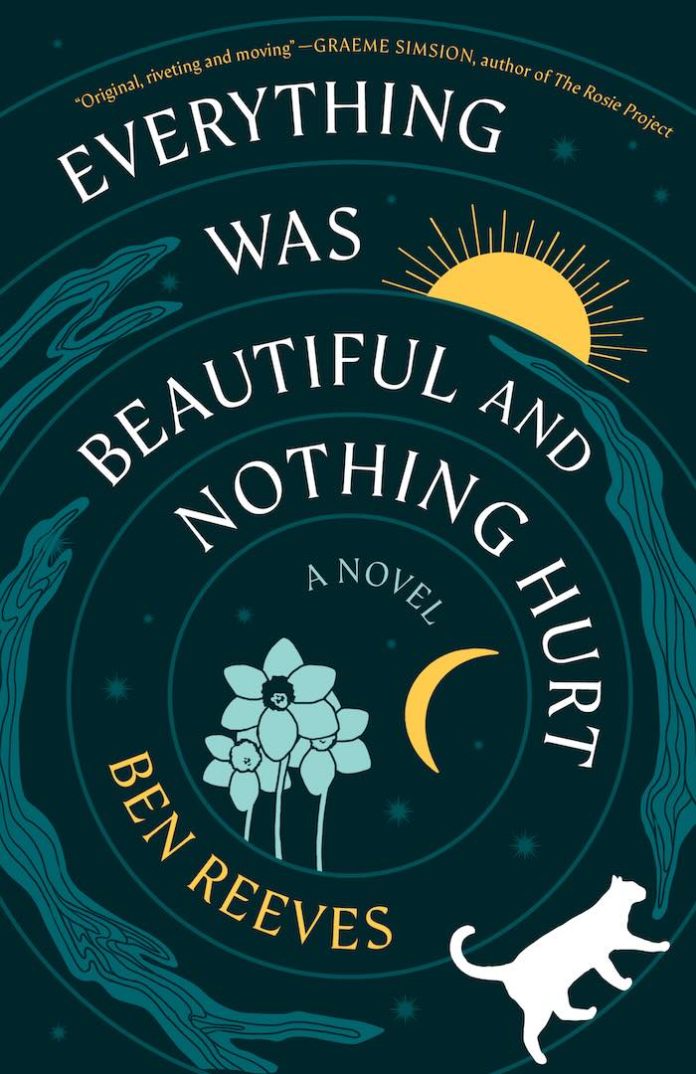
There is a moment early in this book when Death kneels inside an overturned car, cradles a dying stranger, and tells him it is okay now. No scythe. No hood. Just a young man in a grey jumper with holes in his socks, whispering the things a person only learns at the very end. That is the register Ben Reeves works in, and it is the reason Everything Was Beautiful and Nothing Hurt by Ben Reeves announces itself, from its first pages, as a debut with unusual nerve.
Death Wears Jeans and Lives Across the Hall
The narrator calls himself Travis. He is Death, walking a small, drab English town that once mistook itself for a city. He offers comfort in people’s final hours, and he never judges, never bargains, never changes a single fate. Between the heart attacks and the car crashes, he restores old photographs at a folding table, buffing faded faces back to the day they were developed.
Then a cat wanders through his window, and a hunt for cat food leads him to the flat across the hall, where a tired midwife named Dalia lives with her eight-year-old, Layla, and a baby, Neda. Layla decides she likes him. Dalia decides, slowly, that she might too. And Travis, who has spent an eternity keeping the living at arm’s length, begins to want something he was never built to hold.
That is as far as I will take the plot, because the spell of this novel depends on not knowing where it is going. What I can promise is that it goes somewhere, and that the ending earns every tear it asks for.
A Voice That Refuses to Blink
Much of the pull of Everything Was Beautiful and Nothing Hurt by Ben Reeves comes from its voice. Reeves writes in a close, restless present tense, often slipping into a second-person address that puts the reader inside the skin of the grieving. The prose is sensory to the point of overload: the woody chew of an apple pip, the cobweb smell of a brick, the way morning light cuts red and gold through willows over a canal choked with shopping trolleys. He finds the sacred and the squalid pressed together on the same street, and he refuses to look away from either.
The structure mirrors this restlessness. The book is built from short titled chapters, each a self-contained visit:
- The dying, given full and specific lives before Travis takes them: a widowed poet who greets strangers just to be seen, a hoarder who tidies his home for the first time when the end arrives, a very old woman who begs for release on every birthday.
- The town itself, glimpsed in fevered montages of ordinary people doing ordinary, secret things behind their curtains.
- The natural world, in interludes about a deer and her fawn, a snail crossing a road, and a pond of mayfly nymphs waiting all their lives for a single day.
Woven through it all is the quiet, aching thread of Dalia and her girls. Reeves closes many chapters with a stark line of type: a name, then the exact years, months, and days the person lived. It should feel like a gimmick. Instead it lands like a bell.
Why the Warmth Works
What keeps the book from tipping into misery is its tenderness, and its odd, well-timed humour. A funeral scene involving five siblings and a coffin they insist on carrying themselves is one of the funniest and most human things I have read in a novel about death. Layla’s dialogue is pitch-perfect, all narwhals and clowns and the fierce logic of a child who has decided a brick is boring and must be talked out of it.
Travis is a genuinely original creation. His naivety, despite knowing everything, gives the book its beating heart. He is an immortal learning, far too late, what mortals have always known. When he sits on a sofa with a jumper that is too long in the sleeves and a woman resting against his chest, and realises this ordinary nothing is more real than any wedding, the moment is quietly devastating precisely because he has never had it before.
Where It Stumbles
An honest review has to name the strain, and there is strain here.”Everything Was Beautiful and Nothing Hurt” is a very good book with visible seams, and this is that.
- The prose can exhaust. Reeves rarely lets a plain sentence stand plain. Page after page of high lyricism and stacked sensory detail is beautiful in a chapter and tiring across a whole book. A little more restraint would have made the peaks hit harder.
- The vignette form scatters the momentum. Some townspeople are unforgettable. Others feel like set pieces that pause the central story rather than deepen it, and a reader impatient to return to Dalia may find a few of the detours long.
- The metaphors are underlined. The deer, the snail, the colliding planets, the mayflies: each is lovely, and each says roughly the same thing about the brevity and worth of a life. By the third or fourth, the book is telling you what it has already shown you beautifully.
- The premise invites comparison. A sensitive, humane Death narrating human lives will remind many readers of Markus Zusak’s The Book Thief. Reeves does something distinct enough to survive that shadow, but he is standing in it, and he knows it.
None of this sinks the book. It simply keeps a remarkable debut from being a flawless one.
Who Should Read It
“Everything Was Beautiful and Nothing Hurt” is for readers who cried at Fredrik Backman and went looking for the next thing, for anyone who likes their fiction to sit at the border of the real and the strange, and for people who can bear a story that stares hard at loss on its way to something like hope. If you need a tidy plot with a brisk pace, the mood here may test you. If you read for voice, feeling, and the ache of a single perfect image, Everything Was Beautiful and Nothing Hurt by Ben Reeves will stay with you for days.
A note for context on the author’s standing. Reeves won the Bath Novel Award in 2024 for this manuscript, and the book arrives as his published debut, which makes its assurance all the more striking. He lives in Peterborough, paints, makes music, and by day designs for a book printer, a biography that reads a little like one of his own characters. First novels rarely sound this fully formed.
If You Loved This, Read These Next
For readers who finish Everything Was Beautiful and Nothing Hurt by Ben Reeves and want to stay in its emotional weather, these make natural companions:
- The Book Thief by Markus Zusak, the obvious touchstone, Death as narrator with a wholly different music.
- Grief Is the Thing with Feathers and Lanny by Max Porter, for that same fusion of the domestic and the mythic in fractured, poetic prose.
- Lincoln in the Bardo by George Saunders, a chorus of the dead circling one small, unbearable loss.
- A Man Called Ove by Fredrik Backman, for the warmth, the humour, and the grief hiding underneath.
- The Five People You Meet in Heaven by Mitch Albom, for readers drawn to the afterlife framing and the tally of a life’s meaning.
The Last Twenty Minutes
Reeves ends on a small thought experiment that I will not spoil, except to say it reframes the whole novel as a gift rather than a lament. Everything Was Beautiful and Nothing Hurt by Ben Reeves is not subtle, it is not always disciplined, and it will not be for everyone. But it is brave, strange, and full of feeling, and it treats the oldest subject we have as if no one had ever written about it before. That is a rare thing for any novelist, let alone one publishing his first. Read it when you are ready to be moved, and keep something soft nearby to cry into.







