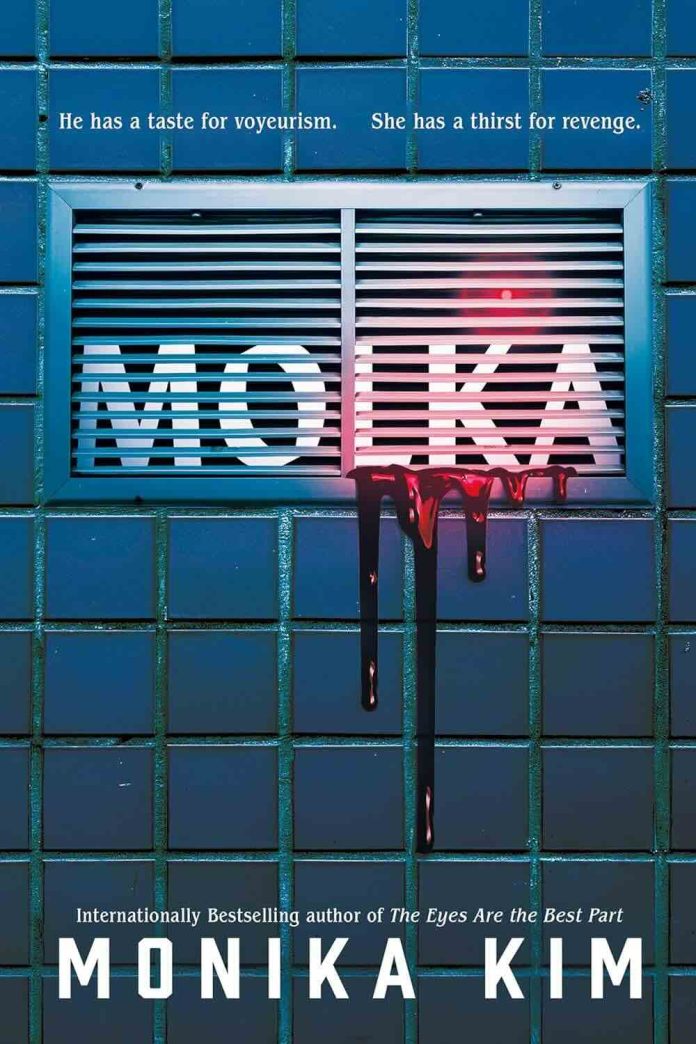
Some books are read. Others put their hand on the back of your neck and lean in close until you can hear them breathing. Molka by Monika Kim, the second novel from the author of The Eyes Are the Best Part, belongs firmly in the second group. It is sleek, unkind, and so committed to its rage that it sometimes overwhelms its own architecture. That is also, mostly, the point.
The Setup, Unspoiled
Dahye is a young woman in Seoul who has fallen suddenly and completely for Hyukjoon, the chaebol heir of a media empire whose Rolex costs more than her annual rent. Their relationship has the soft-focus shimmer of a K-drama, until a hidden camera turns it into something else entirely. The footage spreads. Hyukjoon disappears across the Pacific. Dahye is left alone with the wreckage, with her mother’s quiet contempt, and with the memory of a sister whose drowned body has refused, after five years, to stay drowned.
In a basement office across town, an IT technician named Junyoung is filming the women’s restrooms. He has an ugly little kingdom of forty camera feeds and a father’s voice in his head telling him this is what men are for. When Dahye crosses his radar, his sickness has a target.
That is the engine. Molka by Monika Kim runs it hard.
Three Points of View, One Long Scream
The book rotates through three perspectives:
- Dahye, whose grief over her sister Eunhye, whose love for Hyukjoon, and whose slow comprehension of what has been taken from her form the emotional spine.
- Junyoung, whose chapters are the most uncomfortable thing in the book. Kim writes him without softening, without rescue, and without a single scene that lets the reader off the hook.
- A third presence that hovers between them and refuses to be classified as either dream, hallucination, or ghost.
The structural choice is the bravest thing about the novel. By forcing readers into Junyoung’s interiority, Kim disallows the comfortable distance most thrillers offer their voyeur villains. You sit with him while he rationalises, while he watches, while he convinces himself he is in love. It is foul. It is also necessary, because the book’s argument is that this man is not a monster lurking somewhere offstage. He is the guy at the next desk.
What Works
- The prose is lean and built for speed. Sentences land like jabs, paragraphs end on small bruises.
- Kim’s use of Korean ghost story conventions, water-soaked figures, hair across faces, blue-skinned and wrinkled, is sourced from a tradition older than the cameras and made to comment on them directly.
- The ensemble of women Dahye meets at a molka support group is the warmest, most human thing in the book. They are funny, prickly, exhausted, and they give the narrative a moral counterweight it badly needs.
- The author’s note at the front, which discusses the 2019 Burning Sun scandal and the real legal failures around digital sex crimes in Korea, primes the reader without preaching.
What Doesn’t Quite Land
I want to be honest about this, because Molka by Monika Kim is being received with a great deal of justified enthusiasm and not very much pushback. A few things:
- The middle act sags. There is a stretch where Dahye’s grief loops on itself, and certain set pieces (the bridge, the bathroom mirror) are repeated in ways that feel like emphasis rather than escalation.
- Junyoung’s chapters are calibrated for revulsion, and Kim is very good at it, but past a certain point the reader is no longer learning anything new about him. A few of those scenes could be trimmed without losing the indictment.
- Hyukjoon, who needs to be charming enough for Dahye’s choices to read as plausible, is sketched a little too thinly. He works as a symbol of inherited power and casual cruelty. He is less convincing as a man someone could actually fall for.
- The supernatural and the realist registers occasionally elbow each other. There is a version of this novel where the ghost is more ambiguous, and a version where the violence is more grounded, and Kim is reaching for both at once.
None of these flaws are fatal. They are the kind of seams you only notice because so much else is pulled so tight.
A Genre That Won’t Sit Still
Trying to label this book is its own little exercise. The publisher calls it horror. It is also a revenge thriller, a domestic mystery, a piece of social realism about gender and surveillance, and, in places, a quiet ghost story about two sisters. Kim trusts her reader to hold all of those at once. The only place the genre balancing slips is the ending, where the supernatural is asked to do a lot of work that the realism has been doing fine on its own. Some readers will find that thrilling. Others will wish for a quieter, harder landing.
What is consistent throughout is the voice. There is a sardonic, slightly stand-back quality to Kim’s narration, a willingness to let small absurdities sit next to atrocities, that owes something to writers like Han Kang and Sayaka Murata, but is also very much Kim’s own.
How It Compares to The Eyes Are the Best Part
Readers who came to Kim through her debut, The Eyes Are the Best Part, will recognise several preoccupations: the body as battleground, the misogyny embedded in family, food and consumption as horror imagery. The earlier book is the more contained, more domestic of the two, with a tighter focus on a single family. Molka by Monika Kim is louder, bigger in scope, and willing to risk overshooting in service of its larger argument. If the debut was a controlled cut, this one is a wider gash that is bleeding on purpose.
Who This Book Is For
Pick this up if you want:
- A horror novel rooted in a real, ongoing crisis rather than invented scares
- Korean settings written by an author who treats the place as more than backdrop
- Female rage that is allowed to be ugly, wrong, and effective
- Body horror that has a thesis
- Endings that prefer rupture over resolution
Skip it, or hold off, if you are sensitive to detailed depictions of voyeurism, sexual harassment, suicide, and graphic violence. The content notice in the front matter is not decorative.
Read-Alikes Worth Your Time
Once you finish, these are the natural neighbours:
- The Eyes Are the Best Part by Monika Kim, for the through-line of her thinking
- Bat Eater and Other Names for Cora Zeng by Kylie Lee Baker, who blurbed this novel and shares its register
- Julie Chan Is Dead by Liann Zhang, for sharp, internet-aware horror
- Bunny by Mona Awad, for academic-feminist unease that turns feral
- Boy Parts by Eliza Clark, for an inverted gaze and a genuinely uncomfortable narrator
- Tender Is the Flesh by Agustina Bazterrica, for a parallel use of horror as social diagnosis
- Kim Jiyoung, Born 1982 by Cho Nam-Joo, for the realist context behind Kim’s nightmare
- The Vegetarian by Han Kang, for the body-as-resistance lineage Kim is writing inside
The Verdict
Molka by Monika Kim is a furious, unstable, often brilliant book that knows exactly what it is angry about and only occasionally trips over the size of that anger. It will not be for everyone, and it is not trying to be. For readers who want horror with a working argument, and who can sit with a narrator they should not be sitting with, this is one of the strongest genre novels of the year.