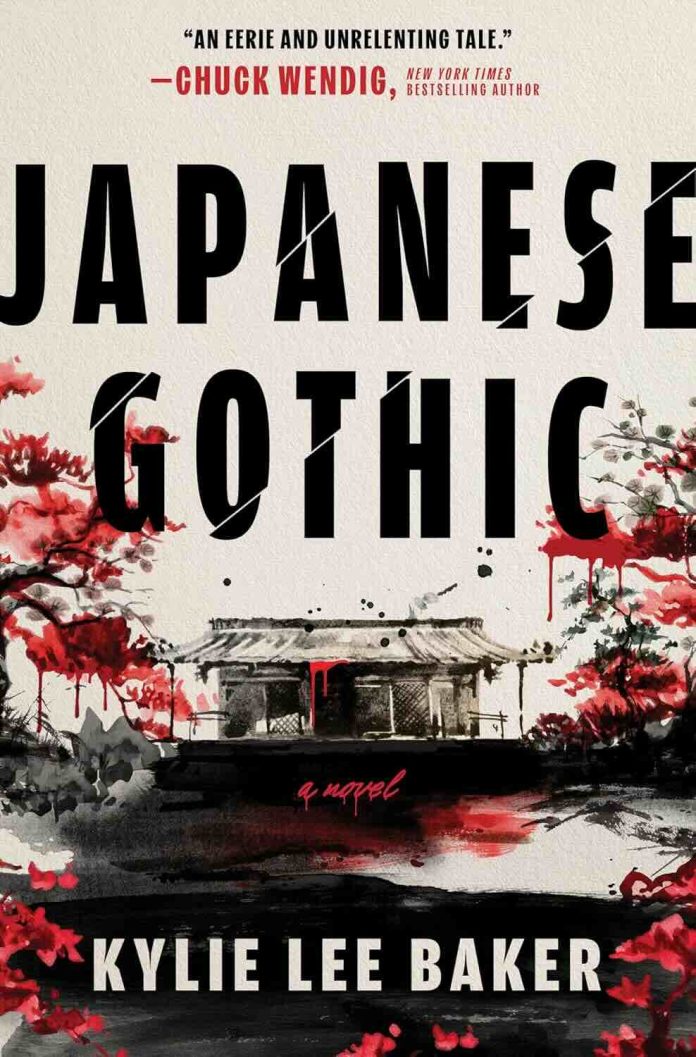
Some houses are simply old. The house at the center of Japanese Gothic by Kylie Lee Baker is something else entirely. Hidden at the bottom of an incline in Chiran, Kagoshima Prefecture, veiled by sword ferns and wild ginger, ringed by flowers that should not bloom in the same season, it has a heartbeat. Not a metaphorical one. The walls drink sound. The window that looks out to the yard is not always there. And a room that measures six feet longer from the inside than the outside should end any reasonable debate about whether the house is normal. Somehow, it only makes things worse.
Baker has built a career writing Japan through a lens of darkness and myth. Her debut YA duology, The Keeper of Night and The Empress of Time, followed a half-British, half-Japanese Shinigami navigating the supernatural politics of the Meiji Era. Bat Eater and Other Names for Cora Zeng followed. With Japanese Gothic, she makes the leap into adult horror, and the shift is palpable. The writing is denser, the damage runs deeper, and the mythology is no longer a backdrop but the engine of the entire story.
A Murderer and a Samurai, Separated by 150 Years
Japanese Gothic by Kylie Lee Baker opens in October 2026 with Lee Turner, a young American college student who has killed his roommate James and cannot quite remember how. He is not particularly horrified by this, and that detail may be the most unsettling thing about him. Lee is heavily reliant on sedatives, Ativan and Benadryl and Xanax he has been accumulating for years, and he experiences the world with an almost unbearable sensitivity: he can hear his father’s heartbeat, knows when people lie by watching their eyes dull, and has lost all sense of smell since the night of the murder. He flees to his father’s recently purchased home in southern Japan, the house behind the sword ferns, seeking shelter and distance from what he has done.
The other protagonist is Iwasaki Sen, encountered in October 1877. She is the daughter of the last surviving samurai of the Satsuma Rebellion, trained since childhood to be a warrior in a world that no longer has room for warriors. Sen sparred with her brothers at swordpoint before breakfast. She memorized the Hagakure. She buried her little sister Kura. And she follows her father’s commands even when they carry the unmistakable smell of something broken and wrong. And she is exceptionally skilled with a blade.
Baker alternates between these two voices chapter by chapter, threading the Legend of Urashima Taro through the narrative as a series of mythological interludes that build from fable into something far more personal. The technique creates mounting pressure, the sensation that two worlds are pressing against each other through a paper wall, until eventually, inevitably, something tears. The structure is one of the novel’s strongest choices, and Baker controls the rhythm of revelation with confidence.
What Baker Gets Exactly Right
The prose in Japanese Gothic by Kylie Lee Baker is not decorative. It is precise and strange, built of short declarative sentences that accumulate into dread. Baker writes about violence with the same flat clarity she applies to breakfast, which is exactly the right approach for a story where cruelty has been so thoroughly normalized that the characters themselves have stopped recognizing it. Stylistically, she draws Lee’s interior monologue with a pharmaceutical haze that lifts or thickens based on how many pills he has taken, an unusual and effective formal choice.
Several elements land with genuine force:
- Lee’s psychology is original territory. He is not a sympathetic antihero in the conventional mold. He is observant and fractured, dependent on sedatives to mute a mind that runs too hot, and he approaches the supernatural with the same clinical curiosity he applies to everything else. His relationship with his distant, quietly loving father is rendered with enough restraint to ache.
- Sen’s world is historically grounded. The depiction of the Satsuma Rebellion’s aftermath, the slow humiliation of the samurai class, the forced poverty, the Hagakure as a philosophical lifeline rather than a theatrical prop, all feel researched and inhabited rather than costumed. Sen’s ferocity reads as earned rather than convenient.
- The mythology works at the level of plot, not just atmosphere. The Urashima Taro framework is not layered decoratively on top of the story. By the final quarter of the novel, it becomes clear that the myth was never ornament. Baker has made it the actual architecture of the plot, and the way she brings the sea goddess Otohime into the modern narrative is the book’s most ambitious and successful risk.
- The house itself functions as a genuine character. The flowers that bloom out of season. The well with Okiku inside it. The closet that is and is not a closet. Baker renders the strangeness of the property through accumulating sensory detail rather than direct explanation, and the effect is properly gothic.
Where the Novel Strains
Japanese Gothic by Kylie Lee Baker is not without its difficulties, and four-star praise needs to account for them honestly.
The middle section, roughly Parts Two and Three, can feel like a long holding pattern. Both timelines accumulate repetitive beats: Lee questions the house, reaches for his pills, circles the same existential questions. Sen trains, absorbs punishment, trains again. The dual-narrative structure creates a natural push-pull, but the pacing occasionally stalls when neither character is allowed to move forward for extended stretches. Readers who are patient with atmosphere will survive it. Those who expect continuous momentum may grow restless.
There is also the question of emotional access. Baker has constructed Lee with obvious craft, but his sedated detachment sometimes feels less like a character choice and more like a structural barrier between the reader and the story’s emotional core. He is fascinating to observe and difficult to feel alongside, which creates an unusual kind of tension that does not always resolve in the narrative’s favor.
Finally, the mystery of the house, while satisfying in its resolution, is fairly generously telegraphed through the Urashima Taro interludes. Attentive readers will arrive at the shape of the answer earlier than the novel intends, which softens what might otherwise have been a properly devastating reveal.
If You Found Your Way to This House
Readers drawn to Japanese Gothic by Kylie Lee Baker will find kindred books in:
- Mexican Gothic by Silvia Moreno-Garcia, for gothic horror grounded in historical and cultural specificity
- The Haunting of Hill House by Shirley Jackson, for psychological horror that lives entirely inside the narrator’s perception
- A Tale for the Time Being by Ruth Ozeki, for a dual-narrative structure crossing Japanese time and consciousness
- The Vegetarian by Han Kang, for the quiet, visceral horror of a character unmade by the weight of others’ demands
- The Keeper of Night by Kylie Lee Baker herself, for her earlier, more YA-pitched supernatural take on Meiji Japan
Final Reckoning
Japanese Gothic by Kylie Lee Baker earns most of its ambitions. The house behind the sword ferns is a genuinely uncanny creation. Lee and Sen resist easy sympathy and are more interesting for it. The mythological underpinning, once fully revealed, elevates the whole enterprise from haunted house story into something with actual philosophical weight, a meditation on fate, on the lengths a lonely immortal will go to keep the things she loves from dying, and on whether being saved from your own ending is a kindness or a theft.
It is slower in the middle than it deserves to be, and the pacing occasionally works against its own suspense. But as a marriage of Japanese history, samurai ethics, and psychological horror, it marks Baker as a writer with a genuinely distinctive voice and a willingness to go somewhere strange and stay there. The sword ferns close around this book. They do not let go easily.
More Halloween reading: This book is one of the 67 haunted house books on our Halloween list.