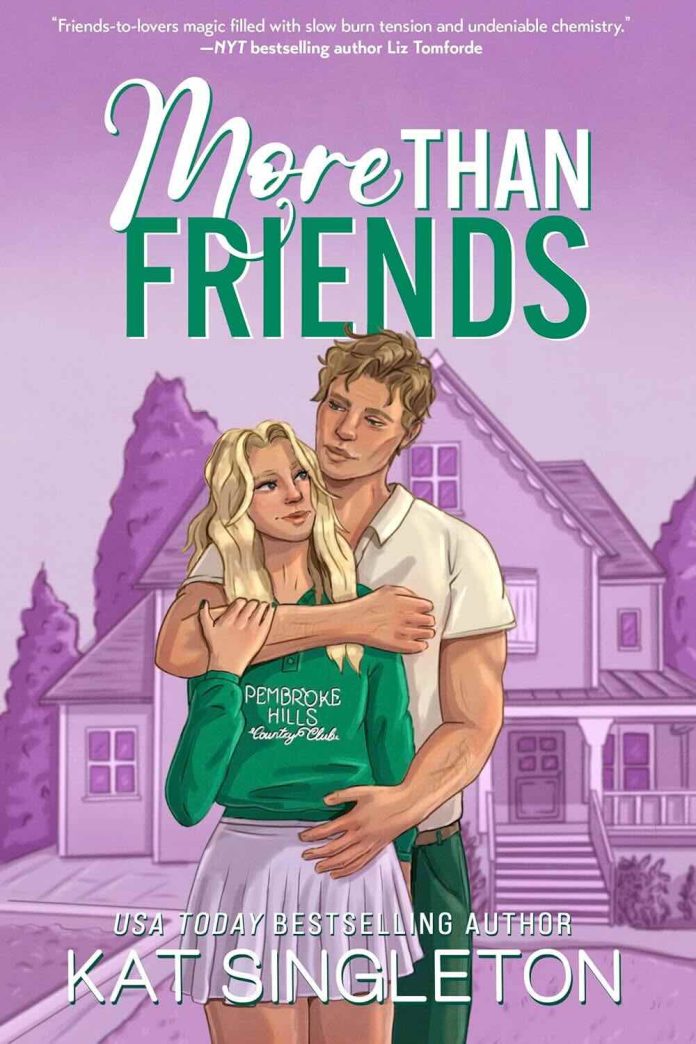
There is a particular kind of romantic tension that only a very specific type of story can sustain — the kind born in close proximity, fed by shared laughter, and deliberately buried under a year’s worth of careful restraint. More than Friends by Kat Singleton lives entirely within that tension. It is the third installment in the Pembroke Hills series, and it delivers what readers have quietly waited for since Jude Kensington first appeared at the edges of someone else’s love story: a charming, commitment-averse billionaire finally meeting the one woman who sees straight through the performance.
The World Already Built
If you are arriving at this series fresh, More than Friends by Kat Singleton functions as a standalone — but you will miss the texture it carries when read in sequence. In Good Company gave us Lucy and Cal’s slow, aching friends-to-lovers story. Bad for Business followed Camille and Ryker through their enemies-to-lovers arc with sharp wit and real emotional stakes. Now, with the fourth book Long Story Short still ahead for this world, Kat Singleton arrives at the pairing she has been quietly assembling across both previous novels. By the time Jude and Charlotte take center stage here, their friendship already feels genuinely lived-in. That groundwork is not accidental — it is the whole foundation.
A Summer Deal That Was Never Going to Stay Platonic
The premise fits squarely within the friends-to-lovers, forced proximity tradition: Charlotte Wells has just been evicted from her Hamptons apartment by a landlord who found tourists willing to pay full summer price. Jude Kensington, the effortlessly charming man she has spent a year treating as strictly a friend, has just had a baby dropped on his doorstep — an infant daughter named Ava, from a past relationship he knew nothing about.
The deal between them is clean on paper. She helps him survive sudden fatherhood. He gives her somewhere to live for the summer. Temporary. Convenient. Completely platonic. Except there was already a wine-blurred kiss the night before Ava arrived — a brief, disorienting moment that neither of them fully addresses — and with a baby suddenly in the house, every excuse not to talk about it becomes remarkably easy to make.
What More than Friends by Kat Singleton does particularly well is resist the instinct to play this premise purely for laughs. Kat Singleton takes the slow burn seriously. She understands that the payoff only earns its weight if the restraint that preceded it felt genuinely costly.
The Real Romance Is in the Ordinary Moments
The strongest sections of this novel are not the grand confessions or the charged physical scenes — they are the quiet, domestic snapshots that accumulate steadily until they become almost unbearable. Jude assembling a Pack ‘n Play while swearing at the instruction manual. Charlotte photographing the moment Jude’s parents hold Ava for the first time. Both of them frozen in the hallway, watching the baby monitor screen, waiting to see if the transfer succeeded. Singleton writes these scenes with a warmth that is neither saccharine nor manufactured. They feel real, which is the most difficult quality to achieve in this genre.
Jude’s character arc is the novel’s most compelling thread. He enters the story having built his entire identity around being easy, charming, and uncomplicated. Fatherhood quietly dismantles that self-image without Singleton ever turning the transformation into something forced. His love for Ava feels immediate and convincing, and the vulnerability that begins to emerge in his feelings for Charlotte is more affecting because he spends half the novel refusing to name it. The alternating dual POV gives the reader direct access to a man slowly understanding that he has been falling for a long time — and choosing, out of something that looks like self-protection, to call it friendship.
Charlotte is similarly well-drawn. She has her own life running parallel to the romance: a photography dream she has been quietly saving toward, a family she genuinely misses in Arizona, opinions she states without hedging, and a sense of humor that holds its own against Jude’s without collapsing into a supporting role. She is not defined by the romance, which is exactly what makes the romance feel earned.
What the Novel Gets Right
- Dual POV that actually earns its chapters: Both perspectives are distinct in voice and emotional register. Jude is wry and increasingly tender; Charlotte is self-aware and quietly longing. Singleton avoids the common trap of making two narrators sound like the same person wearing different clothes.
- A supporting cast used with intention: Lucy, Cal, Camille, Ryker, and the quietly compelling Tyson Bishop all feel like people rather than plot devices. Their appearances enrich the world without cluttering the central story.
- Baby Ava is not a narrative gimmick: The single dad trope lives or dies by how the child is handled. Ava is present, charming, and emotionally central without ever becoming manipulation in miniature.
- Banter that actually lands: Singleton’s dialogue remains one of her most reliable tools across the Pembroke Hills series. The back-and-forth between Jude and Charlotte is genuinely funny, and the shift from sparring to tenderness is handled with real care.
Where the Story Stumbles
The Thin Middle and the Quick Resolution
The novel is not without its weaknesses. The primary external conflict — the misunderstanding that forces the two leads to briefly separate before their reconciliation — is introduced and resolved with less development than the rest of the story deserves. It carries weight because of the emotional investment already built, but as a structural complication, it feels underwritten relative to the strength of the first and final acts.
There are also stretches in the second act where the domestic scenes, as warmly rendered as they are, begin to circle the same emotional realization without meaningfully advancing it. Both characters understand they are falling. At a certain point, the gap between knowing and admitting stops feeling like hard-won restraint and starts feeling like stalling for its own sake. Readers with patience for deeply internalized longing will find this less frustrating than those who prefer forward momentum.
These are recognizable friction points in the slow-burn genre, and they do not undermine what is genuinely strong here. But they are real enough to mention.
Kat Singleton’s Craft and the Series Ahead
More than Friends by Kat Singleton represents her most emotionally grounded entry in the Pembroke Hills series to date. Her earlier Wildfire series demonstrated a clear instinct for character-driven romance, and the Pembroke Hills books have sharpened that instinct considerably. With each installment, she has grown more confident allowing quiet, ordinary moments to carry the emotional load of the narrative — a confidence that is on full display here. Given the hints laid throughout this book about what waits in Long Story Short, readers have reason to be curious about where this world goes next.
If You Loved This, Read These Next
- People We Meet on Vacation by Emily Henry — buried feelings, a decade of summers, and the cost of pretending
- The Unhoneymooners by Christina Lauren — forced proximity, sharp banter, and earned tenderness underneath
- Practice Makes Perfect by Sarah Adams — a single dad, a woman next door, and a slow burn neither wants to name
- The Spanish Love Deception by Elena Armas — friends who have spent years not saying the obvious thing







