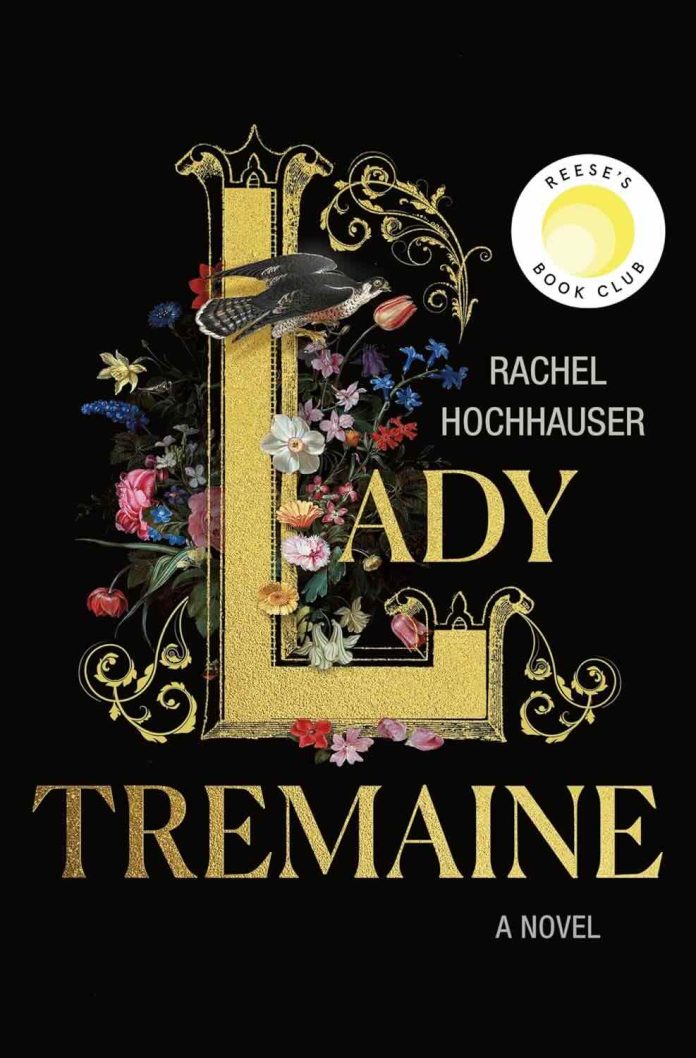
There is a moment, early in this novel, when Etheldreda describes herself as the Lady of the Dead Rabbit, the Lady of the Mud. She is standing in the woods before dawn, mud-spattered, a peregrine falcon on her arm, a dead coney tied to her belt, racing to get home before a royal carriage arrives at her crumbling front door. It is this image — not a glass slipper, not a pumpkin coach — that defines what Lady Tremaine by Rachel Hochhauser actually is: a story about a woman clinging to survival with bloodied fingernails while performing respectability as though her life depends on it. Because it does.
Where Fairy Tales Go to Grow Up
Hochhauser’s debut novel takes the most enduring villain in fairy tale history and strips away the cartoon cruelty, replacing it with something far more uncomfortable and far more interesting — a mother who is ruthless because she cannot afford not to be. Etheldreda, twice-widowed and functionally destitute, keeps her two biological daughters and one stepdaughter alive through a precarious balancing act: selling off furniture, bartering embroidery, hunting illegally on royal land, and spending their last pennies on lace sleeves so the neighbors will not smell the rot underneath.
The novel unfolds in a medieval-adjacent kingdom where the rules governing women are as rigid as iron and as indifferent as weather. In Lady Tremaine by Rachel Hochhauser, respectability is a lifeboat, and marriage is the only shore. Etheldreda understands this with the grim pragmatism of someone who has watched unprotected women crawl in the dirt and die without witnesses. Every choice she makes — every manipulation, every calculation — is filtered through that knowledge.
The Architecture of Motherhood
What elevates this book beyond a clever retelling is its sustained, unflinching meditation on what motherhood actually costs. Hochhauser builds Etheldreda’s inner life with sentences that feel carved rather than written, each one weighted with contradiction and self-awareness. The prose carries a formal cadence that mirrors its historical setting without ever becoming stiff, alternating between sharp wit and passages of genuine lyrical beauty.
The relationship between Etheldreda and her three daughters — Rosamund, Mathilde, and stepdaughter Elin — is the structural heart of the novel and its richest territory. Rosamund, the younger, is warm and eager and a gifted seamstress. Mathilde, the elder, is flinty and perceptive and unwilling to swallow the performance her mother insists upon. And Elin, the stepdaughter, is passive and proper, a walking compendium of pleasant maxims who is simultaneously the novel’s most heartbreaking and most frustrating figure.
Hochhauser does not make the mistake of turning these women into a united front. They argue, misunderstand each other, and collide. Etheldreda’s love for her biological daughters is bodily and instinctual, while her relationship with Elin must be constructed from scratch, each gesture of care consciously learned and earned. This distinction is one of the book’s most honest observations, and it refuses to sentimentalize either kind of bond.
A Falcon Named Lucy
Among the novel’s most stirring elements is Etheldreda’s peregrine falcon, Lucy. Not a metaphor, not merely a plot device, but a fully realized presence whose weight on a gauntleted fist, whose razor talons and obsidian eyes, ground the story in a tactile, physical reality that many fairy tale retellings lack.
Lucy represents what Etheldreda cannot allow herself to be: an undomesticated creature whose violence is a stepping stone to survival. The falconry sequences — drawn with evident research and care — are some of the most vivid writing in the novel. When tragedy comes for Lucy late in the story, it hits with a force that catches you off guard.
Key Strengths Worth Noting
- The prose style adapts the formal cadence of historical fiction while remaining modern in its emotional precision, never veering into pastiche
- Hochhauser weaves familiar Cinderella moments — the torn dress, the ball, the lost shoe — into the narrative as natural, inevitable events rather than winking Easter eggs
- The villain reveal in the novel’s second half is genuinely shocking and recontextualizes every interaction that preceded it
- Supporting characters like the household staff, Alice and Wenthelen, provide comic relief and emotional ballast in equal measure
- The slow-burning romantic tension with Otto Abensur avoids every predictable beat without sacrificing warmth
Where the Shoe Pinches
For all its accomplishments, Lady Tremaine by Rachel Hochhauser is not without its rough seams. The novel’s pacing, particularly in the first third, asks for significant patience. The extended backstory of Etheldreda’s youth and first marriage, while beautifully rendered, slows the narrative momentum at a point where some readers may need a stronger hook to carry them forward. The novel takes its time getting to the royal ball and the darker revelations that follow, and that slow burn will not suit every reader’s temperament.
Elin’s characterization, too, can feel like a deliberate frustration taken slightly too far. Her relentless quoting of moral platitudes, while clearly designed to illustrate both her naivety and her eventual transformation, occasionally grates rather than endears. The payoff is satisfying, but the journey there tests patience.
Areas That May Challenge Readers
- The medieval setting, while atmospheric, occasionally lacks specificity about its exact time period or geography, creating a slightly floating quality to the worldbuilding
- Some secondary characters, particularly the Enright family, feel more functional than fully fleshed out
- The novel’s tonal shift in its final act — from domestic drama to something considerably darker and more violent — may feel abrupt for readers expecting the lighter register of the book’s comparisons to Bridgerton
Additionally, certain philosophical passages about motherhood, while individually powerful, can accumulate to a point where the narrative voice edges toward the didactic. Hochhauser is at her strongest when she trusts the story itself to carry the thematic weight, and at her most vulnerable when she reaches for one more meditation on the nature of maternal sacrifice.
A Debut with Teeth
What makes Lady Tremaine by Rachel Hochhauser ultimately succeed — and succeed resoundingly — is its refusal to offer a comfortable moral. The ending is deliberately open, deliberately messy, deliberately unresolved. The novel’s final lines do not reassure you. They dare you. There is no fairy godmother here, no magical transformation, no prince on a white horse. Instead, there is a middle-aged woman standing in the woods with her daughters and their hawks, covered in mud and blood and blister, announcing to no one in particular: You are the scariest thing in the woods.
This is Hochhauser’s debut novel, published by St. Martin’s Press and selected as a Reese’s Book Club pick for March 2026. For a first book, the confidence on display is remarkable. The prose rarely falters, the emotional register is controlled and precise, and the structural gamble — telling the most famous fairy tale in the world from its villain’s perspective, and then detonating that fairy tale entirely — pays off with conviction.
Lady Tremaine by Rachel Hochhauser sits comfortably alongside the best fairy tale reimaginings of the last decade. It is fiercely intelligent, deeply felt, occasionally imperfect, and impossible to forget. It is not the fairy tale you grew up with. And it is the one you needed.
If You Loved This, Read These Next
For readers captivated by the world of Lady Tremaine by Rachel Hochhauser, here are some thoughtfully selected companion reads that explore similar thematic territory:
- Circe by Madeline Miller — Another mythological woman recast as the protagonist of her own story, told in luminous, muscular prose
- Wicked by Gregory Maguire — The original villain-as-protagonist reimagining, which asks similar questions about the stories we inherit and who gets to tell them
- The Bear and the Nightingale by Katherine Arden — A fairy tale retelling steeped in folklore, atmosphere, and a young woman’s defiance of the roles assigned to her
- Weyward by Emilia Hart — A multigenerational story of women, nature, and survival that shares Hochhauser’s interest in the wildness women are forced to suppress
- The Lost Apothecary by Sarah Penner — Historical fiction centered on women navigating a world built to contain them, with a slow-reveal mystery at its core
- Spinning Silver by Naomi Novik — A fairy tale retelling that grounds its fantasy in economic desperation and female pragmatism
- Hester by Laurie Lico Albanese — A reimagining of the woman behind The Scarlet Letter that, like Hochhauser’s novel, explores the gap between how women are judged and who they actually are







