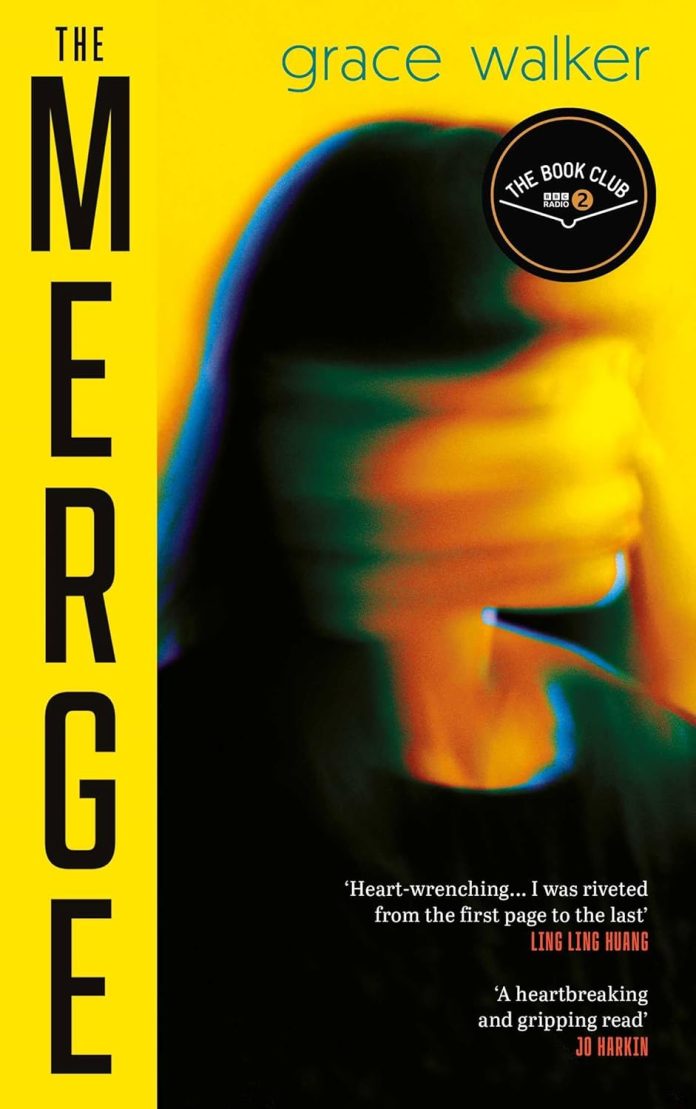
When love collides with experimental science and desperate hope meets sinister manipulation, Grace Walker’s debut novel, The Merge, emerges as a chilling examination of how far we’ll go to hold onto those we love. The Merge presents a future where consciousness can be transferred and blended, offering salvation to the dying while raising profound questions about identity, autonomy, and the price of technological progress.
A Premise Both Intimate and Terrifying
Set against a backdrop of environmental collapse and resource scarcity, Walker introduces us to a world where “merging” has become the revolutionary solution to multiple crises. The concept is deceptively simple: two consciousnesses can be combined into a single body, allowing the terminally ill to survive by sharing their partner’s healthy form. What begins as an intimate story of a daughter’s love for her ailing mother transforms into a sophisticated psychological thriller that interrogates the boundaries of self, the ethics of consent, and the dangers of unchecked corporate power.
Amelia, a once-passionate activist turned documentarian, watches her mother Laurie succumb to Alzheimer’s disease. Faced with the unbearable prospect of losing her last remaining parent, Amelia signs them up for an experimental merging trial. Alongside them are other desperate participants: teenage Lucas merging with his dying brother Noah, Ben merging with his pregnant fiancée Annie, and Jay attempting to save his addicted daughter Lara. Each pairing carries its own emotional weight, its own ethical complications, and its own trajectory toward either salvation or tragedy.
Narrative Architecture and Stylistic Innovation
Walker demonstrates remarkable structural ambition in her debut. The novel unfolds in two distinct sections that mirror the psychological fragmentation at its core. Part One employs alternating perspectives between Amelia and Laurie during their three-month preparation period, establishing their individual voices, fears, and motivations with careful precision. The writing here is grounded and naturalistic, allowing readers to fully inhabit both women before the merge occurs.
Part Two represents Grace Walker’s boldest creative choice. Following the merge, the narrative voice becomes “Laurie-Amelia,” written in a fragmented, stream-of-consciousness style that brilliantly captures cognitive dissonance and the dissolution of individual identity. Short, staccato sentences. Incomplete thoughts. Shifting pronouns. This experimental prose initially disorients readers before revealing itself as a masterful technique for conveying the horror of losing one’s singular self. The fragmentation intensifies as the merged consciousness struggles to maintain internal dialogue, creating a claustrophobic reading experience that mirrors the protagonist’s psychological imprisonment.
Character Development and Emotional Resonance
Walker excels at creating fully realized characters whose motivations feel authentically complex rather than conveniently binary. Laurie emerges as more than a passive victim of disease; she’s an artist, a survivor of childhood abuse, a woman grappling with agency and control. Her resistance to the merge, documented in her notebook entries, provides the novel’s moral backbone. Amelia’s transformation from fierce activist to complicit participant initially appears contradictory until Walker reveals the layers of manipulation, love, and desperation driving her choices.
The supporting cast receives equally thoughtful development. Benjamin and Annie’s relationship, pregnant with hope and doomed by circumstance, becomes one of the novel’s most heartbreaking elements. Lucas and Noah’s brotherly bond offers moments of genuine tenderness amid the darkness. Even the most tragic figure, Lara-Jay, whose merge results in silence and ultimately suicide, receives dignified treatment that refuses to exploit their suffering for mere shock value.
Thematic Depth and Social Commentary
Beneath its science fiction premise, The Merge by Grace Walker functions as incisive social commentary on multiple fronts. Walker interrogates contemporary anxieties about:
- The erosion of bodily autonomy in the face of medical and corporate authority
- How economic desperation forces impossible choices upon the vulnerable
- The manipulation of language to disguise coercion as choice
- Society’s willingness to sacrifice individual rights for collective “solutions”
- The weaponization of love and family bonds to override consent
The novel’s treatment of the Combine corporation as simultaneously savior and predator feels unnervingly prescient. The luxurious “Village” where merged participants recover operates as gilded cage, complete with euphemistic language (“Support Workers” instead of guards), mandatory drugging disguised as treatment, and constant surveillance presented as care. Walker’s critique of how institutions exploit vulnerability while maintaining benevolent facades resonates powerfully.
Where the Novel Falters
Despite its considerable strengths, The Merge by Grace Walker occasionally struggles with pacing in its middle sections. The preparation period, while necessary for character establishment, sometimes feels repetitive as sessions rehash similar ground. Certain revelations about the manipulation techniques—particularly the use of recorded voices to implant false memories—arrive with insufficient setup, creating moments that feel more convenient than earned.
The novel’s bleakest elements, while thematically justified, may prove overwhelming for some readers. Walker doesn’t flinch from depicting psychological torture, the loss of infant Teddy’s true nature, or the complete erasure of individual consciousness. The balance between maintaining hope and confronting horror tips decisively toward darkness, which serves the story’s message but may challenge readers seeking any measure of uplift.
Additionally, some secondary characters remain underdeveloped. Nathan and Eliza, the primary antagonists, function more as representatives of institutional evil than fully dimensional individuals. While this serves the novel’s critique of systemic rather than individual villainy, it occasionally reduces them to plot mechanisms rather than complex human actors.
Technical Accomplishments
For a debut novelist, Walker demonstrates impressive command of multiple technical elements. The dual timeline structure maintains clarity despite narrative complexity. Dialogue captures distinct voices while advancing both character and plot. The speculative elements remain internally consistent without overwhelming the emotional core. Most impressively, Walker sustains tension across 300+ pages, ensuring each revelation lands with appropriate impact.
The ending, which this review won’t spoil, manages to be both devastating and oddly cathartic. Walker refuses easy resolutions while providing narrative closure, trusting readers to sit with uncomfortable questions rather than offering false comfort.
A Significant Debut That Demands Attention
Grace Walker, an English teacher from Surrey, has crafted a debut that announces a significant new voice in speculative fiction. The Merge by Grace Walker succeeds both as gripping thriller and thoughtful meditation on identity, autonomy, and love’s dangerous edges. While not without flaws, its ambition, emotional intelligence, and willingness to confront difficult questions mark it as a standout work.
This is not comfortable reading, nor is it meant to be. Walker has written a novel that lingers in the mind long after the final page, raising questions that resist simple answers. In an era of increasing technological intervention in human experience, corporate consolidation of power, and ethical gray zones in medical practice, The Merge feels urgently relevant.
For Readers Who Enjoyed
If The Merge by Grace Walker captivated you, consider these similarly thought-provoking works:
- Never Let Me Go by Kazuo Ishiguro – Another intimate examination of bodily autonomy, sacrifice, and institutional control with devastating emotional impact
- The Power by Naomi Alderman – Speculative fiction that interrogates power structures and societal transformation through a single radical change
- Severance by Ling Ma – Dystopian fiction blending corporate critique with questions of identity and consciousness
- Station Eleven by Emily St. John Mandel – Post-apocalyptic narrative exploring what remains of humanity when civilization collapses
- Parable of the Sower by Octavia Butler – Prescient dystopian vision examining environmental collapse and societal breakdown
- The Handmaid’s Tale by Margaret Atwood – Classic exploration of bodily autonomy under oppressive systems disguised as salvation
Grace Walker’s The Merge establishes her as a writer unafraid to ask difficult questions and trust readers with complex, uncomfortable answers. This is speculative fiction that speculates meaningfully about power, identity, and the terrifying potential futures we might create from desperate love.