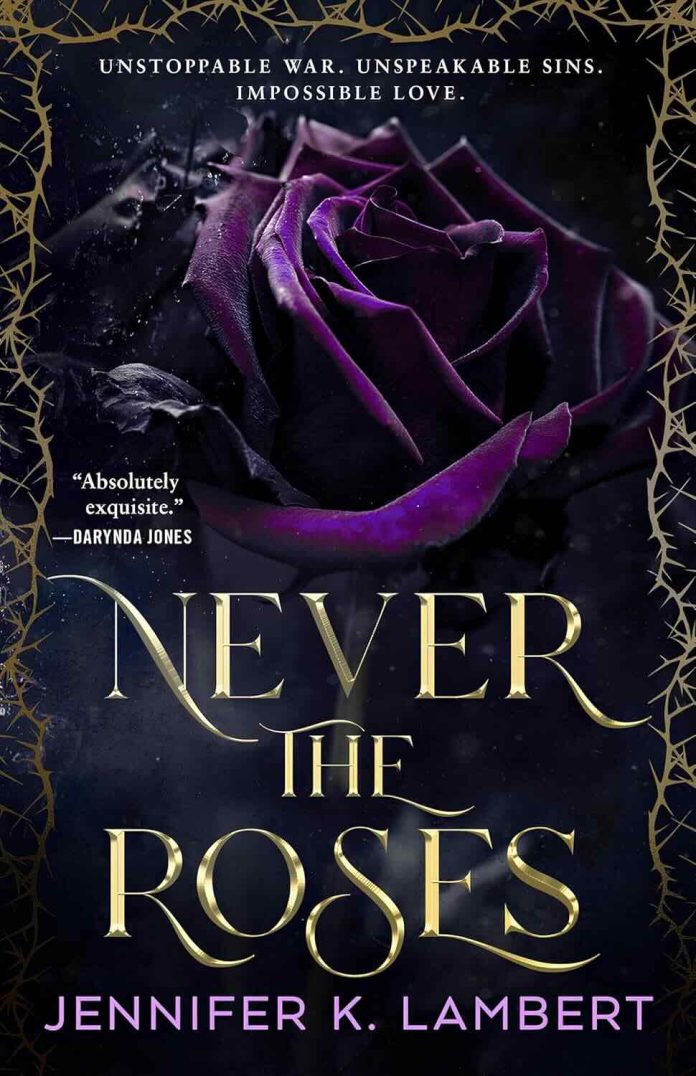
Jennifer K. Lambert’s debut under this pseudonym arrives like a whispered confession in the dark—intimate, devastating, and impossibly beautiful. Never the Roses transcends the conventional boundaries of fantasy romance, offering instead a deeply philosophical exploration of what it means to live with the consequences of one’s choices, and whether love can bloom from the scorched earth of a war-weary soul.
The story centers on Oneira, the infamous “Dread Sorceress” who has finally escaped the endless cycle of magical warfare that has defined her existence. Retired to a crystal dome on a remote island, she tends to impossible Veredian roses and contemplates the weight of her past sins—most notably the complete annihilation of Govirinda. When a simple act of literary theft brings her into correspondence with Stearanos “the Stormbreaker,” her most powerful rival, their exchange of letters evolves into something neither expected: a connection that threatens to reignite the very flame of life within her.
A Tapestry Woven from Dreams and Thorns
The Architecture of Sorrow
Lambert constructs her narrative with the deliberate precision of someone who understands that the most powerful magic lies not in spectacle, but in restraint. The book unfolds through a series of carefully orchestrated encounters—first through stolen books and written correspondence, then through increasingly intimate meetings that feel both inevitable and impossibly fragile.
The author’s choice to begin the story after Oneira’s retirement proves masterful. Rather than wallowing in the familiar territory of epic battles and world-ending stakes, Lambert focuses on the aftermath: what happens when the destroyer seeks to create, when the weapon tries to become human again. This decision elevates the work beyond typical fantasy fare into something approaching literary fiction with magical elements.
The pacing feels intentionally meditative, matching Oneira’s own careful, deliberate attempts to cultivate beauty in her exile. Lambert understands that healing—both for characters and readers—requires time to breathe, to sit with discomfort, to allow emotions to develop organically rather than through forced dramatic beats.
The Language of Longing
Lambert’s prose carries the weight of poetry without sacrificing clarity. Her descriptions of the Dream—the metaphysical realm where all sleeping minds connect—read like fragments of half-remembered visions. When Oneira enters this space, the language itself becomes more fluid, more symbolic, mirroring the logic of actual dreams where meaning exists beyond literal interpretation.
The author demonstrates particular skill in her handling of intimate scenes. The physical relationship between Oneira and Stearanos develops with a rare authenticity, where desire serves character development rather than mere titillation. Their first kiss arrives not as conquest but as mutual recognition—two damaged souls acknowledging their shared wounds and the possibility of healing through connection.
The Magic of Specificity
One of the novel’s greatest strengths lies in Lambert’s attention to magical detail without drowning readers in exposition. Oneiromancy—dream magic—becomes not merely a plot device but a lens through which to examine consciousness, guilt, and the thin boundaries between sleeping and waking life. Oneira’s ability to pull objects from dreams into reality serves as a beautiful metaphor for the creative process itself, while her fear of entering others’ dreams speaks to the intimate terror of truly knowing another person.
The titular roses function as more than symbolic decoration. These Veredian roses—difficult to grow, blooming only in winter’s darkest days, armed with vicious thorns—become a perfect representation of beauty that can only emerge from harsh conditions. Oneira’s obsessive cultivation of them mirrors her own difficult journey toward redemption.
Characters as Complex as Real People
Oneira: The Weight of Godlike Power
Oneira stands as one of the most compelling protagonists in recent fantasy fiction. Lambert refuses to soften her edges or excuse her past. The destruction of Govirinda haunts every page, not as a distant plot point but as a living wound that shapes every decision, every moment of self-doubt, every tentative step toward connection with others.
The author excels at showing rather than telling us about Oneira’s power. We see it in the casual way she creates crystal domes from dream-stuff, in how other characters react to her presence, in the careful control she exercises over every magical impulse. Yet Lambert also reveals her vulnerability through small details: her surprise at experiencing physical desire, her awkward attempts at domesticity, her genuine wonder at Stearanos’s ability to see past her reputation.
Stearanos: The Burden of Duty
Stearanos could have easily fallen into the trap of being merely the “dark, brooding love interest,” but Lambert gives him genuine depth and agency. His initial appearance as “His Majesty’s Sorcerer” bound by magical contract parallels Oneira’s own past enslavement to war, creating an immediate foundation for understanding between them.
His development throughout the novel feels earned rather than convenient. The transformation from duty-bound weapon to a man capable of choosing love over obligation happens gradually, through conversations about books, shared moments of vulnerability, and the slow recognition that he and Oneira are more alike than different.
Supporting Characters That Matter
Even the minor characters feel fully realized. Bunny, Moriah, and Adsila—Oneira’s magical animal companions—serve as more than mere fantasy window dressing. They represent different aspects of her journey toward connection and trust, each relationship reflecting her capacity for nurturing that has survived despite everything she’s endured.
Tristan, the young poet who briefly enters Oneira’s life, could have been a mere romantic rival, but Lambert uses him to explore themes of appropriate relationships and the difference between infatuation and genuine connection. His presence serves as a foil that helps define what makes Oneira’s relationship with Stearanos unique and necessary.
Themes That Resonate Beyond the Genre
Redemption Without Absolution
Perhaps the novel’s most powerful achievement lies in its honest exploration of guilt and redemption. Lambert never suggests that Oneira’s love for Stearanos, or her attempts to create beauty, somehow erase or balance out her past destruction. The weight of Govirinda remains constant throughout the narrative, a reminder that some actions cannot be undone, only lived with.
This refusal to offer easy answers elevates the novel beyond simple redemption narratives. Instead, Lambert asks more complex questions: How do we continue living with the knowledge of irreversible harm we’ve caused? Can love exist alongside unforgivable guilt? What does it mean to choose creation over destruction when both impulses live within us?
The Politics of Power
While never heavy-handed, the novel offers subtle commentary on how societies use and dispose of their most powerful individuals. Both Oneira and Stearanos have been shaped by systems that valued their magical abilities while treating them as weapons rather than people. Their relationship develops partly as a rejection of these systems—a choice to value each other as individuals rather than tools.
The magical contracts that bind sorcerers to serve kings and queens function as a fantasy metaphor for real-world systems that exploit talent while offering limited agency. Lambert explores how trauma bonds can form between people who’ve been similarly used, and how healing requires not just personal growth but systemic change.
Love as Radical Act
In a world built on endless warfare and exploitation, the simple act of two people choosing to care for each other becomes revolutionary. Lambert presents love not as a weakness that makes characters vulnerable, but as a form of resistance against systems designed to prevent human connection.
The roses themselves embody this theme—difficult to grow, requiring specific conditions, blooming against all odds in the darkest season. Like love, they demand patience, skill, and faith that beauty can emerge from harsh circumstances.
Critical Considerations
Pacing Challenges
While the meditative pace serves the story’s themes, some readers may find the middle sections slower than expected for a fantasy romance. Lambert prioritizes character development and emotional authenticity over action sequences, which may disappoint readers seeking more traditional fantasy adventure elements.
The book’s focus on internal transformation over external conflict requires patience from readers accustomed to faster-paced narratives. However, those willing to engage with the book’s contemplative rhythm will find themselves rewarded with genuinely moving character development.
Worldbuilding Gaps
Lambert’s decision to focus intensely on character relationships means some aspects of the larger world remain underdeveloped. While we understand the basic political situation and magical systems, details about history, culture, and geography sometimes feel sketched rather than fully realized.
The book works best when read as a character study that happens to include fantasy elements rather than as a comprehensive secondary world fantasy. Readers seeking detailed worldbuilding may find themselves wanting more context about the political systems, magical education, and cultural differences between regions.
Familiar Fantasy Elements
Despite its emotional sophistication, Never the Roses relies on some well-worn fantasy tropes: the retired powerful sorceress, the rival-to-lover relationship, magical contracts binding sorcerers to rulers. While Lambert executes these elements skillfully, they may feel predictable to well-read fantasy fans.
However, the author’s psychological depth and literary sensibility generally overcome these familiar elements. The execution proves more important than originality, and Lambert’s character work elevates common tropes into something genuinely affecting.
Literary Influences and Connections
Lambert openly acknowledges her debt to Patricia A. McKillip’s The Forgotten Beasts of Eld, and readers familiar with that classic will recognize similar themes of power, isolation, and the choice between revenge and love. Like McKillip, Lambert understands that the most compelling fantasy emerges from emotional truth rather than elaborate magical systems.
Never the Roses also echoes the psychological complexity found in Ursula K. Le Guin’s Earthsea series, particularly in its examination of how power corrupts and what true mastery actually means. Lambert’s Oneira shares DNA with Le Guin’s Ged—both characters must confront the shadow aspects of their power and find ways to live with the consequences of their choices.
Contemporary readers will also find resonances with Madeline Miller’s approach to mythological retelling, though Lambert creates her own mythology rather than adapting existing stories. The focus on complex, morally ambiguous characters and the psychological realism applied to fantastic situations connects Never the Roses to the current trend toward more literary fantasy.
The Author’s Voice
Writing under the Jennifer K. Lambert pseudonym, this work represents a departure for an author better known for her epic fantasy romance under the name Jeffe Kennedy. The Lambert voice feels more introspective, more willing to sit with difficult emotions and unresolved tensions. This shift in tone serves the material well, creating space for the kind of quiet character development that drives the narrative.
Lambert’s experience as both a writer and former president of SFWA shows in her confident handling of genre conventions and reader expectations. She knows when to fulfill them and when to subvert them, creating a work that feels both familiar and fresh.
Similar Works to Explore
For Readers Who Loved This Book
- The Forgotten Beasts of Eld by Patricia A. McKillip – The acknowledged inspiration, featuring similar themes of power, isolation, and choosing love over revenge
- The Goblin Emperor by Katherine Addison – Another character-driven fantasy focused on healing and kindness in a harsh world
- The Priory of the Orange Tree by Samantha Shannon – Epic fantasy with complex characters and thoughtful worldbuilding
- The Ten Thousand Doors of January by Alix E. Harrow – Literary fantasy exploring love, loss, and the power of stories
- The Song of Achilles by Madeline Miller – Mythological fiction with psychological depth and beautiful prose
For Further Reading by the Author
While Never the Roses is Lambert’s debut under this name, readers should explore her extensive bibliography as Jeffe Kennedy, particularly the Twelve Kingdoms series for those who enjoy her worldbuilding and the Uncharted Realms series for similar romantic fantasy elements.
Final Verdict
Never the Roses succeeds as both fantasy and literary fiction, offering readers a mature exploration of love, guilt, and redemption wrapped in beautiful prose and compelling characters. Lambert has created something special here—a book that honors genre conventions while transcending them, that takes fantasy seriously as a vehicle for examining real human emotions and experiences.
The novel will particularly appeal to readers who appreciate character-driven narratives, complex protagonists, and prose that rewards careful attention. While it may not satisfy those seeking action-heavy adventure or comprehensive worldbuilding, it offers something perhaps more valuable: a genuine exploration of what it means to choose love and creation over destruction and despair.
Never the Roses is fantasy fiction for adults, in the best sense—not because of content warnings, but because it grapples with the kind of complex moral questions that mature readers can appreciate. Lambert has given us a book that lingers long after the final page, like the fragrance of roses blooming against all odds in winter’s deepest darkness.
- Recommended for: Readers who enjoyed the psychological depth of Robin Hobb’s Fitz and Fool trilogy, the lyrical prose of Patricia Briggs’s Hurog duology, or the character focus of Martha Wells’s Books of the Raksura series.
- Content Notes: Contains mature themes including warfare, guilt, trauma, and intimate relationships between consenting adults. The violence exists primarily in backstory rather than on-page action.







