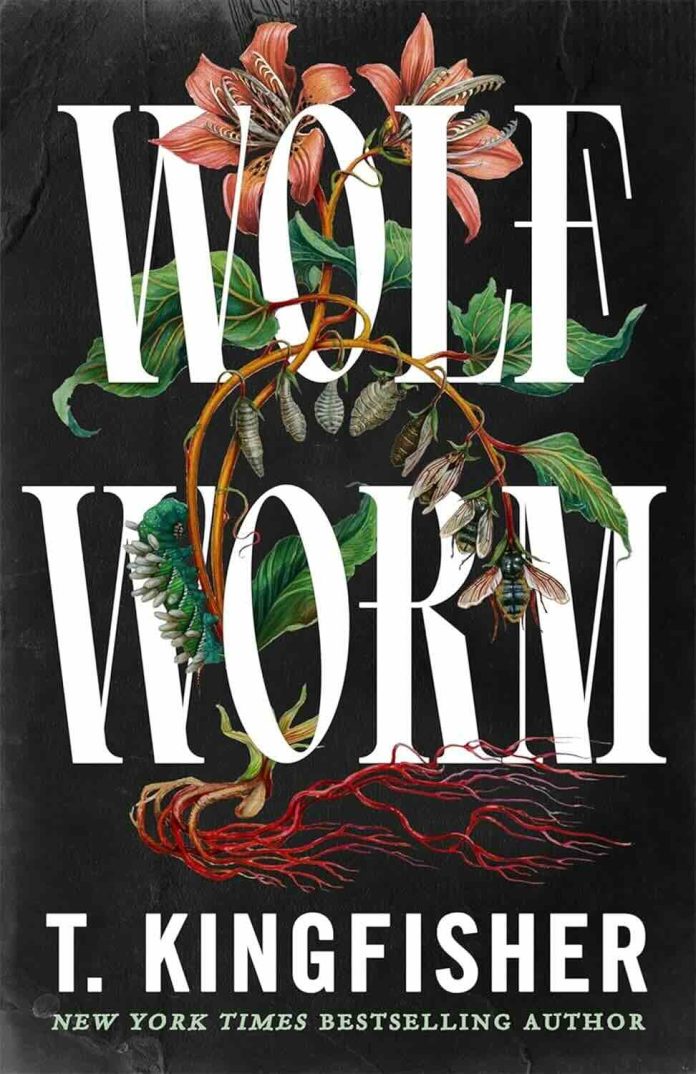
The year is 1899, and Sonia Wilson steps off a train in Siler Station, North Carolina, clutching a cardboard suitcase full of sketchbooks and nearly nothing else. At thirty-three, she is a scientific illustrator without work, a spinster by Victorian reckoning, and the daughter of a botanist whose death left her financially stranded. Dr. Matthias Halder has hired her to illustrate his collection of parasitic insects — a grotesque assignment she is nonetheless grateful for. No one has come to meet her at the station.
Wolf Worm by T. Kingfisher announces itself in that opening: a woman competent at her craft but constrained from every direction, navigating a world that has no dignified category for what she is. Sonia’s first-person narration is one of the novel’s greatest pleasures. She sees everything through watercolors — Halder’s faded complexion rendered in sepia washes blotted right back up, the sky overhead “a blue watercolor wash, the clouds picked out in white gouache.” This technique never becomes a tic; it earns its place as both characterization and atmosphere, showing us a woman who understands the world best when she can find a way to paint it.
The Household at Halder’s Manor
The characters orbiting the crumbling estate are, collectively, more interesting than any single one. Rose Kent, the housekeeper, is the novel’s moral center: a Black woman in the post-Reconstruction South whose continued employment by a man she despises is rooted in grief, circumstance, and the brutal mathematics of caring for an ailing mother. She is sharp, warm, and occasionally terrifying. Jackson Kent, her husband, provides comic counterweight — a storyteller who spins tales of “blood thieves” in the nearby woods with cheerful relish.
Ma Kersey, the Lumbee healer who drops in from the county margins, may be the book’s most quietly vital presence. She arrives in a nest of vivid shawls with gold teeth and an encyclopedic knowledge of local plants, local gossip, and local horrors. Through her, Wolf Worm by T. Kingfisher achieves something that many gothic novels attempt and few manage: a grounded sense of folk knowledge that feels earned rather than merely atmospheric. Her account of certain unusual births from years prior does more for the novel’s mythology than any conventional exposition could.
Halder himself is precisely as unpleasant as advertised, and the novel wisely never softens him. His entomological research is legitimate — the science in these pages is real — but his character holds secrets that Sonia, with her naturalist’s compulsion to observe and classify, cannot leave alone. When she begins to notice his nighttime excursions to a locked outbuilding coincide with the mysterious disappearance of Mrs. Kent’s chickens, her curiosity takes her somewhere she cannot easily come back from.
What Festers Beneath
The horror in Wolf Worm by T. Kingfisher is earned rather than imposed. T. Kingfisher is skilled enough to let dread accumulate through perfectly mundane anxieties — a possibly rabid raccoon staring from a sweetgum tree, Halder’s apoplectic rages, Sonia’s constant financial precarity — before the deeper wrongness surfaces. The botfly’s life cycle is rendered with clinical precision: larvae that burrow beneath skin, the raised warble on a host animal’s neck, the fly’s deceptively fuzzy, bumblebee-like appearance belying its purpose. The science is the horror here, and it is more disturbing for being real.
This restraint is the novel’s greatest asset. The gothic atmosphere of the decaying manor — algae powdering the columns, tin ceiling tiles stamped with dragonflies, the dining room that echoes like a sealed room — does not require explanation. It simply accumulates, the way damp does in old wood.
A folkloric thread runs alongside the entomological one: stories of blood thieves, whispered community memory of violent events three years prior, a Lumbee healer’s account of infants that were “wrong from the first.” These layers add a second frequency to the novel’s dread. The tension between Sonia’s empirical worldview and the community knowledge surrounding her is genuinely productive, and the novel is at its best when those two registers brush against each other.
Praise, and a Few Honest Reservations
What the novel gets exactly right:
- Sonia’s narration is immediately distinctive — sardonic, precise, and genuinely funny. Her parenthetical catastrophizing, perpetually ordered to stand down, is charming rather than cloying.
- Historical texture is fine-grained without being pedantic. The racial politics of the period are woven into character and plot rather than deployed for atmosphere.
- The horror is body-based and will get under your skin — readers with a sensitivity to parasites should know what they are signing up for.
- The resolution is satisfying and the epilogue earns its warmth.
Where the novel strains:
- The middle section, in which Sonia methodically times Halder’s excursions like a proper naturalist, slows the pace considerably over several chapters. Authentic to character, but it will test impatient readers.
- The supernatural dimension of the story — its folklore, its creatures — is somewhat less developed than the entomological one. The balance tips toward science, which fits Sonia’s worldview but leaves some threads underexplored.
T. Kingfisher’s Gothic Tradition
Readers who have followed this author’s recent work — What Moves the Dead (2022), her elegant reworking of Poe’s “House of Usher,” or A House With Good Bones (2023), another Southern Gothic rooted in real-world horror — will recognize the signature: the genre-literate protagonist, the understated accumulation of dread, and the mordant humor that makes the frightening parts land harder. Wolf Worm by T. Kingfisher is perhaps her most ambitious marriage yet of scientific realism and supernatural unease, and it belongs in the same conversation as the best of the contemporary gothic.
If You Enjoyed This, Read These
- What Moves the Dead by T. Kingfisher — the same body horror precision, applied to Poe’s most famous house
- A House With Good Bones by T. Kingfisher — Southern Gothic with a modern sensibility and deep entomological roots
- Mexican Gothic by Silvia Moreno-Garcia — a scientific heroine, a decaying estate, and horror nested in biology
- The Historian by Elizabeth Kostova — vampiric lore rendered through scholarly research and period immersion
- Plain Bad Heroines by Emily M. Danforth — gothic and period-inflected, full of dread and impossible institutions for women
- Bellman & Black by Diane Setterfield — Victorian gothic, ornithological obsession, and a professional life haunted by its own choices
- The Little Stranger by Sarah Waters — slow-burn gothic horror with an unreliable professional narrator in a crumbling English manor
Wolf Worm by T. Kingfisher is the kind of novel that takes its horror seriously without losing its sense of the absurd — a woman scrubbing potential botfly eggs from her scalp at three in the morning is both terrifying and bleakly funny, and that tension is the book’s most distinctive quality. The middle drags, and not every thread is fully drawn tight, but the world of Chatham County in 1899 is vividly rendered and Sonia Wilson stubborn enough of a protagonist that most readers will forgive its pacing. This is gothic fiction with mud on its boots and science in its heart, and it is well worth the discomfort.







