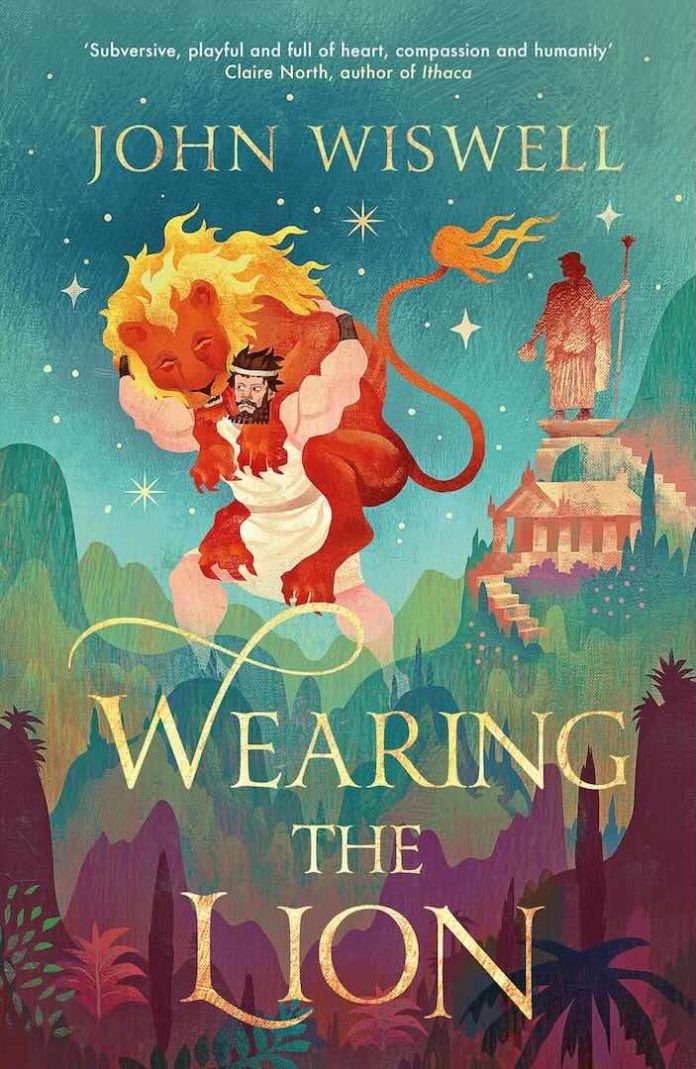
John Wiswell has done something remarkable with Greek mythology—he’s found the human heart beating beneath the marble monuments of divine legend. In Wearing the Lion, the follow-up to his Nebula Award-winning debut Someone You Can Build a Nest In, Wiswell transforms the familiar tale of Hercules into something both achingly familiar and startlingly fresh: a story about trauma, family, and the courage to choose healing over vengeance.
The Divine and the Damaged
The novel opens not with the expected heroic fanfare, but with profound domestic tragedy. Heracles, driven mad by divine fury, has killed his three young sons—Therimachus, Creontiades, and little Deicoon. The opening chapters plunge us immediately into the aftermath, where grief sits heavy as lead in every sentence. Wiswell’s prose here carries the weight of genuine mourning, refusing to treat this mythic tragedy as mere plot device.
What follows is not the traditional tale of twelve labors performed in penance, but something far more complex. Heracles and his wife Megara, united in their devastation, seek vengeance against whichever god orchestrated this horror. Their quest becomes a journey through a Greece populated not by monsters to be slain, but by creatures to be understood, healed, and protected.
A Fresh Perspective on Familiar Monsters
Wiswell’s greatest achievement lies in his reimagining of the legendary creatures. The Nemean Lion becomes not an invincible beast to be skinned, but a lonely creature desperate for affection—one that has never known anything but hunters seeking its death. When Heracles first encounters the lion in its cave, the scene unfolds with startling tenderness:
“So many killers have come after this lion. Has nobody ever thought to pet it?”
This moment encapsulates the novel’s central philosophy: what if strength meant protection rather than destruction? The Lernaean Hydra suffers from a poisonous infection that Heracles cures rather than causing. The Bull of Crete finds acceptance rather than conquest. Each “labor” becomes an act of compassion, transforming the traditional narrative from one of domination to one of healing.
Hera’s Guilt and Divine Dysfunction
The novel’s dual perspective structure, alternating between Heracles and Hera, provides its emotional core. Hera emerges not as a vindictive stepmother figure, but as a goddess consumed by guilt and struggling with her own capacity for destruction. Her chapters reveal the claustrophobic politics of Olympus, where gods scheme and manipulate mortal lives as casual entertainment.
Wiswell’s Hera is magnificently complex—simultaneously powerful and powerless, divine yet deeply flawed. Her relationship with Zeus reads like a toxic marriage writ large across the cosmos, where infidelity and neglect poison everything they touch. When she finally confesses her role in the tragedy to Heracles, the scene crackles with genuine divine horror at her own capacity for casual cruelty.
The Power of Found Family
As Heracles gathers his menagerie of rescued creatures—the lion (now called Purrseus), the rehabilitated Hydra (Logy), the Erymanthian Boar, and the Ceryneian Hind—Wiswell crafts something beautiful: a found family born from mutual trauma and healing. These relationships feel genuine, built on careful trust rather than mere narrative convenience.
The dialogue between these characters sparkles with personality. Logy’s sardonic commentary provides levity without undermining the story’s emotional weight, while Boar’s protective instincts toward Heracles reveal depths of loyalty that feel earned rather than decreed by plot necessity. The growing bond between these unlikely companions becomes the novel’s beating heart.
Mythological Authenticity Meets Modern Sensibility
Wiswell demonstrates impressive command of Greek mythological tradition while making it speak to contemporary concerns. The novel grapples seriously with themes of trauma, toxic masculinity, and the cyclical nature of divine violence. Heracles’s struggle with PTSD feels authentic, as does his resistance to solving problems through violence—a radical departure for a character traditionally defined by his strength.
The author’s background in speculative fiction serves him well here. His world-building feels both mythically grand and intimately human, populated by gods who bleed petty resentments and mortals who discover unexpected reserves of grace.
Areas Where the Divine Falters
While Wearing the Lion succeeds brilliantly in its character work and thematic ambitions, it occasionally stumbles under the weight of its own scope. The novel’s pacing, particularly in its middle sections, sometimes feels uneven as Wiswell balances multiple narrative threads. Some readers may find the philosophical approach to the traditionally action-oriented Hercules myth either refreshing or frustrating, depending on their expectations.
The alternating perspective structure, while generally effective, occasionally creates awkward transitions that interrupt narrative flow. Additionally, certain supporting characters—particularly some of the human followers who join Heracles’s growing retinue—feel underdeveloped compared to the richly realized monsters.
The novel’s climactic confrontation, while emotionally satisfying, relies perhaps too heavily on dialogue and internal revelation rather than external action. Readers seeking traditional mythic spectacle may find themselves wanting more concrete resolution to some plot threads.
The Author’s Growing Voice
Following his acclaimed debut Someone You Can Build a Nest In, Wiswell continues to demonstrate his gift for finding humanity in the monstrous and monstrosity in the human. His prose has grown more confident, particularly in handling large-scale emotional moments and complex character relationships. The influence of his short fiction background shows in his ability to craft individual scenes that resonate with symbolic weight.
Wiswell’s approach to mythology feels particularly relevant in our current cultural moment, where questions about power, accountability, and healing carry urgent social weight. His Heracles becomes a model for masculine strength redefined—protection rather than conquest, nurturing rather than domination.
Comparison and Context
Readers of Madeline Miller’s Circe or Pat Barker’s The Silence of the Girls will find familiar territory in Wiswell’s approach to classical material, though his focus on rehabilitation rather than retribution offers a distinct perspective. The novel also shares DNA with contemporary fantasy works that interrogate traditional power structures, such as Martha Wells’s Murderbot Diaries or Becky Chambers’s Wayfarers series.
Among recent mythology retellings, Wearing the Lion stands out for its commitment to genuine character transformation and its willingness to imagine alternatives to cycles of violence that dominate classical literature.
Recommended for Readers Who Crave
- Mythology retellings with psychological depth – Jennifer Saint’s Ariadne, Stephen Fry’s mythology Odyssey or Troy
- Found family narratives – Martha Wells’s Murderbot Diaries, Becky Chambers’s A Closed and Common Orbit
- Fantasy exploring trauma and healing – N.K. Jemisin’s Broken Earth trilogy, Sofia Samatar’s A Stranger in Olondria
- Character-driven mythological fiction – Madeline Miller’s Circe, Jennifer Saint’s Hera
- Speculative fiction questioning traditional heroism – Ursula K. Le Guin’s The Wizard of Earthsea, Robin Hobb’s Fitz and Fool trilogy
Final Judgment
Wearing the Lion succeeds as both mythology retelling and contemporary fantasy, offering a vision of heroism redefined through compassion rather than conquest. While it occasionally struggles with pacing and scope, its emotional authenticity and innovative approach to classical material make it a worthy successor to Wiswell’s debut.
The novel asks difficult questions about power, accountability, and the possibility of breaking cycles of violence—and provides answers that feel both mythically resonant and deeply human. In Wiswell’s hands, the legendary strength of Hercules becomes something far more valuable: the courage to choose healing over revenge, and love over glory.
For readers seeking mythology that speaks to contemporary concerns while honoring classical tradition, Wearing the Lion offers a powerful and moving experience. It’s a book that trusts its readers to embrace nuance and finds profound meaning in the simple radical act of choosing gentleness over violence.







