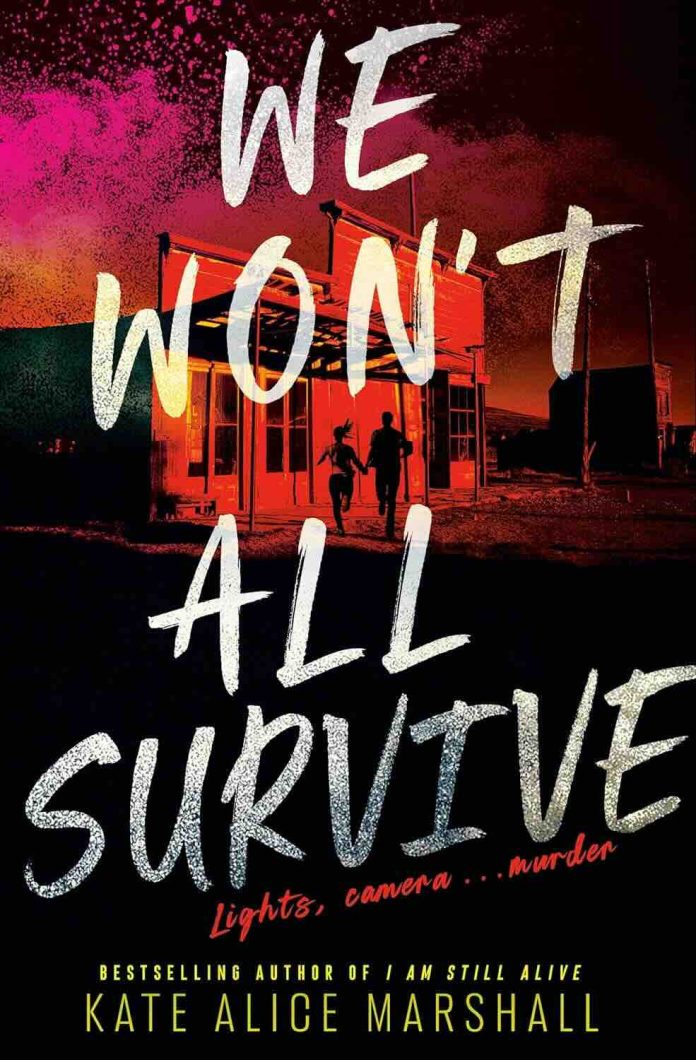
Kate Alice Marshall’s latest offering, We Won’t All Survive, arrives with the weight of expectation that follows her previous successes like What Lies in the Woods, I Am Still Alive and Rules for Vanishing. This time, she delivers a psychological thriller that masquerades as a simple survival story but evolves into something far more complex—a meditation on trauma, community, and the ways we survive not just physical danger, but the ghosts that follow us home.
Marshall’s central premise feels deceptively familiar: eight teenagers arrive at an isolated location for a reality survival show, only to find themselves truly trapped when contestants begin dying. Yet beneath this well-worn framework lies a story that challenges every assumption about who deserves to live, who gets to decide, and what survival actually means.
The Architecture of Mercy: Character Development at Its Finest
Marshall’s greatest triumph lies in her protagonist, Mercy Gray. Two years removed from being labeled a hero after a mall shooting, Mercy carries both literal and metaphorical scars—a bullet fragment lodged near her spine serves as a tangible reminder of a day she can never fully escape. Marshall crafts Mercy’s internal landscape with surgical precision, showing us a young woman who saved others but couldn’t save the one person whose warning might have prevented everything.
The author’s characterization extends beyond her protagonist with remarkable depth. Harrison Hane, the true-crime podcaster with an encyclopedic knowledge of facts but little real-world experience, becomes more than comic relief. His verbose enthusiasm masks a deep vulnerability, and his relationship with Mercy develops with a tenderness that feels earned rather than manufactured. Alethea Baptiste emerges as the story’s most compelling secondary character—a wealthy girl who performs vapid privilege while harboring both competence and genuine care for her companions.
Marshall’s skill shines in her ability to subvert reader expectations through these characterizations. Colby Morris, initially presented as a potential threat due to his violent reaction to confined spaces, becomes a sympathetic figure whose trauma from a train derailment manifests in frightening but understandable ways. Even the enigmatic Eli Burgess, whose past holds secrets that gradually unfold, feels authentically human rather than merely plot-driven.
The Mechanics of Terror: Plot Structure and Pacing
The novel’s structure mirrors the claustrophobic experience it depicts. Marshall begins with the familiar setup of isolated teenagers and systematically strips away every comfort, every safety net, every assumption about how stories like this should unfold. The revelation that Spencer Hall is actually Louis, a former coworker of Mercy’s obsessed with their shared trauma, transforms the entire narrative from external survival story to psychological horror.
Perhaps most effectively, Marshall refuses to rely on jump scares or gore to create tension. Instead, she builds dread through accumulated details: the automated systems that shouldn’t be automated, the missing production crew, the way characters’ stories don’t quite align. When violence does occur, it carries emotional weight rather than serving as mere spectacle.
The pacing occasionally stumbles in the middle section, where the mechanics of the various challenges sometimes overshadow character development. However, Marshall recovers magnificently in the final third, where the psychological revelation that Milo is actually Ryan—the obsessed former classmate whose warnings Mercy ignored—recontextualizes everything that came before.
Themes That Resonate: Community Over Individual Triumph
Marshall’s thematic exploration proves more sophisticated than many entries in the survival thriller genre. The title itself becomes a thesis statement: survival isn’t about identifying the strongest or most deserving individuals, but about community, support, and collective resilience. The author challenges the toxic individualism that pervades both reality television and American culture more broadly.
The examination of trauma proves particularly nuanced. Rather than treating past trauma as either a weakness to overcome or a superpower to deploy, Marshall shows how trauma shapes but doesn’t define her characters. Mercy’s PTSD manifests in hypervigilance and self-doubt, but also in her fierce protectiveness of others. The various characters’ “crossroads moments”—their past survival experiences—inform their present choices without determining them.
The Double-Edged Sword of Psychological Realism
Marshall’s commitment to psychological authenticity represents both the novel’s greatest strength and its occasional weakness. Her portrayal of Mercy’s internal dialogue—haunted by the ghost of Ryan, the shooter she failed to stop—creates genuine emotional resonance. The way guilt manifests as hallucination feels honest rather than melodramatic.
However, this psychological realism sometimes slows the narrative momentum. Mercy’s tendency toward self-blame and second-guessing, while psychologically accurate, occasionally frustrates readers who want her to act more decisively. Marshall walks a fine line between depicting realistic trauma responses and maintaining narrative tension.
Writing Style: Lean Prose with Emotional Heft
Marshall’s prose style proves remarkably effective for the story she’s telling. Her sentences tend toward the shorter side, creating a staccato rhythm that mirrors Mercy’s anxious mental state. The author demonstrates particular skill in dialogue, giving each character a distinct voice that feels natural rather than forced.
The author’s background in multiple genres—from middle grade through young adult—serves her well here. She avoids the overly ornate language that can bog down thriller narratives while maintaining the emotional sophistication necessary for a story this complex. Her descriptions of the physical environment feel lived-in without becoming overwrought.
Technical Craft: The Mechanics of Suspense
Marshall demonstrates masterful control over information flow throughout the novel. She plants clues about character identities and motivations with remarkable subtlety—readers may notice Milo’s occasional lapses in his wilderness knowledge or the way he seems more concerned with Mercy than makes sense for a stranger, but the full revelation still lands with devastating impact.
The author’s handling of the reality show framework proves particularly clever. Rather than simply using it as a convenient way to isolate characters, she interrogates the ethics of trauma entertainment and the way society commodifies other people’s suffering. The revelation that Damien Dare himself was manipulated by someone else’s obsession adds another layer of complexity to questions about agency and responsibility.
Minor Criticisms: Where the Formula Shows
Despite its many strengths, We Won’t All Survive occasionally falls into genre conventions that feel less fresh than the rest of the narrative. The middle section’s focus on solving challenge puzzles sometimes reads more like a video game walkthrough than character development. Additionally, some of the deaths—particularly Piper’s early demise—feel more like plot necessities than organic story developments.
The novel’s resolution, while emotionally satisfying, wraps up perhaps too neatly. The epilogue’s podcast format provides nice closure for the characters but doesn’t quite address some of the larger systemic issues the story raises about exploitation and manipulation.
In the Company of Peers: Literary Context
Marshall’s work stands favorably alongside other contemporary young adult thrillers that blend survival elements with psychological depth. Readers who enjoyed Karen McManus’s One of Us Is Lying or Holly Jackson’s A Good Girl’s Guide to Murder will find similar pleasures here, though Marshall’s treatment of trauma feels more grounded and less sensationalized.
We Won’t All Survive also shares DNA with adult thrillers like Riley Sager’s The Last Time I Lied in its examination of how past trauma influences present danger. However, Marshall’s young adult perspective brings a fresh urgency to these themes, particularly in her exploration of how society fails to protect young people while simultaneously exploiting their suffering.
The Verdict: A Worthy Addition to Marshall’s Canon
We Won’t All Survive succeeds as both thriller and character study, offering readers the page-turning tension they expect while delivering emotional depth that lingers beyond the final page. Marshall’s examination of trauma, community, and survival feels both timely and timeless, particularly in its rejection of the “strong individual” myth in favor of collective resilience.
While the novel doesn’t quite reach the heights of Marshall’s I Am Still Alive, it represents a mature evolution in her storytelling, tackling darker themes with greater sophistication. The book’s central message—that survival is not a solo sport—resonates particularly strongly in our current cultural moment.
For readers seeking a thriller that respects both their intelligence and their emotions, We Won’t All Survive delivers on its promise. Marshall has crafted a story that entertains while examining serious themes, never exploiting trauma for cheap thrills while still delivering genuine suspense.
For Readers Who Enjoyed This Book
Similar Recent Releases:
- The Companion by Katie Alender – Another isolation thriller with psychological depth
- What Lies in the Woods by Kate Alice Marshall – Marshall’s own adult debut exploring childhood trauma
- The Counselors by Jessica Goodman – Teen thriller examining privilege and survival
- House of Hollow by Krystal Sutherland – Dark YA with supernatural elements and sister dynamics
- The Project by Courtney Summers – Psychological thriller about cults and family bonds
Classic Influences to Explore:
- Lord of the Flies by William Golding – The original survival story exploring human nature
- And Then There Were None by Agatha Christie – The template for isolated group mysteries
We Won’t All Survive reminds us that the best thrillers don’t just ask “who will live?” but “what does it mean to truly survive?” Marshall’s answer—that survival means choosing community over competition, healing over heroism—feels both hard-won and hopeful.