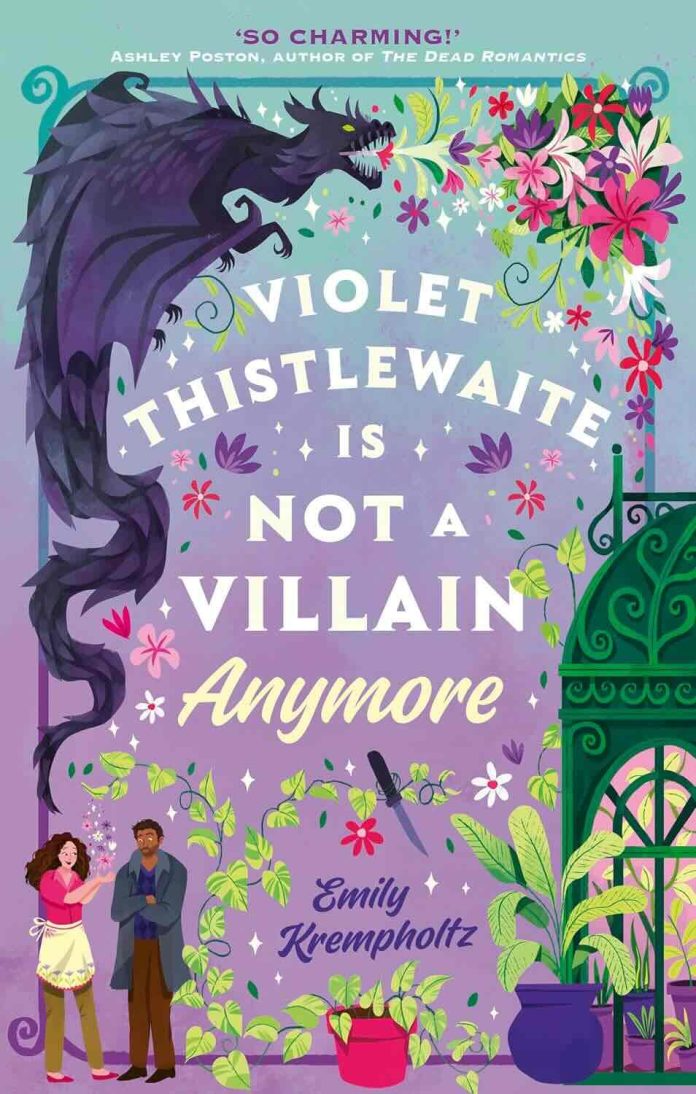
Emily Krempholtz’s debut novel poses a question that feels both whimsical and deeply serious: can a former villain truly become good? In Violet Thistlewaite Is Not a Villain Anymore, we meet a protagonist who spent most of her life as the Thornwitch, the feared right-hand enforcer of the dark sorcerer Shadowfade. With her master now dead, Violet arrives in the quaint mountain town of Dragon’s Rest with a singular goal—to reinvent herself as a kind, normal florist and finally discover who she might have been if circumstances had been different.
This isn’t your typical redemption arc where a character simply announces they’ve changed and everyone accepts it. Krempholtz crafts something far more nuanced and emotionally resonant. Violet’s journey toward goodness is messy, uncertain, and filled with the kind of self-doubt that makes her feel startlingly real. She doesn’t just want to stop being evil—she wants to understand what being good even means, and whether someone with her past deserves the gentle life she’s trying to build.
The Charm of Dragon’s Rest and Its Residents
The setting of Dragon’s Rest functions as much more than backdrop. This mountain town, recovering from years under Shadowfade’s shadow, becomes a character in its own right. Krempholtz populates it with a cast of supporting characters who each carry their own scars from the dark sorcerer’s reign, creating a community that understands trauma, survival, and the complicated work of healing. The town’s inhabitants include Quinn, a warm-hearted baker with her own mysterious past; Jerome, a gruff gnome with unexpected depths; and Pru, Nathaniel’s cheerful twin sister whose optimism provides essential lightness.
What makes Dragon’s Rest particularly engaging is how Krempholtz avoids painting it as either wholly idyllic or irreparably damaged. It’s a place where people are trying—sometimes succeeding, sometimes stumbling—to rebuild their lives. The town’s gradual acceptance of Violet mirrors her own journey of self-acceptance, and the author handles this parallel with admirable restraint.
Nathaniel Marsh: The Reluctant Neighbor
Enter Nathaniel Marsh, Violet’s landlord and the owner of the apothecary that shares a building (and a greenhouse) with her flower shop. If Violet represents the question of whether people can change, Nathaniel embodies the struggle of moving forward while honoring the past. He’s an alchemist running his family’s traditional business when his true passion lies elsewhere, burdened by guilt over past mistakes and the weight of expectations he never asked to carry.
The initial antagonism between Violet and Nathaniel crackles with tension. Their shared greenhouse becomes a battleground of passive-aggressive chalkboard signs, territorial disputes, and scientific versus magical worldviews. Krempholtz excels at writing this enemies-to-lovers dynamic, allowing their relationship to develop through small moments of vulnerability and understanding rather than sudden dramatic shifts. When Nathaniel begins to soften toward Violet, it feels earned because we’ve watched him slowly recognize himself in her struggles.
Their romance unfolds with a gentleness that belies its intensity. The author crafts intimate scenes that focus on emotional connection as much as physical attraction, from late-night conversations through adjoining doors to collaborative work solving the mysterious blight threatening the town. The chemistry between them builds naturally through mutual respect, shared trauma, and the recognition that they’re both trying to become people they can be proud of.
The Magic System: Where Science Meets Sorcery
Krempholtz demonstrates impressive creativity in her magical worldview, particularly in how she distinguishes between different types of magic. Violet’s plant magic exists on a spectrum—she can conjure flowers from pure imagination (creating illusions that smell and feel real but lack true life) or she can nurture actual living plants by encouraging their natural magical energy to flourish. This distinction becomes central to both the plot and Violet’s character development, as she must learn to understand the difference between controlling nature and working with it.
Nathaniel’s alchemy provides an interesting counterpoint, drawing on external materials and precise formulations rather than innate magical ability. The way these two systems complement and challenge each other creates opportunities for both characters to grow. Their collaboration on understanding the mysterious blight affecting Dragon’s Rest becomes a metaphor for their relationship—combining different approaches to solve a problem neither could tackle alone.
The magical elements also serve the book’s thematic concerns beautifully. Violet’s thorns, which burst through her skin when threatened, represent both her power and her pain. Learning to control them isn’t about suppressing who she is, but about choosing when and how to deploy her strength.
Strengths and Moments That Shine
What Works Exceptionally Well in Violet Thistlewaite Is Not a Villain Anymore:
- Character depth and psychological complexity – Violet’s internal struggle with her identity feels authentic and never oversimplified
- The cozy atmosphere balanced with real stakes – Krempholtz maintains tension without sacrificing the warm, comforting tone
- Supporting cast that enriches the world – Characters like Quinn and Jerome have their own complete arcs
- The sentient houseplant Bartleby – This mildly homicidal plant provides both comic relief and unexpected emotional moments
- Pacing in the middle section – The slow build of trust between Violet and Nathaniel allows readers to fully invest in their relationship
The author’s background as a ghostwriter and book coach shines through in her structural choices. The narrative never feels rushed, allowing emotional beats to resonate while maintaining forward momentum. Krempholtz also demonstrates skill in weaving humor throughout—Bartleby’s antics, the chalkboard sign wars, and Pru’s well-meaning meddling provide levity without undercutting serious moments.
Areas for Growth
While Violet Thistlewaite Is Not a Villain Anymore succeeds on many fronts, certain elements could have been strengthened. The revelation of Violet’s secret identity, which readers know from the outset, takes perhaps too long to emerge organically within the story. The dramatic irony works well initially, but the extended period before key characters discover her truth occasionally feels artificially prolonged.
The villain of the piece, Sedgwick, functions adequately as an antagonist but lacks the dimensional complexity of the protagonists. His motivations, while clear, don’t receive the same careful development as other aspects of the plot. The climactic confrontation, though satisfying, resolves somewhat quickly compared to the measured pacing of the rest of the novel.
Additionally, while the book’s cozy fantasy elements are generally well-executed, readers seeking extensive world-building beyond Dragon’s Rest may find themselves wanting more detail about the broader Merethi Empire and the political implications of Shadowfade’s defeat. Krempholtz keeps her focus tight on the personal, which serves the emotional arc but sometimes limits the scope.
Themes of Identity, Forgiveness, and Community
At its heart, Violet Thistlewaite Is Not a Villain Anymore explores what it means to remake yourself after trauma—both the trauma you’ve experienced and the trauma you’ve inflicted on others. Violet must grapple with the reality that she did terrible things, even if she was manipulated and controlled. The book doesn’t offer easy absolution; instead, it suggests that redemption is an ongoing process of choosing differently each day.
The theme of found family runs strongly throughout the narrative. Both Violet and Nathaniel are isolated by their pasts, and watching them build connections with Dragon’s Rest’s residents provides some of the book’s most touching moments. The community’s gradual embrace of Violet—even after learning the truth about her—speaks to the power of second chances and collective healing.
For Readers Who Loved…
If Violet Thistlewaite Is Not a Villain Anymore resonates with you, consider these similar reads:
- “Legends & Lattes” by Travis Baldree – Another cozy fantasy about leaving adventure behind for a quieter life
- “The Ex-Princess” by Ursula Vernon – Explores themes of identity transformation with humor and heart
- “A Wizard’s Guide to Defensive Baking” by T. Kingfisher – Combines everyday magic with genuine stakes and character growth
- “The House in the Cerulean Sea” by TJ Klune – Features found family and the healing power of community
- “Sorcery and Small Magics” by Maiga Doocy – Another academic magical romance with rivals-to-lovers dynamics
Final Thoughts
Violet Thistlewaite Is Not a Villain Anymore marks an impressive debut from Emily Krempholtz, establishing her as a voice to watch in cozy fantasy romance. While the book has minor pacing issues and could have pushed certain elements further, its emotional core remains strong throughout. The central question—whether we are defined by our worst actions or by our continuous choice to do better—receives thoughtful, compassionate treatment.
Violet Thistlewaite Is Not a Villain Anymore will particularly appeal to readers who appreciate character-driven narratives, slow-burn romances, and stories that prioritize emotional healing alongside external conflict. It’s a book about planting gardens in soil that’s been scorched, about learning that growth takes time, and about discovering that the most powerful magic might be the courage to let people see who you truly are.
Krempholtz’s prose style adapts beautifully to her subject matter, balancing moments of whimsy with genuine emotional depth. Her debut suggests a writer with both technical skill and narrative heart, capable of crafting stories that comfort while still challenging readers to think about difficult questions. As Violet learns throughout her journey, change isn’t about becoming someone entirely new—it’s about nurturing the good that was always there, waiting for the right conditions to finally bloom.
- Recommended for: Fans of cozy fantasy, redemption arcs, enemies-to-lovers romance, found family narratives, and anyone who believes people deserve second chances.