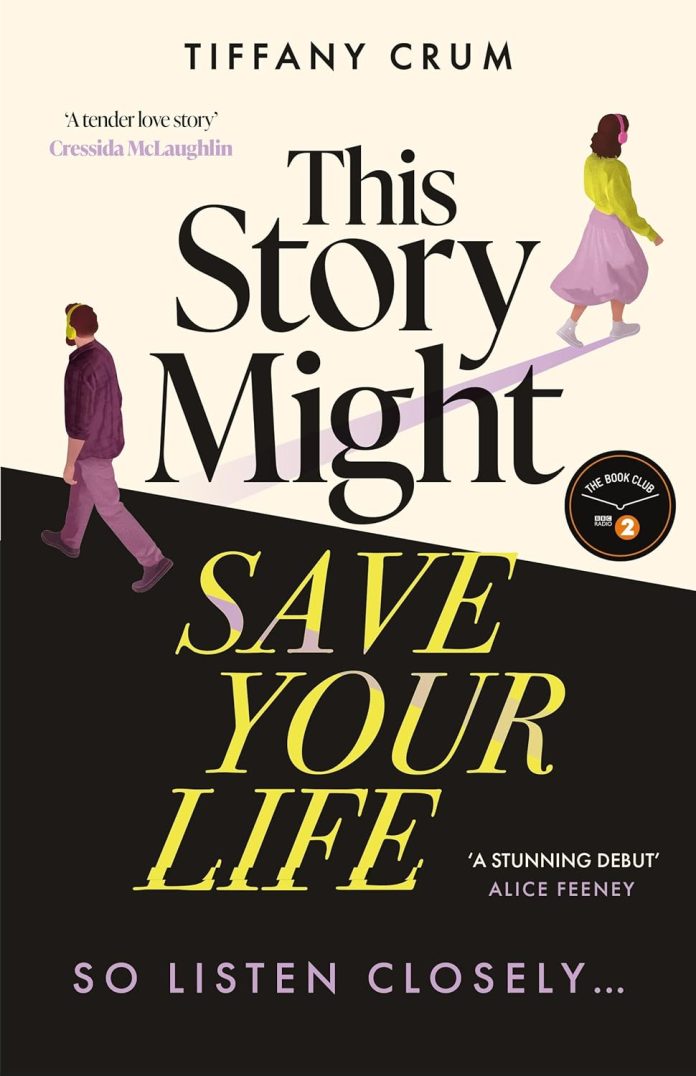
There is a particular kind of audacity in writing a debut novel that demands to be both a white-knuckle thriller and a tender, aching love story. Tiffany Crum possesses that audacity in spades. This Story Might Save Your Life by Tiffany Crum arrives with the confidence of a seasoned author and the raw emotional honesty of someone who has been saving this story for a very long time. Published by Flatiron Books in March 2026, the novel braids together a missing-persons investigation, a podcast empire on the verge of collapse, a marriage poisoned by control, and a friendship that has quietly, stubbornly been something more for over a decade.
The result is a reading experience that feels like being swallowed whole—not unlike the humpback whale scenario that opens the book—and not quite knowing whether you will be spit back out laughing or crying.
What Lies Beneath the Banter
The premise unfolds with deceptive ease. Benny Abbott and Joy Moore co-host a wildly popular survival podcast where they riff, joke, and hypothetically rescue each other from improbable near-death scenarios. It is a comedy show built on genuine chemistry and the kind of friendship that makes thirty-five million monthly listeners feel like they are in on an inside joke. But when Benny arrives one morning to record and finds Joy and her husband Xander missing, their house scattered with shattered glass and unsettling silence, the real survival story begins.
What makes This Story Might Save Your Life by Tiffany Crum structurally fascinating is the way it toggles between two narrative modes. Benny’s chapters unfold in real time across a harrowing week, each day ticking forward as the investigation deepens and suspicion begins to circle him like vultures over carrion. Joy’s chapters, by contrast, arrive as excerpts from an unfinished memoir, a document that travels backwards and forwards through time, peeling away the layers of her life with Xander, her narcolepsy, her friendship with Benny, and the slow erosion of her agency within a marriage that tightened around her so gradually she barely noticed the walls closing in.
This dual structure is one of Crum’s strongest creative decisions. It generates a constant, almost addictive tension between what the reader knows and what the characters understand, and it ensures that every revelation in Benny’s present-day chapters is informed by a deeper emotional context from Joy’s past.
Characters Who Breathe
Crum’s characterization is remarkably assured for a debut. Joy Moore is not a damsel waiting for rescue. She is funny, self-aware, and unflinchingly honest about her own blind spots. Her voice in the memoir chapters carries a conversational warmth that pulls the reader close—she digresses, she jokes, she addresses her audience with the casual intimacy of someone who has spent years talking into a microphone. And then, when the narrative requires it, her voice turns devastating. The passages about living with narcolepsy are handled with both medical specificity and deep humanity, never reducing her condition to a plot device.
Benny, meanwhile, is the beating heart of the present-day narrative. His loyalty is almost painful to witness, and Crum wisely avoids making him a flawless hero. He is messy, reactive, and prone to making impulsive decisions that complicate an already dire situation. Watching him piece together clues while simultaneously being investigated as a suspect creates a propulsive reading experience.
The supporting cast enriches the story considerably. Here are a few who stand out:
- Mallory, Xander’s enigmatic Danish sister and the podcast’s assistant producer, whose loyalties remain deliberately ambiguous for much of the novel
- Luna, Benny’s ex-wife turned Joy’s secret divorce attorney, whose presence introduces layers of legal and emotional complexity
- Carlotta and Emil, the next-door neighbors whose garden-variety friendliness conceals connections that ripple outward in surprising ways
- Sarah, Benny’s sister, who arrives as a grounding force of common sense when everything else is spiraling
Where Thriller Meets Tenderness
The romance at the center of This Story Might Save Your Life by Tiffany Crum is not a subplot bolted onto a mystery. It is the engine that drives every major decision in the book. Benny and Joy have been orbiting each other for over a decade, and Crum renders their unspoken feelings with a patience that many thrillers would never dare attempt. Their banter crackles with the ease of two people who know each other so well they can communicate in shorthand, but beneath every joke and every hypothetical survival scenario lies a deeper question neither is brave enough to ask aloud.
This restraint pays enormous dividends. When the emotional dam finally breaks, it carries the weight of an entire novel’s worth of longing.
The thriller elements, meanwhile, are genuinely taut. Crum understands pacing in a way that feels instinctive. She knows exactly when to drop a revelation and when to let silence do the heavy lifting. The investigation unfolds with enough procedural texture to feel grounded without ever drowning in forensic detail, and she scatters clues with a confidence that rewards attentive readers.
Where the Story Stumbles
For all its considerable strengths, This Story Might Save Your Life by Tiffany Crum is not without its rough patches. The novel’s middle section, particularly around Days Three and Four, occasionally sags under the weight of its own structural ambition. Because the memoir chapters and the present-day chapters must remain in careful balance, there are moments when Joy’s retrospective voice holds the reader at arm’s length from the urgency of Benny’s search. A few of the memoir detours, while beautifully written, feel like scenic routes through material that could have been covered more efficiently.
Additionally, some readers may find that the book’s genre-blending, while largely successful, creates occasional tonal whiplash. The pivot from a genuinely harrowing depiction of domestic abuse to a playful callback to a Happy Days desk statue is a high-wire act, and not every transition sticks the landing. Crum’s ambition occasionally outpaces her ability to smooth those seams.
A few other observations worth noting:
- The narcolepsy hallucination subplot, while thematically resonant, relies on a degree of coincidence that stretches credulity in the later chapters
- Xander, as the primary antagonist, is drawn with sufficient menace but occasionally slides toward a flatness that contrasts with the richness of every other character
- The resolution, while emotionally satisfying, asks the reader to accept certain moral compromises that may not sit comfortably with everyone
These are not fatal flaws by any measure. They are the growing pains of a writer who has attempted something genuinely ambitious and largely succeeded.
Narcolepsy, Visibility, and the Stories We Tell Ourselves
One of the most impressive aspects of This Story Might Save Your Life by Tiffany Crum is its treatment of narcolepsy. Crum clearly did her homework, acknowledging resources like Narcolepsy Network and Julie Flygare’s memoir Wide Awake and Dreaming in her acknowledgments. Joy’s experience with the condition is rendered with the specificity that only thorough research can provide, and Crum refuses to treat it as a simple narrative gimmick. Instead, narcolepsy becomes a lens through which the novel explores larger questions about visibility, control, and what it means to be believed.
Joy’s invisible disability intersects powerfully with the domestic abuse she endures. Xander’s ability to reframe her vulnerability as dependence, to install surveillance under the guise of care, to convince her that needing help is the same as being helpless—these dynamics are depicted with a chilling authenticity that speaks to Crum’s understanding of how abusers exploit existing structures of support.
The Craft Behind the Curtain
Crum’s prose is sharp and often witty, with a conversational fluency that belies the complexity of her plotting. Her background in the film industry shows in her cinematic scene construction and her instinct for visual detail. The Los Angeles setting is rendered with specificity and affection, from the Santa Ana winds that serve as both atmospheric backdrop and thematic metaphor, to the hillside Spanish homes and jacaranda-shaded streets that ground the story in a particular place and time.
This is a debut novel, and that fact bears repeating because it is genuinely difficult to believe. The structural confidence, the tonal control, the ability to sustain multiple narrative threads across nearly four hundred pages—these are not beginner-level skills. Crum worked in the film industry and earned an MFA in creative writing, and the combination of those experiences is evident on every page.
Similar Books You Might Enjoy
If This Story Might Save Your Life by Tiffany Crum resonated with you, consider adding these to your reading list:
- Listen for the Lie by Amy Tintera — a podcast-driven thriller with a similar blend of dark humor and genuine suspense
- Mother-Daughter Murder Night by Nina Simon — atmospheric mystery with sharp character work and a strong sense of place
- My Husband’s Wife by Alice Feeney — domestic thriller exploring the dark underbelly of seemingly perfect marriages
- I Have Some Questions for You by Rebecca Makkai — literary suspense that interrogates memory, truth, and the stories we construct about ourselves
- It’s a Love Story by Annabel Monaghan — for readers who want the romance element dialed up with genuine emotional depth
- Twenty-Seven Minutes by Ashley Tate — a debut mystery with multiple perspectives and carefully layered secrets
- First-Time Caller by B.K. Borison — blends soft romantic yearning with a compelling central mystery
Final Verdict: A Survival Story Worth Telling
Tiffany Crum has written a novel that does something genuinely rare—it makes you laugh, then breaks your heart, then makes you turn the page so fast you nearly tear it. The thriller mechanics are sound, the romance is earned, and the treatment of narcolepsy and domestic abuse is handled with both sensitivity and unflinching clarity. It is not a flawless book, but its imperfections are the kind that come from reaching for something extraordinary rather than settling for something safe.
What doesn’t kill you makes you a survivor. And sometimes, against all odds, it makes you a storyteller too.